Public oversight of closed institutions: achievements and challenges
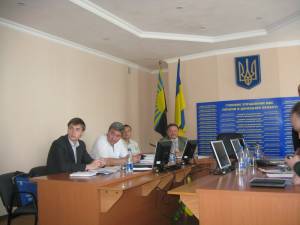
The public human rights organisation “Donetsk Memorial”, within the framework of a special project supported by the International Renaissance Foundation, held a “round table” on 22 May 2008 on the topic: “Public oversight of closed institutions: achievements and challenges”.
The purpose of the event was to discuss the state of public oversight of closed institutions in the region among specialists, to identify problems, and to propose ways to solve them.
Invited to participate in the “round table” were representatives of the Ministry of Labour and Social Policy, the Ministry of Justice, the Department for the Execution of Sentences, regional supervisory commissions, Public Councils under the Main Directorate of the Ministry of Internal Affairs of Ukraine in the Donetsk region and the Department for the Execution of Sentences administration, the mobile group under the Main Directorate of the Ministry of Internal Affairs, and non-governmental organisations.
The meeting was organised and held with the participation of the press service of the Main Directorate of the Ministry of Internal Affairs of Ukraine in the Donetsk region.
The chairman of the “Donetsk Memorial” council familiarised the event participants with the purpose and tasks of public oversight of closed institutions and the status of the legislative framework governing the activities of institutions that are required by law to exercise such oversight. He also spoke about the outcomes of similar “round tables” held in Simferopol and Luhansk in February-March of this year.
O. Kondratenko spoke about the activities of the Ministry of Labour and Social Policy in resolving the issues of individuals released from places of imprisonment. He reported that in 2004, a special department was created within the Ministry to deal with the problems of former prisoners. Currently, 51 institutions for homeless persons, 38 institutions for those released from prison, and one social adaptation centre have been established in the country.
According to the Department for the Execution of Sentences, there are 165 supervisory commissions in Ukraine; according to the regional units of the Ministry, there are 657. More than 6,400 people work in them. Currently, regulatory documents are being adopted in the country that facilitate the resolution of issues for released persons, and the adoption of new documents aimed at protecting the rights of this vulnerable group of citizens is supported. The adoption of an updated version of the Regulation on Supervisory Commissions, which more closely reflects current realities, is also seen as timely.
Oleh Peftiev, a member of the mobile group under the Main Directorate of the Ministry of Internal Affairs in the Donetsk region, spoke about the activities of the mobile group, the nature of inspections, and typical violations in the activities of district and city internal affairs bodies. The second member of the mobile group, Andriy Shulha, a lecturer at the Donetsk Institute of Internal Affairs, added that the activities of the mobile group currently lack feedback and information regarding the correction of identified violations. He also added that a feature of the visits is the conduct of anonymous questionnaires among police officers regarding their attitude towards human rights violations in the activities of police bodies, as well as the observance of their own rights.
Oleksiy Viktorovych Mylostnyi, Assistant to the Minister for the Regional Control Service of the Human Rights Compliance Monitoring Department of the Minister’s office, spoke about the tasks of his activities.
Nelya Yevsiukova, secretary of the council, spoke about the activities of the Public Council under the Main Directorate of the Ministry of Internal Affairs in the Donetsk region. She reported on the initiatives that the council is overseeing, in particular, the issue of citizens’ road safety and the discovery of identity documents belonging to individuals detained by the police.
Concluding the discussion on issues of human rights compliance in the activities of internal affairs bodies, Oleksandr Bukalov added that an informational brochure on the activities of the mobile group is being prepared, and issues regarding the conduct of seminars for district police officers on international standards of human rights observance are being discussed with the Assistant to the Minister. He also emphasised that the activity of non-governmental organisations is quite low when it comes to any concrete work, rather than just talk about the poor state of human rights compliance.
Mykhailo Matanhyn, acting head of the regional department of the Department for the Execution of Sentences, spoke about resolving issues of human rights compliance in the institutions of the penal system. He noted that when the public council under the Department's administration was headed by a former employee of the system, it essentially did not work. Only after his replacement did the work pick up. However, public activity remains low. The administration has declared its agreement to involve representatives of non-governmental organisations in visits to colonies every Thursday, but unfortunately, almost none of the non-governmental organisations have taken advantage of this offer.
Lyudmila Kuzminova, chair of the council, spoke in more detail about the work of the Public Council under the Department's administration.
Zubkov, a representative of the supervisory commission of the Budionovskyi district of Donetsk, noted that the non-governmental organisation he represents on the commission previously received funds from enterprises for its activities and was able to help released convicts. Now, enterprises no longer provide funds, and it has become extremely difficult to work.
S. Aslamov, secretary of the regional supervisory commission, spoke about its activities. He noted the long period of its inaction and attributed it to problems in the leadership of the Regional State Administration and high staff turnover in its Regional State Administration department.
V. Prokopchuk, head of the regional branch of the veterans’ organisation and member of the regional supervisory commission, and I. Nizovtseva drew attention to important aspects of the activities of public institutions that deal with human rights protection issues.
To O. Bukalov’s question regarding whether the creation of mobile groups within the Department for the Execution of Sentences system is relevant, M. Matanhyn replied that he does not consider such an initiative relevant for the penal system.
Summarising the speeches on issues of public oversight in the activities of penal institutions, O. Bukalov noted that supervisory commissions remain a too-weak mechanism for protecting the rights of prisoners. To a large extent, this is because the work in the commissions is unpaid. Therefore, it is impossible to demand responsible work in such a structure, especially when the volume of such work is quite significant, as is the case in commissions in the territories where penal institutions are located.
Other issues of public oversight practice in the region, the state of the legislative framework, and the need for its improvement were also discussed at the meeting. We hope that concrete proposals on these issues will also be developed. A tentative agenda for the event is attached.
At the conclusion of the “round table”, the following recommendations (proposals) were discussed and approved:
To the Ministry of Labour and Social Policy, the Ministry of Justice, and the Department for the Execution of Sentences — to step up efforts to promote the adoption of an updated version of the Regulation on Supervisory Commissions.
To the Ministry of Finance — to take a constructive position on the issue of adopting the updated version of the Regulation on Supervisory Commissions.
To the Regional Supervisory Commission — to regularly summarise the work experience of local supervisory commissions, and to regularly consider the issue of human rights compliance in institutions and exercise public oversight in places of imprisonment during its meetings.
To the Public Council under the Main Directorate of the Ministry of Internal Affairs in the Donetsk region:
- to facilitate the publication of an informational brochure on the work experience of the mobile group;
- to regularly cover the activities of the Public Council and the mobile group in the media;
- to prepare and send to the Ministry of Internal Affairs proposals to solve the problem of identity documents disappearing from individuals detained by the police;
- for council members from non-governmental organisations to participate more actively in the reception of citizens by the administration.
To the Department for the Execution of Sentences — to pay serious attention to the implementation of public oversight of penal institutions and not to limit themselves to assurances of support for it within the system.
Every participant in the event received handouts, which included, in particular, the text of the Regulation on Supervisory Commissions, the text of the Cabinet of Ministers Resolution of 15 October 2004 No. 1378, the PROCEDURE for conducting consultations with the public on issues of forming and implementing state policy, and the model Regulation on the Public Council under the territorial body of the Department’s administration.
The “round table” held will undoubtedly serve as a positive step in developing the ideas of involving the public in decision-making by government authorities and in activities to protect the rights of citizens in the region.