THE PENAL ENFORCEMENT SYSTEM OF THE REPUBLIC OF KAZAKHSTAN 2000–2008
Analytical Report[1]
“THE PENAL ENFORCEMENT SYSTEM
OF THE REPUBLIC OF KAZAKHSTAN 2000–2008:
CURRENT STATUS AND DEVELOPMENT PROSPECTS”
Contents:
Introduction
- Development strategy of the legal policy of the Republic of Kazakhstan in the sphere of sentencing and execution of criminal penalties
- Development programmes for the penal enforcement system of the Republic of Kazakhstan
- Institutional changes in the penal enforcement system of the Republic of Kazakhstan
- Legislative changes and their impact on the penal enforcement system of the Republic of Kazakhstan
- Concluding provisions
Proposals for further reform of the penal enforcement system of the Republic of Kazakhstan
Introduction
According to the Law of the Republic of Kazakhstan dated 13 December 1997 No. 209-I, the Penal Enforcement Code of the Republic of Kazakhstan was brought into effect on 1 January 1998. It should be noted that from the moment of gaining sovereignty until 1998, the Correctional Labour Code of the Kazakh SSR of 1971 was in force in Kazakhstan, which was based, in turn, on the correctional labour legislation of the USSR and the Union Republics. Concurrently, from 1 January 1998, the Criminal Code of the Republic of Kazakhstan was brought into effect in the republic, which defined an exhaustive list of types of penalties.
Thus, 2008 marked ten years since the adoption of the new penal legislation and the actual creation of the penal enforcement system of sovereign Kazakhstan. This is a sufficiently long period to analyse the stage passed and the effectiveness of the penal enforcement system in the new political and economic realities.
At the same time, the development of the penal enforcement system of Kazakhstan cannot be considered outside the general strategy for the development of the legal policy of the Republic of Kazakhstan, which is carried out through the drafting and adoption of programme documents and the improvement of legislation.
1. Development strategy of the legal policy of the Republic of Kazakhstan in the sphere of sentencing and execution of criminal penalties
The most important document that defined the development and formation of penal enforcement policy is the Decree of the President of the Republic of Kazakhstan dated 12 February 1994 No. 69, “On the State Programme of Legal Reform in the Republic of Kazakhstan”. The implementation of the programme's provisions was reflected in the Criminal and Penal Enforcement Codes of the Republic of Kazakhstan, which entered into force on 1 January 1998.
In the Criminal Code of the Republic of Kazakhstan, the list of types of penalties underwent significant changes. As stipulated by the Reform Programme, such types of penalties as public censure and dismissal from office, as well as suspended sentences and conditional release with compulsory involvement in labour at national economic construction sites, were excluded from it.
At the same time, the system of penalties was supplemented with types such as community service, restriction of freedom, restriction of military service, and arrest. However, the introduction of penalties in the form of community service, restriction of freedom, and arrest was deferred until the necessary conditions were created.
In the Penal Enforcement Code of the Republic of Kazakhstan (hereinafter – the PEC RK), a progressive system of serving sentences was legally established. In correctional colonies of general and strict regimes, four types of conditions for serving sentences are created according to legislation – ordinary, light, privileged, and strict; while in correctional colonies of special regime – ordinary, light, and strict. Depending on the behaviour and the term of the sentence served, convicts are consistently transferred from one set of conditions to another. Those positively characterised may be gradually transferred to privileged conditions for serving their sentence, where, for the purpose of successful adaptation to life in freedom, they are permitted by order of the head of the correctional colony to reside in special hostels outside the correctional colony under supervision. They may move freely within the boundaries of the territory adjacent to the correctional institution and are not restricted in their rights to visits with relatives. Convicts who do not wish to comply with the requirements of the internal regulations are placed in strict conditions for serving their sentences, where they reside in locked premises.
The differentiation of conditions for serving sentences within one institution allowed for a reduction in the number of types of correctional institutions – the new legislation did not provide for reinforced-regime colonies.
An important achievement of the penal enforcement legislation is the inclusion of Section 2, “Legal Status of Convicts”. It details the rights and duties of persons serving criminal penalties, including in the area of personal safety and the provision of freedom of conscience. At the same time, the legislation is, for the first time, focused on compliance with international norms and standards, which is emphasised by Clause 11 of Article 10 of the PEC RK, establishing that the procedure for the realisation of the rights of convicts is set by the Code, the laws of the Republic of Kazakhstan, other normative legal acts, and interstate agreements ratified by the Republic of Kazakhstan.
The next document defining the future direction for the development of criminal and penal enforcement policy is the Decree of the President of the Republic of Kazakhstan dated 20 September 2002 No. 949, “On the Concept of Legal Policy of the Republic of Kazakhstan”.
The Concept determines that the implementation of the criminal policy of the Republic of Kazakhstan should develop in accordance with the principles of legality, equality of citizens before the law and the court, justice, humanism, and the economy of criminal repression, the inevitability of criminal liability and punishment, and the protection of the rights of victims, including the state, and include the adoption of a complex of legislative measures aimed at:
continuing the course towards the gradual narrowing of the sphere of application of the death penalty, as well as considering the possibility of declaring a moratorium on the death penalty;
further decriminalisation of offences classified as minor crimes, including through their transfer to the sphere of administrative and civil-legal liability;
expanding the application of property sanctions for certain types of economic crimes, as well as expanding the application of non-custodial penalties in relation to persons who have committed minor and moderate gravity crimes;
broader application of incentive measures for the active repentance of persons who have committed crimes;
excluding the application of custodial sentences in relation to minors who have committed minor crimes, and narrowing the scope of custodial sentences in relation to minors who have committed moderate gravity crimes;
creating the necessary conditions for bringing into effect criminal-legal norms providing for such new types of penalties as restriction of freedom, arrest, and life imprisonment.
The main directions for the development of the penal enforcement system were determined as follows: improving the legislative framework with the aim of bringing it into compliance with the main provisions of international human rights acts and international agreements defining the basic principles and procedures for the treatment of convicts, as well as the further improvement of its material and technical base and the continuation of the policy of humanisation.
For the purpose of preventing recidivism, it is necessary to create a system of conditions and draft normative legal acts aimed at the social adaptation of persons released from places of deprivation of liberty, and to ensure the functioning of relevant social adaptation centres.
Since the implementation of these directions for the development of criminal and penal enforcement policy is carried out through the adoption of legislative acts, its results will be examined in the chapter, “Legislative changes and their impact on the penal enforcement system of the Republic of Kazakhstan”.
2. Development programmes for the penal enforcement system of the Republic of Kazakhstan
The resolution of the strategic tasks of the development of the legal policy of the Republic of Kazakhstan in the sphere of sentencing and the execution of criminal penalties was carried out in stages, through the implementation of interdepartmental programmes approved by the Government of the Republic of Kazakhstan.
First in this series of programmes is the Government Programme for the logistical and social-legal provision of the penal enforcement system of the Ministry of Internal Affairs and the places of pre-trial detention of the State Investigation Committee of the Republic of Kazakhstan for the period until 2000, approved by the Resolution of the Government of the Republic of Kazakhstan dated 1 October 1996 No. 1199, “On measures to stabilise the activities of institutions of the penal enforcement system and places of pre-trial detention in the Republic of Kazakhstan”.
It should be specially noted that this Programme provided not only for measures to improve the material and technical equipment of penal enforcement system institutions, but also saw the approval, within its framework, of the Concept for the development of the penal enforcement system of the Republic of Kazakhstan. The Concept provided for the transition to differentiated conditions of detention, the implementation into legislation of international norms and standards for the treatment of convicts, and the introduction of new types of penalties and methods for correcting convicts. Thus, the plan of measures provided for the construction of arrest houses, the introduction of psychologists into the staff of correctional institutions, the strengthening of ties with public and religious organisations, and the creation of medical-rehabilitation centres for employees of the penal enforcement system.
Unfortunately, the Programme was not sufficiently supported by resources, and not all measures could be realised in full. Nevertheless, new penal enforcement legislation was developed, the construction of new correctional institutions on the basis of military towns was initiated, and new principles for the correction of convicts were laid, in which priority was given not to labour, but to psychological and pedagogical methods. From this point of view, the significance of the first Programme is hard to overestimate.
The Resolution of the Government of the Republic of Kazakhstan dated 22 January 2001 No. 92 approved the Programme for improving the material and technical base of correctional institutions and pre-trial detention centres of the Republic of Kazakhstan for 2001–2003.
The goal of the Programme was to strengthen the material and technical base of correctional institutions and pre-trial detention centres of the penal enforcement system of the Ministry of Internal Affairs of the Republic of Kazakhstan, update engineering and technical security equipment, and bring the communal-living conditions of convicts and persons suspected and accused of committing crimes, as well as their transport, into compliance with the requirements of the applicable penal enforcement legislation. To achieve this, the following tasks had to be solved:
1) reducing the density of convicts in correctional institutions and pre-trial detention centres through the construction of new and the reconstruction of existing correctional institutions and pre-trial detention centres;
2) creating conditions for serving sentences for all categories of convicts within the region where they were convicted or resided before arrest;
3) reducing the number of transportations of convicts throughout the republic;
4) increasing the security of the detention of convicts in correctional institutions while serving their sentences;
5) reducing the number of crimes among convicts and the number of escapes from guarded correctional institutions and pre-trial detention centres.
For the resolution of these tasks, the allocation of 4,135 million tenge from the Republican budget was intended.
It should be noted that the Programme was aimed specifically at strengthening the material and technical base of correctional institutions and pre-trial detention centres, as their condition was quite deplorable, the number of people held in the institutions exceeded the established capacity limits, and improving the conditions for the detention of convicts under these circumstances was problematic. This Programme was successfully implemented, which created the conditions for solving other tasks.
The Resolution of the Government of the Republic of Kazakhstan dated 31 December 2003 No. 1376 approved the “Programme for the further development of the penal enforcement system of the Republic of Kazakhstan for 2004–2006”.
The goal of the Programme: improving the conditions of detention for convicts held in correctional institutions; the quality of the execution of sentences not related to isolation from society; and the professional training of penal enforcement system employees.
Tasks:
1) improving legislation in the sphere of the execution of sentences, ensuring the rights and legitimate interests of persons held in correctional institutions;
2) maximising the alignment of conditions of detention for convicts with the requirements of international norms and standards;
3) construction of new and reconstruction of existing correctional institutions;
4) improvement of the material and technical base of correctional institutions;
5) creating conditions for the effective execution of non-custodial sentences and criminal-legal impact measures;
6) increasing the employment rate of convicts;
7) improving the professional training of penal enforcement system employees.
In general, the implementation of the Programme was successfully completed. The normative legal framework for the activities of the penal enforcement system was significantly improved, material and technical equipment was improved, and the engineering and technical security of correctional institutions and pre-trial detention centres was increased.
At the same time, during the implementation of the Programme, a number of problematic issues arose that did not allow for the full achievement of the set tasks and the receipt of the expected results from its implementation.
Thus, points 5, 6, and 7 of the Plan initially provided for an increase in the staff size of penal enforcement inspections and supervisors in correctional institutions, as well as the transformation of penal enforcement inspections into state institutions.
However, in connection with the adjustment of expenditure amounts for 2005–2006 and with the goal of bringing budget expenditures for the implementation of the Programme into compliance with legislation, the Resolution of the Government of the Republic of Kazakhstan dated 11 February 2006 No. 97, “On making amendments to the Resolution of the Government of the Republic of Kazakhstan dated 31 December 2003 No. 1376”, these points of the Plan were excluded.
Currently, the “Programme for the further development of the penal enforcement system of the Republic of Kazakhstan for 2007–2009”, approved by the Resolution of the Government of the Republic of Kazakhstan dated 6 August 2007 No. 673, is in force.
The goal of the Programme is to increase the effectiveness of the penal enforcement system.
Tasks:
1) Improving the management organisation of the penal enforcement system and improving the conditions for the detention of persons in penal enforcement system institutions;
2) Increasing the effectiveness of the execution of criminal penalties, ensuring the employment of convicts, and creating conditions for the social rehabilitation of persons released from places of deprivation of liberty;
3) Increasing the effectiveness of criminal-legal impact measures not related to the isolation of convicts from society;
4) Strengthening the personnel base, improving the system of professional training for employees, increasing the legal and social security of penal enforcement system institution personnel, and reducing the number of corrupt offences among penal enforcement system employees.
To achieve the set tasks, a Plan of measures for the implementation of the Programme has been developed. Unfortunately, the Plan of measures presents issues of capital construction and the strengthening of the material and technical base quite broadly, while there are only two points for increasing the effectiveness of criminal-legal impact measures, including one on increasing the number of penal enforcement inspections, the implementation form of which is the submission of proposals to the Interdepartmental Commission. In fact, this programme does not provide for the allocation of funds for these purposes.
3. Institutional changes in the penal enforcement system of the Republic of Kazakhstan
In August 2000, the Head of State issued an instruction on the transfer of the penal enforcement system from the jurisdiction of the Ministry of Internal Affairs to the jurisdiction of the Ministry of Justice. This decision was a logical continuation of the implementation of the State Programme of Legal Reform in the Republic of Kazakhstan, approved by the Decree of the President of the Republic of Kazakhstan dated 12 February 1994 No. 1569.
Specifically, the Programme stated: “Think through other measures for relieving the Ministry of Internal Affairs of functions not related to the protection of public order, investigation and inquiry, and the prevention of offences.” Implementing this provision, the functions of fire protection were transferred from the Ministry of Internal Affairs to the jurisdiction of the Ministry of Emergency Situations, and special records were transferred to the General Prosecutor's Office.
To solve the complex of tasks regarding the transfer of the penal enforcement system to the jurisdiction of the Ministry of Justice, the Resolution of the Government of the Republic of Kazakhstan dated 1 November 2000 No. 1651 established an interdepartmental commission on issues of reforming the penitentiary system.
The Commission was instructed, by 1 December 2000, to draft and submit for the consideration of the Government of the Republic of Kazakhstan a package of draft normative legal acts necessary for the implementation of the transfer of the penitentiary system to the jurisdiction of the Ministry of Justice of the Republic of Kazakhstan; the experience of the Russian Federation, where such a transfer was carried out in 1997, was studied.
The main goals pursued by the transfer of the penal enforcement system to a civilian department were:
1) Separation of the functions of criminal prosecution and the execution of criminal penalties;
2) Increasing the legal protection of convicts and the more complete realisation of their rights and legitimate interests;
3) Implementation into national legislation of international norms and standards for the treatment of prisoners;
4) Demilitarisation of the penal enforcement system.
In legislative terms, the transfer of the penal enforcement system was carried out by the adoption of the Law of the Republic of Kazakhstan No. 244 dated 16 July 2001, “On making changes and additions to certain legislative acts of the Republic of Kazakhstan on issues of reforming the penal enforcement system and the status of its workers”.
The Committee of the Penal Enforcement System under the Ministry of Justice was created by the Resolution of the Government of the Republic of Kazakhstan dated 28 December 2001 No. 1755, “Issues of the Committee of the Penal Enforcement System of the Ministry of Justice of the Republic of Kazakhstan”.
It should be noted that the penal enforcement system was not transferred in its entirety to the jurisdiction of the Ministry of Justice – pre-trial detention centres remained under the jurisdiction of the Ministry of Internal Affairs. Their transfer to the Ministry of Justice was carried out in 2004 by the Resolution of the Government of the Republic of Kazakhstan dated 8 January 2004 No. 17, “Some issues of the transfer of pre-trial detention centres of the Ministry of Internal Affairs of the Republic of Kazakhstan to the jurisdiction of the Ministry of Justice of the Republic of Kazakhstan”, within the framework of implementing the Decree of the President of the Republic of Kazakhstan dated 23 December 2003 No. 1255, “On measures for the further improvement of the state administration system of the Republic of Kazakhstan”.
Currently, the Committee of the Penal Enforcement System of the Ministry of Justice of the Republic of Kazakhstan includes 75 institutions. These include: 19 general regime correctional colonies, 19 strict regime colonies, 5 special regime colonies, 1 prison, 17 settlement colonies, 8 hospitals, 4 educational colonies, and 2 social rehabilitation centres for persons released from places of deprivation of liberty.
4. Legislative changes and their impact
on the penal enforcement system of the Republic of Kazakhstan
Over the period that has passed since the introduction of the criminal and penal enforcement legislation, changes were made to the Criminal Code of the Republic of Kazakhstan twenty-three times, and to the Penal Enforcement Code of the Republic of Kazakhstan – twelve times.
The Law of the Republic of Kazakhstan dated 5 May 2000 No. 47-II, “On making changes and additions to certain legislative acts of the Republic of Kazakhstan on issues of combating crime”, was, in general, aimed at strengthening liability for certain categories of crimes. A brief analysis of the law allows us to establish the following. The toughening of liability occurred for thirty types of crimes by increasing the lower or upper limit of the penalty in the form of deprivation of liberty. At the same time, for ten types of crimes, the severity category changed – from minor gravity to moderate gravity, and from moderate gravity to grave crimes. The mitigation of liability occurred for two types of crimes, one of which moved from the category of grave crimes to the category of moderate gravity crimes.
A certain reservation should be made here. The draft law was developed during the period of the State Programme of Legal Reform in the Republic of Kazakhstan, one of the priorities of which was the expansion of the size and scope of application of property-based sanctions, as being more consistent with market relations. It is likely that this explains why the sanctions for ten types of crimes were supplemented with penalties in the form of fines and confiscation of property. The sanction for one more type of crime was supplemented with a penalty in the form of correctional labour.
Regarding changes in the system of penalties, it must be noted that this Law, from 1 January 2000, brought into effect the penalty in the form of community service, the introduction of which had been deferred until the creation of the necessary conditions, but no later than 2003, in accordance with the Law of the Republic of Kazakhstan dated 16 July 1997 No. 168-I, “On the introduction of the Criminal Code of the Republic of Kazakhstan”.
The penalty in the form of socially useful work was recommended for inclusion in national legislation by Clause 8.2 of the United Nations Standard Minimum Rules for Non-custodial Measures (Tokyo Rules, adopted by General Assembly resolution 45/110 on 14 December 1990).
In the Criminal Code of the Republic of Kazakhstan, the penalty in the form of community service is included in the sanctions for more than seventy types of crimes. Therefore, based on global experience in the application of this type of penalty, it was assumed that community service would significantly displace the types of penalties traditional for the previously applicable legislation. In some countries of Western Europe and America, the share of community service in the overall structure of penalties reaches 20%. Great importance was attached to community service when it was included in the types of penalties.
At the same time, judicial practice has shown that the imposition of this type of penalty occurs quite rarely, which can be judged by statistical data provided by the Committee on Legal Statistics and Information under the General Prosecutor's Office of the Republic of Kazakhstan.
Chart 1
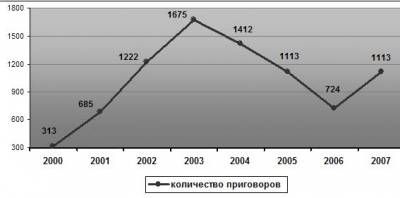
Number of sentences imposing a penalty in the form of community service
In 2000, the number of sentences passed imposing a penalty in the form of community service was insignificant due to the fact that this type of penalty was introduced by the Law of 5 May 2000 and courts had not yet developed a practice of applying this norm.
The number of sentences passed imposing a penalty in the form of community service, in absolute figures, shows that in subsequent years this type of penalty began to be applied slightly more frequently; however, their share in the overall structure of penalties remains insignificant, which is demonstrated by Chart 2.
Chart 2
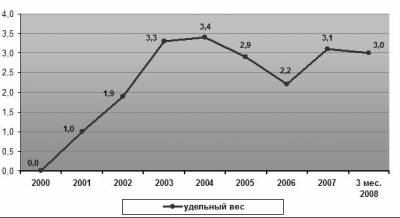
Specific weight of the penalty in the form of community service in the overall structure of penalties
A significant step in the humanisation of legislation was the adoption of the Law of the Republic of Kazakhstan, “On making changes and additions to the Criminal, Criminal Procedure and Penal Enforcement Codes of the Republic of Kazakhstan” dated 21 December 2002. Forty-eight changes and additions were made to the Criminal Code.
Thus, in connection with Kazakhstan's ratification of the Convention against Torture and Other Cruel, Inhuman or Degrading Treatment or Punishment, the Criminal Code was supplemented with Article 347-1, providing for liability for torture committed by officials, primarily investigators and persons conducting inquiries. In this regard, the offence provided for by Part 2 of Article 347 (compulsion to give testimony) was also decriminalised, as this offence is subsumed by the norms of the newly introduced Article 347-1.
Part three of Article 32 (necessary defence) was supplemented with a norm that allows causing harm to a person encroaching on human life, or when repelling another encroachment involving the use of weapons or an attempt to use them, not to be recognised as exceeding the limits of necessary defence. The victim of a criminal encroachment is given the right, in cases where such an encroachment is aimed at taking their life or is coupled with the use of a weapon or an attempt to use one, to repel this attack by any possible means, without fear of being held criminally liable for causing death or harm to the health of the aggressor.
The content of the institution of the penalty in the form of restriction of freedom underwent significant changes. After the amendments were made, the penalty in the form of restriction of freedom consists not of detention in a specialised institution, but of the court imposing certain duties on the convict that restrict their freedom, and it is served at their place of residence under the supervision of a specialised body without isolation from society for a term of one to five years. When imposing a penalty in the form of restriction of freedom, the court imposes on the convict the performance of duties: not to change their permanent place of residence, work, or study without notifying the specialised body; not to visit certain places; not to leave their place of residence during time free from study and work; and not to travel to other localities without the permission of the specialised body. The court may impose upon a person sentenced to restriction of freedom the performance of other duties facilitating their correction: to undergo a course of treatment for alcoholism, drug addiction, substance abuse, or sexually transmitted diseases; and to provide material support to their family. The circle of persons to whom it may be assigned has been expanded (minors, pregnant women and women with young children, disabled persons, persons of retirement age); at the same time, restriction of freedom is not applied to persons with a criminal record for committing grave and especially grave crimes, to military personnel, or to persons without a permanent place of residence.
Amendments have been made to the Criminal Code related to the imposition of penalties. Thus, Part 4 of Article 53 (circumstances mitigating criminal liability) is presented in a new wording: “4. In the presence of mitigating circumstances provided for by points d) provision of medical and other aid to the victim immediately after the commission of the crime, voluntary compensation for property damage and moral harm caused as a result of the crime, other actions aimed at rectifying the harm caused by the crime, and k) sincere repentance, surrender to authorities, active assistance in the disclosure of the crime, exposure of other accomplices to the crime, and the search for property obtained as a result of the crime) of part one of this article, and the absence of aggravating circumstances, the term or size of the penalty for committing a minor or moderate gravity crime cannot exceed half, for committing a grave crime – two-thirds, and for committing an especially grave crime – three-quarters of the maximum term or size of the most severe type of penalty provided for by the relevant article of the Special Part of this Code.” Previously, the severity of the crime committed was not taken into account, and the maximum term of the penalty was limited to three-quarters of the upper limit of the sanction.
Part 2 of Article 58 (imposition of a penalty for a concurrence of crimes) is presented in a new wording: “2. If the concurrence of crimes includes only minor and moderate gravity crimes, then the final penalty is imposed by absorbing the less severe penalty with the more severe one.” Previously, the absorption of a less severe penalty by a more severe one was allowed only in relation to minor gravity crimes, but it did not exclude the partial or full addition of penalties for individual crimes. There was only one limitation – the final penalty could not exceed the maximum term or size of the penalty provided for the most grave crime.
In Part 3 of Article 58 (imposition of a penalty for a concurrence of crimes), moderate gravity crimes were excluded (they moved to Part 2), and the imposition of the final penalty became possible through the absorption of the less severe penalty by the more severe one, which this norm did not previously assume.
In Part 2 of Article 59 (imposition of a penalty in case of recidivism), the sizes of the lower limit of the penalty for committing crimes in case of recidivism were reduced from half to one-third; in case of dangerous recidivism – from two-thirds to half; and in case of especially dangerous recidivism – from three-quarters to two-thirds of the maximum term and size of the most severe type of penalty provided for the crime committed.
In Part 5 of Article 63 (suspended sentence), in connection with the change in the content of the penalty in the form of restriction of freedom, Parts 5 and 7, which provided for the imposition of additional duties on convicts both when imposing the penalty and during its execution, were excluded.
Article 64 (cancellation of a suspended sentence or extension of the probation period) was brought into compliance with Article 63; the cancellation of a suspended sentence or the extension of the probation period became possible only for violations of public order.
Implementing the provisions of the Concept of Legal Policy of the Republic of Kazakhstan, approved by the Decree of the President of the Republic of Kazakhstan dated 20 September 2002 No. 949, in the part regarding the imposition of penalties on juvenile offenders, Article 79 (types of penalties assigned to minors) was supplemented with a new type of penalty – restriction of freedom for a term of one to two years. Part 7 of Article 79 is presented in the following wording: “7. Deprivation of liberty for minors may be assigned for a term of no more than ten years, and for murder under aggravating circumstances or for a concurrence of crimes, one of which is murder under aggravating circumstances – twelve years. For persons who have committed minor crimes for the first time at the age of fourteen to eighteen years, and moderate gravity crimes at the age of fourteen to sixteen years, deprivation of liberty is not assigned.”
Amendments have been made related to exemption from criminal liability and punishment. Thus, Article 67 (exemption from criminal liability in connection with reconciliation with the victim) is presented in a new wording: “1. A person who has committed a minor crime or for the first time committed a moderate gravity crime, not connected with causing death or grave harm to human health, is subject to exemption from criminal liability if they have reconciled with the victim and rectified the harm caused.
2. A person who has committed a moderate gravity crime may be exempted from criminal liability if they have reconciled with the victim and rectified the harm caused to the victim.”
Previously, the article had only one part, and exemption in the case of reconciliation upon the commission of a minor crime did not carry an unconditional character.
Part 2 of Article 70 (parole from serving a sentence) was brought into compliance with the amendments made to Article 45 (restriction of freedom) regarding the court's imposition of duties on those paroled from punishment. In Part 3 of Article 70 (parole from serving a sentence), the term of actual service of the sentence for minor and moderate gravity crimes was reduced from half to one-third, for grave crimes – from two-thirds to half, and for especially grave crimes – from three-quarters to two-thirds.
In connection with the amendments and additions, the replacement of the unserved part of the punishment with a milder type of penalty (Article 71) became possible also for persons convicted of grave crimes. The term of actual service of the punishment for the application of this criminal-legal norm for minor and moderate gravity crimes was reduced from half to one-third; for grave crimes, and for persons previously paroled from serving a sentence in the form of deprivation of liberty who committed new crimes during the period of the remaining unserved part of the punishment, it must be at least half.
The age of a child giving the right to a deferment of serving a sentence for pregnant women and women having young children was raised from eight to fourteen years (Article 72 of the Criminal Code of the Republic of Kazakhstan).
In general, through the amendments and additions to the Criminal Code of the Republic of Kazakhstan, deprivation of liberty was excluded from the sanctions for thirteen types of minor and moderate gravity crimes. The upper limit of the sanction in the form of deprivation of liberty was reduced for twelve types of crimes. At the same time, seven types of crimes moved from the category of grave to the category of moderate gravity, and two types of crimes moved from the category of moderate gravity to the category of minor gravity. It should be noted that the changes affected crimes most frequently encountered in judicial practice: theft (Part 2 of Article 175), fraud (Part 2 of Article 177), and wrongful seizure of a vehicle or other transport without the intent of theft (Part 3 of Article 185). The sanctions for thirteen types of crimes were supplemented with alternatives. With the introduction of these changes, the offence provided for by Part 1 of Article 272 moved from being practically non-alternative (previously, only arrest was provided for as an alternative, the introduction of which was postponed until 2008) to being an alternative type of offence. The expansion of alternatives for the remaining types of crimes allows for the differentiation of sentencing depending on the offender’s personality and the circumstances of the commission of the crime.
The penalty in the form of detention in a disciplinary military unit was excluded from the offence provided for by Part 1 of Article 371 (insulting a military serviceman), if they are not connected by relations of subordination.
Eighteen changes and additions were made to the Penal Enforcement Code of the Republic of Kazakhstan.
Thus, in connection with the change in the content of the penalty in the form of restriction of freedom, Chapter 8, which defines the procedure for the execution of this type of penalty under the conditions of convicts being under the supervision of penal enforcement inspections, was completely revised. The rights and duties of the inspection administration, and the procedure for applying measures of punishment and incentive, were legally defined.
The minimum required served term for the transfer of convicts to a settlement colony was significantly reduced. Now, the transfer of convicts serving sentences in correctional institutions of general and strict regimes to a settlement colony is possible after serving at least one-quarter of the sentence term for minor and moderate gravity crimes, and at least one-third of the sentence term for grave crimes.
Pregnant women sentenced to deprivation of liberty are granted the right to purchase food and necessities starting not from the fourth month of pregnancy, but immediately after receiving a medical certificate.
Restrictions on the number of telephone conversations were lifted. A convict, if technical capabilities exist, may have an unlimited number of conversations, each lasting up to fifteen minutes.
For the purpose of a fuller realisation of the provisions of Article 68 of the Penal Enforcement Code on convicts serving their sentence at their place of residence or place of conviction, amendments were made allowing for the compulsory treatment of convicts suffering from alcoholism, drug addiction, and substance abuse in the medical unit of the correctional colony.
Work continued on improving the differentiation of conditions for the detention of convicts. Under the previously applicable legislation, convicts serving their sentence in light or privileged conditions who were recognised as malicious violators of the detention regime were transferred to strict conditions for serving the sentence. There was no legal mechanism for returning a convict to ordinary conditions: it was mandatory to recognise them as a malicious violator in order to transfer the convict immediately to strict conditions. It turned out that even in the case of a convict committing a violation not related to the category of malicious and being placed in a punishment isolation cell, we again had to return them to privileged conditions. This gap was eliminated by the new law. Now, in the case of committing a violation, a convict serving their sentence in light or privileged conditions may be transferred to ordinary conditions, and those recognised as malicious violators – to strict ones.
Corresponding provisions regulating the procedure for carrying out control over convicted pregnant women and women with young children whose sentence has been deferred, and conditionally convicted persons, were brought into compliance with the amendments made to the Criminal Code of the Republic of Kazakhstan.
The practical implementation of the Law led to a significant reduction in the number of convicts in correctional institutions. At the moment of the adoption of the Law of the Republic of Kazakhstan, “On making changes and additions to the Criminal, Criminal Procedure and Penal Enforcement Codes of the Republic of Kazakhstan”, almost sixty thousand convicts were serving sentences in the republic’s correctional institutions. Decriminalisation, the exclusion of deprivation of liberty from the sanctions of certain types of crimes, as well as the change in the upper limits of sanctions for certain types of crimes, required the review of seven and a half thousand convicts' cases, as a result of which 150 convicts were fully exempted from punishment, and a further 2,660 convicts had their sentence term reduced.
The dynamics of the total number of convicts in recent years are shown in Chart 3.
Chart 3
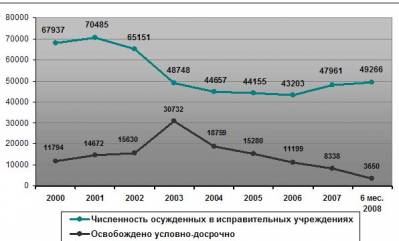
Dynamics of the number of convicts in correctional institutions and the number of convicts paroled from serving their sentence
It can be seen from the chart that in 2002, the number of convicts in correctional colonies was 65,151. In the following year, the number decreased to 48,748, or by more than 16,000 convicts. In many respects, this occurred in connection with the wider application of the institution of parole. If in 2002, 15,630 convicts were paroled from serving their sentence, then in 2003, their number increased to 30,732. In 2004–2006, as expected, the number of those paroled from serving their sentence decreased slightly; however, the total number of persons serving sentences in correctional institutions continued to decline and in 2006 amounted to 43,203 people.
The reduction in the number of convicts allowed for the “unloading” of correctional institutions and the improvement of the conditions of detention for convicts.
The history of the drafting of the Law of the Republic of Kazakhstan, “On making changes and additions to the Criminal, Criminal Procedure and Penal Enforcement Codes of the Republic of Kazakhstan” dated 21 December 2002, is interesting in itself. In fulfilment of the recommendations of the international conference, “Alternatives to Imprisonment”, held in Almaty in October 1999, a Working Group on the development of alternatives to imprisonment was created in Kazakhstan in April 2001, which included representatives of the Senate, the Majilis of the Parliament of the Republic, the Supreme Court, the General Prosecutor's Office, the Ministry of Justice, the Ministry of Internal Affairs, the Ministry of Education and Science, the Ministry of Health, the Ministry of Labour and Social Protection, the Kazakhstan International Bureau for Human Rights and Rule of Law, the Kazakhstan Criminological Association, and the Bar Association of the Republic of Kazakhstan.
Members of the Working Group held a series of meetings at which they discussed the current state of the penal enforcement system, the main problems and the reasons for their emergence, and defined priority paths for the development of the criminal penalty system.
A total of five working group meetings were held, and at the final one, held on 26 February 2002, recommendations for the improvement of legislation were developed, based on the principles and provisions formulated in international documents relating to policy in the area of criminal penalties, primarily the United Nations Standard Minimum Rules for the Treatment of Prisoners and the Tokyo Rules, and oriented towards the development trends of the penitentiary systems of foreign countries and international experience in the area of the humanisation of criminal policy.
These recommendations were sent to the Presidential Administration, the Government, and the Parliament of the Republic of Kazakhstan and were subsequently taken into account during the drafting of the Law, “On making changes and additions to the Criminal, Criminal Procedure and Penal Enforcement Codes of the Republic of Kazakhstan”.
It seems important that for the first time in legislative activity, both representatives of various state organisations and representatives of the non-state sector participated jointly, and experience in mutual cooperation was accumulated. The success of this experience is evidenced by the fact that in the Law, “On making changes and additions to the Criminal, Criminal Procedure and Penal Enforcement Codes of the Republic of Kazakhstan”, adopted on 21 December 2002, about 60 percent of the working group’s recommendations were reflected.
The Law of the Republic of Kazakhstan dated 25 September 2003 No. 484-II, “On making changes and additions to certain legislative acts of the Republic of Kazakhstan on issues of combating corruption”, is interesting for us in that changes were made to the Criminal Code of the Republic of Kazakhstan in the sanctions for such a type of penalty as deprivation of the right to hold a certain position or engage in a certain activity (Article 41).
Previously, the law determined that the penalty in the form of deprivation of the right to hold a certain position or engage in a certain activity is established for a term of one to five years as the main type of penalty and for a term of six months to three years as an additional type of penalty. In the new wording, the article was supplemented, and for the commission of corruption crimes, the deprivation of the right to hold certain positions or engage in certain activities is established for a term of three to ten years as the main type of penalty and for a term of one to seven years as an additional type of penalty.
On 10 March 2004, the Law of the Republic of Kazakhstan No. 529-II, “On making changes and additions to the Criminal, Criminal Procedure and Penal Enforcement Codes of the Republic of Kazakhstan in connection with the introduction of a moratorium on the execution of the death penalty”, was adopted.
In accordance with the Law, amendments were made to Article 49 of the Criminal Code of the Republic of Kazakhstan, according to which, upon the introduction by the President of the Republic of Kazakhstan of a moratorium on the execution of the death penalty, the execution of the death penalty sentence is suspended for the duration of the moratorium. The death penalty sentence is carried out no earlier than one year after the cancellation of the moratorium on the execution of the death penalty.
For the purpose of strengthening the legal guarantees of those sentenced to death, additions were made to the fifth part of the article, according to which persons sentenced to death, in the event of the cancellation of the moratorium on the execution of the death penalty, have the right to petition for pardon regardless of whether they petitioned for this before the introduction of the moratorium or not.
With the additions to the Penal Enforcement Code of the Republic of Kazakhstan, prison was defined as the place of detention for those sentenced to death. Persons in respect of whom the death penalty sentence entered into force before the introduction of the moratorium or during the moratorium on the execution of the death penalty are held in single cells in isolation from other convicts.
For the purpose of implementing the Decree of the Head of State and the Law of the Republic of Kazakhstan, “On making changes and additions to the Criminal, Criminal Procedure and Penal Enforcement Codes of the Republic of Kazakhstan in connection with the introduction of a moratorium on the execution of the death penalty”, a separate block was allocated and equipped in the prison of Arkalyk by the penal enforcement system for the detention of persons sentenced to death who fell under the moratorium on its execution.
For the detention of persons sentenced to life imprisonment, a local section was created in the special regime colony in the settlement of Zhitikara, Kostanay Region, for the detention of the specified category of persons. The regime buildings and cells are equipped with video surveillance systems and security alarms.
The humanisation of legislation was continued by the Law of the Republic of Kazakhstan dated 9 December 2004 No. 10-III, “On making changes and additions to the Criminal, Criminal Procedure, and Penal Enforcement Codes of the Republic of Kazakhstan and the Code of the Republic of Kazakhstan on Administrative Offences regarding issues of simplifying criminal case investigation procedures, the decriminalisation of certain types of crimes, and the improvement of legislation on administrative offences”. In particular, amendments were made to the Criminal Code according to which the penalty in the form of community service (Article 39 of the Criminal Code of the Republic of Kazakhstan) could be assigned both as a main and as an additional type of penalty.
The introduction of combined sanctions was recommended by Clause 8.2 of the United Nations Standard Minimum Rules for Non-custodial Measures (Tokyo Rules, adopted by General Assembly resolution 45/110 on 14 December 1990). Unfortunately, the mechanisms for applying this sanction are not sufficiently prescribed in the legislation, which creates certain difficulties in law enforcement practice.
The execution of the penalty in the form of arrest is formulated in the legislation extremely strictly; therefore, amendments were made to Articles 46 and 79 of the Criminal Code of the Republic of Kazakhstan, according to which this type of penalty is not applied to persons who have not reached the age of eighteen.
Persons who committed crimes through negligence did not have the intent to commit a crime and did not foresee the gravity of the consequences. In this regard, amendments were made to the legislation (Part 5 of Article 48 of the Criminal Code of the Republic of Kazakhstan), in accordance with which all persons who committed crimes through negligence and were sentenced to a penalty in the form of deprivation of liberty are sent to serve their sentence in settlement colonies.
Amendments were made to Article 81 of the Criminal Code, allowing for the exemption of minors from criminal liability and punishment. Previously, this article provided only for the exemption of minors sentenced for the first time for committing minor and moderate gravity crimes from punishment if the court determined that their correction could be achieved through the application of compulsory educational measures. The new wording of the article provides for the exemption from criminal liability of minors who have committed minor crimes and who have committed a moderate gravity crime for the first time. At the same time, the application of compulsory educational measures does not carry an unconditional character. Part 2 of Article 81 of the Criminal Code of the Republic of Kazakhstan provides for the exemption from punishment of a minor sentenced for the first time for the commission of minor and moderate gravity crimes if it is determined that their correction can be achieved through the application of compulsory educational measures.
The minimum required terms of serving sentences for persons who committed crimes at a minor age for the application of parole were reduced (Article 84 of the Criminal Code of the Republic of Kazakhstan). After the amendments were made, parole may be applied after the actual service of:
a) at least one-quarter of the sentence term imposed by the court for a minor or moderate gravity crime;
b) at least one-third of the sentence term imposed by the court for a grave crime;
c) at least half of the sentence term imposed by the court for an especially grave crime not coupled with an encroachment on human life;
d) no less than two-thirds of the sentence imposed by the court for a particularly serious crime involving an attempt on a person's life.
In the Special Part of the Criminal Code, the elements of crimes provided for by Articles 106 (battery), 111 (infliction of moderate bodily harm), and 154 (refusal to provide information to a citizen) have been decriminalised. The sanctions for fifteen types of crimes have been supplemented with alternatives, and in the sanctions for thirteen types of crimes, the minimum limits for sentences involving deprivation of liberty have been excluded.
Of particular note is the Law of the Republic of Kazakhstan ‘On Amending and Supplementing Certain Legislative Acts of the Republic of Kazakhstan on Issues of the Penal System’ dated 26 March 2007, No. 240-III ZRK. Let us clarify at the outset that the Law contains a number of provisions aimed at improving the activities of the penal system, as well as introducing necessary editorial changes to acts regulating the operation of the penitentiary system. At the same time, the Law contains several provisions whose content causes a certain degree of concern from the perspective of international standards.
By the Law of 27 March 2007, amendments were made to the Criminal Code, the Code of Criminal Procedure, and the Penal Enforcement Code, which modified the foundations of the institution of parole in the Republic of Kazakhstan. In particular, the grounds and procedure for the parole of persons serving criminal sentences were changed; a list of duties to be performed by those on parole during the unserved part of their sentence was established; and the body responsible for exercising control over parolees during the unserved part of their sentence was defined.
Thus, according to the previously effective version of Article 70 of the Criminal Code of the Republic of Kazakhstan, a person serving correctional labour, restriction of military service, restriction of liberty, confinement in a disciplinary military unit, or deprivation of liberty could be granted parole if the court determined that the person did not need to serve the full sentence imposed by the court for their rehabilitation. In doing so, the person could be fully or partially exempted from serving an additional type of sentence.
According to the new version, a person serving correctional labour, restriction of military service, restriction of liberty, confinement in a disciplinary military unit, or deprivation of liberty, who has demonstrated law-abiding behaviour, a conscientious attitude towards work (or study), active participation in the work of self-governing organisations and educational activities, and has taken measures to compensate for the damage caused by the crime, and who does not need to serve the full sentence imposed by the court, may be released on parole by the court. In doing so, the person may be fully or partially exempted from serving an additional type of sentence.
Undoubtedly, even previously, when applying for parole, the behaviour of the convict, their attitude towards work, study, and participation in educational activities were taken into account. A novelty in this regard can be considered the introduction of such a criterion as compensation for damage caused by the crime. The legislator’s logic is understandable—to protect the interests of the victim and the state. However, in modern conditions, where barely 30% of convicts are provided with work in correctional institutions, the issue of compensation for damage by the convicts themselves is highly problematic, and it is quite obvious that it will fall on the shoulders of the convicts’ parents or relatives. It is not excluded that victims might use the right granted to them for selfish interests. The issue of compensation for damage can be even more acute if the convict was in a medical institution of the penal system during the period of serving their sentence. Industrial activity is not carried out in these institutions, and the issue of parole is often directly related to the possibility of receiving more qualified medical assistance.
Part two of Article 70 of the Criminal Code of the Republic of Kazakhstan determines that persons released on parole from serving their sentence shall be assigned duties during the remaining unserved part of the sentence, the list of which is established by Article 178-2 of the Penal Enforcement Code of the Republic of Kazakhstan.
Article 178-2 of the Penal Enforcement Code of the Republic of Kazakhstan provides an exhaustive list of duties imposed on persons released on parole during the unserved part of their sentence.
Persons released on parole from serving their sentence are obliged to:
1) undergo registration with the internal affairs bodies at their place of residence in the established manner;
2) not leave their place of residence during times determined by the internal affairs bodies;
3) not change their permanent place of residence, work, or study without written notification to the internal affairs bodies;
4) not visit places determined by the internal affairs bodies during their free time from work and study;
5) not travel to other localities without written permission from the internal affairs bodies;
6) take measures to compensate for damage caused to the health or property of the victim, or material damage to the state;
7) upon the request of the internal affairs bodies, provide explanations and other documents necessary for exercising control over the behaviour of the parolee;
8) appear upon summons to the internal affairs bodies. In case of failure to appear without valid reasons, the parolee may be subject to a warrant for arrest and conveyance;
9) in the manner established by the legislation of the Republic of Kazakhstan, annually submit an income declaration and other information regarding property that is subject to taxation, including property located outside the Republic of Kazakhstan, to the tax authority at the place of residence, and submit proof of this to the internal affairs body.
Thus, these changes provide for broader departmental control over the freedom of movement and private life of persons released on parole than existed prior to the adoption of the Law of 27 March 2007.
At the same time, it is unclear for what purpose the requirement is introduced for persons released on parole to submit tax declarations regarding their income and property, including those located outside the Republic of Kazakhstan. The requirement for parolees to provide the internal affairs bodies with explanations and other documents necessary for monitoring the behaviour of the parolee also raises questions. The right of internal affairs bodies to obtain such general information without sufficient procedural safeguards could lead to unjustified restrictions on the rights of citizens, including the right not to testify against oneself, etc.
Based on the amendments introduced by the Law of 27 March 2007, internal affairs bodies are granted unjustifiably broad powers related to serious restrictions on personal rights and freedoms without judicial oversight, which may lead to abuses.
Before the aforementioned changes and additions were made, the Criminal Code of the Republic of Kazakhstan provided that if, during the remaining unserved part of the sentence, a person who had been granted parole committed a violation of public order punishable by an administrative penalty, or maliciously evaded the performance of duties imposed on them by the court when granting parole, the court, upon the motion of the relevant bodies, could issue a decision to revoke the parole and enforce the remaining unserved part of the sentence.
In the new version of the Criminal Code of the Republic of Kazakhstan, the legislator chose not to limit the grounds for revoking parole solely to the commission of public order violations for which administrative penalties are imposed. In accordance with the new provision, such grounds may also include the commission of repeated administrative offences.
The inclusion of the commission of administrative offences in the list of grounds for revoking parole raises certain doubts, because, in accordance with international standards, persons released on parole should bear individual duties imposed on them only by a court or a special independent body. In other words, even taking into account that the threat of parole revocation for committing any repeated administrative offences is automatically part of the imposed obligations, this condition does not conform to the definition of parole as a measure that, in accordance with international standards, involves the imposition of strictly individualised duties on those released on parole.
In this regard, it is necessary to draw attention to the fact that, in accordance with points 30 and 31 of the Council of Europe Recommendation, it is desirable that ‘the grounds for the revocation of parole correspond to the duties previously imposed on the specific parolee. For minor violations of imposed duties, the special body responsible for monitoring should respond with advice or a warning. Any significant violation should be reported to the authority that has the power to decide on the revocation of parole. Such an authority should have the power to provide further advice or a warning, as well as to impose stricter obligations, including the temporary revocation of parole. These measures should be considered sufficient sanctions for failure to comply with imposed duties.’ Despite the fact that the recommendations of the Council of Europe cannot be legally binding for our state, their content should be heeded, as such international documents form universal standards in the sphere of ensuring human rights and freedoms.
Moreover, the Council of Europe Recommendation, viewing parole as a measure alternative to deprivation of liberty, requires that it be carried out in accordance with the European Rules on Community Sanctions, which in Chapter X establish a number of conditions for such measures. For example, they state that for a person fulfilling all duties imposed upon them, there should be a mechanism for reviewing the nature and duration of the imposed duties, and that deprivation of liberty should not be automatically applied to those who have violated them.
In accordance with paragraph 2 of Article 178-2, the role of the court is now limited only to the following functions. It may impose on the parolee the performance of other duties conducive to their rehabilitation. Namely:
1) undergo a course of treatment for alcoholism, drug addiction, or substance abuse;
2) undergo a course of treatment for sexually transmitted diseases;
3) provide material support to their family.
It is obvious that the changes and additions introduced by the new Law regarding the establishment of a unified list of duties to be performed by those on parole contradict the generally accepted concept of parole. They do not assume an individualised approach to each person released on such grounds and may unjustifiably violate the rights and freedoms of persons released on parole from serving a sentence, as they establish broad discretionary powers for internal affairs bodies to restrict the freedom of movement of citizens and their right to privacy.
While previously parole was not applied only to a person whose death penalty was commuted to deprivation of liberty by way of pardon, now it is not applied to persons who committed an intentional crime during the period of serving their sentence, as well as to persons who had previously been released on parole. This provision contradicts international standards, which do not restrict the categories of convicts to whom parole can be applied.
If a person performed all duties during the parole period, why should they be discriminated against in their right to parole in the event of serving a sentence for a new crime? Thus, in effect, such a person suffers a repeated punishment for the same crime. In any case, such measures should be adopted on the basis of an individual approach, and not applied to all convicted persons indiscriminately.
In accordance with the amendments to part 6 of Article 70 of the Criminal Code of the Republic of Kazakhstan, control over the behaviour of a person released on parole is exercised by the internal affairs bodies at the place of residence of the person released, and in relation to military personnel, by the command of military units and institutions. Prior to the adoption of the Law of 27 March 2007, the wording of the article was of an indefinite nature—‘a specialised state body.’ Following the legislator’s logic, the functions of a specialised state body would most likely have been performed by penal inspection units, as exercising control over parolees differs practically in no way from controlling the behaviour of persons sentenced to restriction of liberty and the performance of duties imposed on them. However, the regulatory legal framework in this direction was not developed for a number of years, and the functions of a specialised body in relation to parolees were not properly defined.
The Standard Minimum Rules for the Treatment of Prisoners, approved by the Economic and Social Council in UN General Assembly Resolutions No. 663 (c) (XXIV) of 31 July 1957 and 2076 (LXII) of 13 May 1977, provide in sub-paragraph 2 of point 60 that ‘it is desirable that, before the completion of the sentence, measures be taken to return the prisoner to life in society gradually. This goal can be achieved by taking into account the characteristics of each offender. By releasing prisoners on a probationary period, during which they still remain under supervision, provided that such supervision is not entrusted to police authorities and is combined with effective social assistance.’
The European Prison Rules, updated in 2006 (Recommendation Rec. (2006) 2 of the Committee of Ministers of the Council of Europe to member states in points 107.2 and 107.3), require the ensuring of a gradual return to life in freedom for prisoners sentenced to long terms of imprisonment. In the opinion of Council of Europe experts, this goal can be achieved by a programme of measures preceding release, or by partial or conditional release under supervision, combined with effective social support.
Based on the above-mentioned standards, it can be concluded that the specialised state body for controlling the behaviour of a parolee should be an agency that does not possess police functions and, furthermore, has the capacity to provide effective social assistance.
By the Law of 27 March 2007, Article 455 of the Code of Criminal Procedure was supplemented with part 6-1, which reads as follows:
‘6-1. When considering the issue of parole from serving a sentence, the opinion of the victim or their representative is taken into account.
The court notifies the victim or their representative of the upcoming court hearing by registered mail. In the case of the impossibility of the personal participation of the victim or their representative in court, written statements and petitions may be considered. Upon proper notification of the victim or their representative and the absence of any written statements and petitions from them, as well as in cases where damage was caused to the interests of the state, an opinion from a prosecutor is mandatorily required regarding the observance of the rights of the victim or the state.’.
Similar procedures allowing for the consideration of the opinion of victims currently exist in Canada, the United Kingdom, France, Germany, and other countries. As a rule, such participation by victims may consist of expressing their position on the imposition of specific duties on the parolee, on the impact the crime had on the victim, any ongoing consequences of the crime regarding the victim and their family, as well as the impact that the release of the convict might have on the victim and their family. In other words, in the first case, the victim’s opinion is taken into account at the moment when a decision on parole in general has already been made by the relevant competent independent body, and in the second case—when the issue of parole or mitigation of punishment is still being considered. In some states, for example in the United Kingdom since 1 September 2007, victims have gained the right to express their position in certain cases on both issues. In this regard, it is recommended to make the necessary clarifications in the legislation concerning the content of this right of the victim.
Furthermore, the experience of many states shows that it is not expedient to extend this right of the victim to all cases where the issue of parole is considered, but only to cases involving grave and particularly grave crimes against the person. Such a practice, for example, has proven itself well in the United Kingdom. At the same time, the legislator proceeds from the premise that if the nature of the crime does not pose a great danger to the victim and the community, and the periods of serving the sentence are not significant, the point in complicating the procedural form of resolving the issue of parole is lost.
It is also necessary to provide for real mechanisms by means of which the victim could exercise the right granted to them. In practice, those sentenced to deprivation of liberty often serve their sentences quite far from the victims’ place of residence. The consideration of materials regarding parole takes place in courts at the place of serving the sentence; consequently, in most cases, it will be difficult for victims to arrive at the place of the judicial proceedings due to transport and other material reasons. In this regard, the state should provide compensation to the victim for expenses related to participation in such judicial proceedings. Otherwise, this right will remain only on paper and will not be properly realised in practice.
By the Law of 27 March 2007, criminal liability was introduced for convicted persons for the commission of an act of self-harm by a group of persons. A new element of crime was introduced into the Criminal Code of the Republic of Kazakhstan: ‘The commission of an act of self-harm by a group of persons held in institutions ensuring isolation from society, for the purpose of destabilising the normal operation of the institutions or obstructing the lawful activities of the staff of the institutions.’ As a sanction, it provided for deprivation of liberty for a term of one to two years.
How self-harm could obstruct the lawful activities of institution staff and destabilise the normal operation of institutions, the Law did not specify. Thus, prison authorities were left with broad scope for the arbitrary classification of such acts. Such an approach allows any group self-harm to be considered aimed at destabilising the normal operation of institutions or at obstructing the lawful activities of institution staff.
Acts of group self-harm are symptoms of serious problems in the management of a correctional institution, and accordingly, the methods for solving them do not lie in the criminalisation of self-harm. The criminalisation of acts of group self-harm is an exclusively punitive action that does not solve the problematic nature of the relationship between prisoners and prison authorities. Responding with repressive sanctions to the use by prisoners of extreme measures such as self-harm, in conditions where they have no other way to draw attention to their problems, is inhumane and unfair. This is an easy way to resolve a crisis—to shift all the blame for what happened immediately onto the prisoners. This amendment clearly protected the departmental interests of the penitentiary service itself, but it did not have a positive impact on the situation in penitentiary institutions.
By a regulatory resolution of the Constitutional Council of the Republic of Kazakhstan of 27 February 2008, No. 2, this provision was declared unconstitutional.
The Penal Enforcement Code of the Republic of Kazakhstan was supplemented by the Law of 27 March 2007 with Article 180-1, which reads as follows:
‘Article 180-1. Release from an institution of the penal system of persons suffering from an infectious form of tuberculosis that poses a danger to others
1. If patients with an infectious form of tuberculosis posing a danger to others, who are being released from an institution of the penal system, have not completed a full course of treatment during the period of serving their sentence, they shall be subject to compulsory treatment after release in accordance with the legislation of the Republic of Kazakhstan.
2. The administration of the institution of the penal system, no later than one month before the end of the sentence, in relation to the persons specified in point 1 of this article, shall send to the court at the location of the institution a petition for the appointment of compulsory treatment in accordance with the legislation of the Republic of Kazakhstan.
3. Notices of the release from institutions of the penal system of persons suffering from an infectious form of tuberculosis, in relation to whom compulsory treatment has been established by a court decision, shall be sent to specialised anti-tuberculosis treatment and preventive organisations and internal affairs bodies at the location of the institution.’.
The new procedure for ensuring compulsory treatment raises a number of questions. Firstly, such treatment is appointed in relation to all convicts who have not completed a full course of treatment. At the same time, it is not taken into account that convicts of this category might not have refused to complete such a course after their release. Thus, by the new Law, persons being released from penal institutions who are evading treatment for tuberculosis and persons who do not intend to evade it, and perhaps are even undergoing such a course of treatment, are equated to the same status. Such a rigid approach—a sort of negative presumption—contradicts common logic, is questionable from the position of observing fundamental rights and freedoms, and is ineffective from the point of view of utilising limited state resources.
Secondly, the wording and logic of the changes and additions themselves provide that even upon confirmation from a person released from an institution of the penal system of their intentions to undergo treatment, they are still subject to compulsory treatment. Previously, a person held in institutions of the penal system could be subjected to compulsory treatment only in the case of a written refusal of voluntary treatment. However, such a proviso was excluded by the Law of 27 March 2007 from Law No. 496-I ‘On Compulsory Treatment of Citizens Suffering from an Infectious Form of Tuberculosis’.
In this regard, the role of the court, to which the administration of the penal institution sends a petition for the appointment of compulsory treatment, is unclear. The imperative wording ‘shall be subject to compulsory treatment’ in point 1 of Article 180-1 of the Penal Enforcement Code of the Republic of Kazakhstan, and the consideration of this issue in court, all the more so without the participation of the convict themselves or their legal representative, turns the judicial procedure into a formality, as in accordance with the law, all persons released from an institution of the penal system who suffer from an infectious form of tuberculosis must be sent for compulsory treatment.
It is interesting that the legislator demonstrates a completely different approach in relation to other categories of citizens. For the application of compulsory measures in relation to citizens not staying in institutions of the penal system, health authorities must prove in court the fact of their evasion of treatment. The Law of the Republic of Kazakhstan of 10 December 1999, No. 496-I ‘On Compulsory Treatment of Citizens Suffering from an Infectious Form of Tuberculosis’ states in part 1 of Article 3 that ‘A decision on the compulsory treatment of citizens suffering from an infectious form of tuberculosis and evading treatment is made by the court upon the petition of health authorities.’ In this regard, the justification for the discrimination against persons being released from penal institutions causes serious concern.
By the same Law, amendments were made to point 1 of Article 5 of the Law of the Republic of Kazakhstan of 5 October 1994 ‘On Prevention and Treatment of HIV Infection and AIDS’, according to which ‘Citizens held in institutions of the penal system of the Ministry of Justice of the Republic of Kazakhstan are subject to a mandatory confidential medical examination for HIV infection.’.
This requirement contradicts international standards. The Guidelines on HIV/AIDS and Human Rights (2006 consolidated version), adopted under the auspices of the Joint United Nations Programme on HIV/AIDS and the Office of the UN High Commissioner for Human Rights, directly prohibit mandatory testing for HIV infection in point 135. In particular, it is explained in this point of the Guidelines that mandatory testing for HIV may constitute an interference with the physical freedom of an individual and violate the human right to security. This coercive measure is often used against groups that are least capable of defending themselves because they are under the control of state institutions or fall under criminal jurisdiction. These are military personnel, prisoners, commercial sex workers, drug addicts, and homosexuals. There is no justification for such a practice from the standpoint of ensuring public health goals. Respect for the right to physical security requires that testing be voluntary and that such a test be carried out exclusively with informed consent. A similar requirement is contained in all international recommendations and standards on this issue.
Mandatory testing is not an effective means of controlling the spread of HIV infection either in penal institutions or outside them. For this, there exists a whole set of other means and methods that have been tested and are effectively used in many countries of the world.
5. Concluding provisions
The transfer of the penal system to the jurisdiction of the Ministry of Justice of the Republic of Kazakhstan pursued the goal of more fully ensuring the rights and legitimate interests of convicts. It was assumed that a civilian agency not connected to the resolution of tasks related to combating crime—an agency responsible for the formation of national legislation—would ensure the implementation of state policy aimed at the humanisation of the system of executing sentences.
Meanwhile, the presented analysis allows us to note that the Law of 27 March 2007 enters into dissonance with previously adopted laws. If previously, during the development of draft laws, great attention was paid to the humanisation of legislation through decriminalisation, depenalisation, the expansion of the use of alternatives for individual types of crimes, and the enhancement of the legal protection of convicts, then in the latest legislative changes, trends towards strengthening the punitive impact on offenders and convicts are clearly manifested.
The attempt to solve problems with repressive methods testifies to a crisis in the penal system and an inability to adequately and timely respond to changes in the situation, which often lie in the plane of the relationship between staff and convicts (in this instance, referring to the attempt to criminalise group self-harm).
The existence of a crisis is also indicated by the changes aimed at modifying the institution of parole from serving a sentence. The introduction of a ban on the application of parole in relation to persons who had previously been released on parole from serving a sentence significantly reduced the application of this criminal law norm, as is clearly evidenced by Graph 3, presented earlier.
But are these restrictions sufficiently justified? Was an analysis of the influence of the number of parolees on the state of crime in the country conducted? Let us turn to the data of the Committee on Legal Statistics and Special Records of the General Prosecutor’s Office of the Republic of Kazakhstan. Table 2 presents data on the number of registered crimes and the number of persons convicted by courts who had previously been released on parole and had an unexpunged or unspent conviction.
Table 2
| Years | 2001 | 2002 | 2003 | 2004 | 2005 | 2006 | 2007 |
| Number of registered crimes | 150790 | 152168 | 135168 | 118485 | 143550 | 146347 | 141271 |
| Number of convicts previously released on parole from serving a sentence | 2468 | 2912 | 4027 | 5081 | 4992 | 4059 | 3469 |
As can be seen from the data presented in the table, the number of persons convicted by courts who had previously been released on parole, in percentage terms, constitutes from 2% to 4.5% of the total number of registered crimes. And it is not even a fact that all of them committed new crimes during the period of the unserved part of the sentence. For comparison, the level of recidivist crime in the years we are considering was approximately 35%.
It should also be noted that control over the behaviour of persons released on parole from serving their sentence was not exercised in the indicated years, as a specialised state body, within whose functions it fell, had not been legislatively defined. A sufficient economic analysis of the law was also not conducted. Even at the stage of developing the draft law, it was possible to predict an increase in the number of convicts in correctional institutions, which is currently confirmed by statistical data on the prison population in Kazakhstan as of June 2008 (Graph 4).
According to data repeatedly voiced by the Penal System Committee, the maintenance of one convict per year costs the state and taxpayers about 250 thousand tenge. It is not difficult to calculate that a significant increase in funding for the prison system is already required today, especially also taking into account the increase in the number of remand prisoners and suspects held in pre-trial detention centres, which also has a tendency to grow.
Graph 4
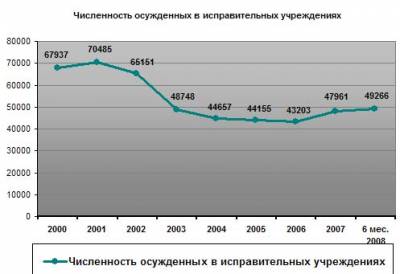
Dynamics of the number of convicts in correctional institutions of the Republic of Kazakhstan 2000-2008
Furthermore, the placement of such a number of convicts in correctional institutions will inevitably entail a deterioration in the conditions of detention due to overcrowding.
In the State Programme of Legal Reform in the Republic of Kazakhstan and the Concept of Legal Policy of the Republic of Kazakhstan, it was emphasised that the implementation of criminal policy should have a two-vector focus, applying: - strict measures of punishment to persons committing grave crimes, previously convicted, and stubbornly unwilling to adopt an honest life; - mild measures of punishment in relation to persons guilty of committing less dangerous crimes and capable of rehabilitation without isolation from society.
During the period we analysed, two new types of punishment were put into effect—involvement in community service and restriction of liberty. As previously indicated, the sanctions of individual types of crimes were supplemented with alternatives; however, punishments alternative to deprivation of liberty did not find wide application. As can be seen from Graph 5, the specific weight of deprivation of liberty in the overall structure of punishments remained practically at the same level, undergoing insignificant fluctuations.
Let us attempt to analyse the reasons. One of them may be that the reserves for the legislative application of alternatives have been exhausted; they have occupied their niche, and only their redistribution by type is possible, or the mechanism for implementing these measures has not been sufficiently developed. However, apparently, this is not so. According to data from the Committee on Legal Statistics and Special Records, in 2000, 19,539 people were sentenced to terms of deprivation of liberty of up to 3 years; in 2002, 14,007 people; in 2004, 9,148 people; in 2005, 8,238 people; and in 2007, 6,970 people. It is obvious that for many of them, it was possible to impose a punishment not connected with deprivation of liberty.
Graph 5
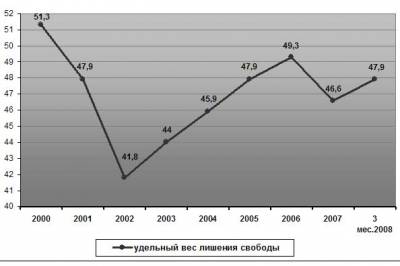
Specific weight of deprivation of liberty in the overall structure of punishments
It appears that the wide application of punishments without deprivation of liberty is held back by the absence of an effective system for their execution. For example, in the Russian Federation, which has criminal legislation identical to the Kazakhstani one, the specific weight of deprivation of liberty in recent years has decreased to the level of 32%. At the same time, the staff strength of penal inspections alone has been increased by 10,000 units over the last three years.
Within the framework of the Programme for the Further Development of the Penal System of the Republic of Kazakhstan for 2004-2006, an increase in the staff strength of penal inspections by 1,183 units was provided for; however, this proposal was rejected by the Republican Budget Commission, and by the resolution of the Government of the Republic of Kazakhstan of 11 February 2006, No. 97 ‘On Introducing Amendments to the Resolution of the Government of the Republic of Kazakhstan of 31 December 2003, No. 1376’, this point was excluded from the Plan of Measures for the implementation of the Programme—apparently, the residual approach to the financing of penal inspections played its negative role in this.
This point was included in the Programme for the Further Development of the Penal System of the Republic of Kazakhstan for 2007-2009, which is currently being implemented; however, as already noted earlier, funding for it has not been provided.
At the same time, the creation of a probation service is extremely urgent at the present time. In connection with the introduction into the legislation of a novelty providing for the consideration of the victim’s opinion when deciding on the application of parole, a need has arisen to establish a dialogue between the victim and the convict. The staff of the correctional institution cannot perform this function as they are territorially limited, and summoning the victim might provoke a counter-reaction. In these conditions, the functions of mediators could be taken on by staff of the penal inspections transformed into a probation service. Similar experience exists in international practice and has successfully proven itself.
In all likelihood, it was the absence of an effective system for executing punishments without deprivation of liberty that caused the control over persons released on parole from serving a sentence to be transferred to the jurisdiction of the Ministry of Internal Affairs. Here, it should be noted that according to the current version of Article 70 of the Criminal Code of the Republic of Kazakhstan, persons being released on parole are released precisely from serving the sentence, and not from the punishment as such. Thus, in fact, the function of executing the punishment has been transferred to the Ministry of Internal Affairs, and the integrity of the penal system has been violated. It is also necessary to take into account that the Ministry of Internal Affairs is a law enforcement structure, a body for combating crime, and in fact does not exercise post-criminal control in relation to persons who have committed a crime.
The transfer of the penal system to the jurisdiction of a civilian ministry provided for the demilitarisation of the system, in particular, the creation of its own security structures. Therefore, security units were created in all correctional institutions being put into operation; infrastructure for conscript military personnel was not created. At present, a decision has been made to transfer security functions to the Internal Troops of the Ministry of Internal Affairs. For this, the plan of measures for the implementation of the programme provides for the construction of military towns in institutions ZhD-158/7, ICh-167/9, ZK-169/5, ETs-166/26, KA-168/5. The security of juvenile colonies and colonies for holding women remains with the penal system.
This decision runs counter to previously adopted decisions, requires significant financial expenditures, and does not comply with international standards for the treatment of prisoners.
Such a frequently and radically changing position of the agency leads to the thought that within the Penal System Committee itself, there is no continuity in the conduct of penal policy. Since its transfer to the jurisdiction of the Ministry of Justice (2001), the Committee has been headed by its sixth chairman. Each of them has their own vision for solving problems, but, unfortunately, the frequent change of leadership does not allow them to fully implement them.
In conclusion, let us dwell on the issues of interaction between the penal system and public organisations. The Head of State, speaking at Civil Forums, repeatedly emphasised that it is necessary to develop permanently operating mechanisms of cooperation at the central and regional levels in the form of public councils, consultative-advisory bodies, commissions, and working groups on legislative work, participation in the formation of state, sectoral, and regional development programmes, and to introduce the practice of conducting public hearings on socially significant problems.
All these issues have been reflected in the Concept for the Development of Civil Society in the Republic of Kazakhstan, approved by the Decree of the President of the Republic of Kazakhstan of 25 July 2006, No. 154.
Previously, the penal system willingly and actively cooperated with public organisations and acted as an initiator of bringing issues related to the reforming of the penal system, the improvement of legislation, and the familiarisation of staff with international norms and standards to international and republican conferences and round tables. Above, information was presented about the positive experience of joint work on preparing proposals and amendments to draft laws.
On 28 September 2002, by Order of the Minister of Justice No. 147, a Public Monitoring Commission was created under the Ministry of Justice, which, on 3 March 2004, by Order of the Minister No. 54, was transformed into the Public Council on Issues of the Penal System under the Minister of Justice of the Republic of Kazakhstan. The Public Council had the status of a consultative-advisory body; its meetings were held quarterly. Issues of compliance with legality, the improvement of penal legislation, public control, and others were brought to the meetings. Members of the Public Council visited correctional institutions and made proposals for improving their activities.
At the same time, despite the effectiveness of the council’s operation, in 2005, meetings ceased to be held, and subsequently, the Public Council was liquidated. The reason for the liquidation was the introduction into the Penal Enforcement Code and the Law ‘On Justice Bodies’ of provisions on public control over the activities of correctional institutions and public monitoring commissions, which, allegedly, began to duplicate their functions. The explanation is not entirely logical, as the activities of public monitoring commissions are confined to the level of territorial administrations of the penal system, or they can make proposals to the authorised body of the penal system, whereas the Public Council, with the status of a consultative-advisory body, made proposals at the level of the Minister of Justice and could influence the adoption of management decisions.
On 17 June 2002, by Resolution of the Government of the Republic of Kazakhstan No. 655, the Regulations on the Board of Trustees under juvenile colonies of the penal system were approved, for the provision of assistance to the administrations of juvenile colonies in organising the educational-upbringing process and strengthening the material-technical base, and for contributing to the resolution of issues of social protection of convicts, and the labour and domestic settlement of persons being released. However, at present, for a number of reasons, the Boards of Trustees do not perform such functions to a sufficient degree, and one of the reasons is the weak interaction of the penal system with representatives of civil society.
It is worth noting that in the Programme for the Further Development of the Penal System of the Republic of Kazakhstan for 2004-2006, a point was laid down on expanding interaction with public associations, including human rights organisations and charitable foundations; however, by Resolution of the Government of the Republic of Kazakhstan of 11 February 2006, No. 97, it was excluded. It is unclear for what reasons; apparently, a bureaucratic underestimation of the resources of civil society played a role.
From the same time, contacts between the penal system and public organisations became noticeably less active. Initiatives from the penal system to involve public organisations in normative-legal activities were seriously restricted.
Proposals for further reforming thepenal system of the Republic of Kazakhstan
Today, the following paths for reforming the penal system appear expedient:
- development of the penal system as a holistic structure located within the framework of the civilian agency of the Ministry of Justice of the Republic of Kazakhstan;
- conducting further demilitarisation of the penal system through the preparation of a concept and a plan of work;
- transition from barrack-style housing of convicts to cell-style housing, ensuring greater security for both convicts and the staff of correctional institutions. In this vein, the convergence of the colony and prison systems of executing sentences is expedient;
- introduction of amendments and additions to legislation aimed at reducing the number of convicts, as otherwise, reforming is impossible or too costly;
- adoption of legislative and organisational measures to increase the effectiveness of executing sentences not connected with deprivation of liberty. In this direction, the prompt resolution of the issue of creating a modern and effective probation service appears important;
- further improvement of forms and methods of correctional influence on convicts, their adaptation and resocialisation;
- bringing legislation and the practice of serving sentences into compliance with international human rights standards in the sphere of protecting the health of convicts, in particular, the reforming of the departmental healthcare of the penal system;
- improvement of the system of personnel training and conducting an analysis of the effectiveness and expediency of departmental education;
- increasing the applied and academic level of penitentiary science, presupposing the development of the problematic of executing sentences, both by individual scientists and by collectives of scientific and educational institutions of the Republic of Kazakhstan;
- establishing a constructive dialogue with civil society institutions and improving its legal forms;
- ensuring the transparency of the activities of institutions and bodies of the penal system through the consistent implementation of public control and other forms of cooperation with civil society;
- ensuring a consistent course towards the humanisation of the penal system, which is especially important in connection with the obligations of Kazakhstan under the International Covenant on Civil and Political Rights, which require bringing national legislation into compliance with the provisions of this most important UN human rights document, as well as in light of Kazakhstan’s chairmanship in the OSCE in 2010.
Centre for Legal Policy Research 14 August 2008
[1] This analytical report was prepared within the framework of a project of the Centre for Legal Policy Research with the financial support of the Organisation for Security and Co-operation in Europe (OSCE) Centre in Astana. The opinions and views contained in the analytical report may not coincide with the position of the OSCE and reflect the viewpoint of the Centre for Legal Policy Research.