Access to Legal Knowledge in the Kovel Juvenile Correction Colony
Sociological report on the results of a survey of convicts in a juvenile correction colony, conducted within the project "Improving Access to Legal Knowledge for Individuals in Places of Deprivation of Liberty," which was implemented with the support of the International Renaissance Foundation.
Lutsk 2009
GENERAL INFORMATION ABOUT THE STUDY
Research Methodology
From 12 to 26 November 2008, the Volyn Youth Rights Protection Association conducted a survey of 128 individuals serving sentences at the Kovel Juvenile Correction Colony.
Information was collected using the questionnaire method. The survey was conducted among all inmates of the colony, without exception, who are literate. Therefore, we can confidently assert the absolute accuracy of the obtained data and the absence of statistical or other errors in the sample population.
The processing of the obtained information was carried out using SPSS software.
Respondents from the educational institution were distributed as follows:
- by education:
vocational secondary – 12.2%;
complete secondary – 32.5%;
incomplete secondary – 52.0%;
primary – 3.3%.
- by age:
14 years old – 9%; 17 years old – 41.9%;
15 years old – 2.6%; 18 years old – 18.8%;
16 years old – 19.4%; 19 years old – 13%;
20 years old – 2.6%
- by duration of stay in the educational institution:
| Duration of stay in months | Number of responses, persons | Percentage of responses, % |
| 1 – 3 | 13 | 11.6 |
| 4 – 9 | 29 | 25.9 |
| 10 – 18 | 35 | 31.3 |
| 19 – 24 | 22 | 19.6 |
| 25 – 36 | 9 | 8.0 |
| 37 – 50 | 2 | 1.8 |
| 51 – 81 | 2 | 1.8 |
| Total: | 112 | 100.0 |
POSITIONS FORMED PRIOR TO IMPRISONMENT
The vast majority of those surveyed, namely 67.5%, were registered with the criminal executive inspection prior to their conviction. The answer that they were not registered was given by 32.3%.
Prior to their conviction, 25.2% were not familiar with the terms "offence" and "crime," nor with the types of liability that exist for committing such acts. 74.8% possessed such information and were familiar with the terms.
Table 1
| How often did legal problems arise? | Number of responses, persons | Percentage of responses, % |
| Very rarely | 29 | 23.2 |
| Rarely | 56 | 44.8 |
| Never arose | 23 | 18.4 |
| Often | 14 | 11.2 |
| Very often | 3 | 2.4 |
| Total | 125 | 100.0 |
As can be seen from the data in Table 1, 68% of convicts rarely or very rarely encountered situations where solving problems would require specialised knowledge of the law. Conversely, for 13.6% such a situation occurred frequently in life, while 18.4% of those surveyed had no such precedents at all.
Fig. 1
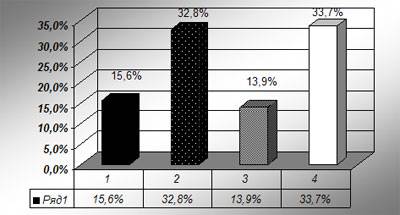
The number of convicts, which amounts to 15.6%, evaluate their actions that led to their conviction as being very dangerous (Fig. 1); 32.8% evaluate them as dangerous. 13.9% consider their own actions to be more dangerous than safe in relation to society, while 33.7% see no danger at all in the actions they committed.
FORMATION OF LEGAL CONSCIOUSNESS
73.9% of the individuals serving sentences believe that the amount of legal information they receive in the colony is sufficient to exercise their rights. In contrast, 26.1% are inclined to believe that this information is insufficient.
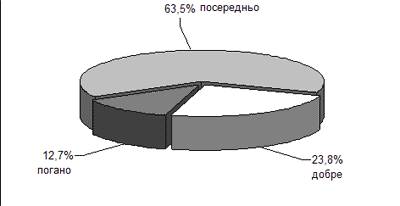
However, despite such a high percentage of respondents confident in the sufficiency of legal information, the assessment of their own knowledge level is not so unequivocal. Thus, at the time of serving their sentence, 23.8% (Fig. 2) of respondents evaluate their own legal knowledge as very good or good, while 12.7% possess very poor or poor legal knowledge. 63.5% of those surveyed rated their own legal orientation as moderate.
Fig. 2
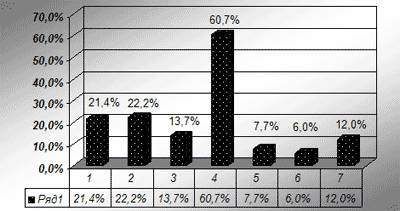
Knowledge of the law received by inmates is a significant tool for influencing their future legal behaviour, legal culture, and resocialisation. Therefore, the knowledge they receive should be presented from an appropriate angle and from appropriate sources. Today, minors most often receive information from colony staff – 60.7% (Fig. 3); 22.2% and 21.4% receive it from official sources (laws, codes, etc.) and mass media, respectively. A share of 13.7% accounts for sources whose carriers are other individuals serving sentences. Among those surveyed, there are also some (6%) who do not receive legal knowledge because they do not consider it necessary. 12% are pragmatically inclined and wish to receive legal knowledge, but do not know exactly where to obtain it.
Fig. 3
To the question: "Do you admit your guilt in committing the crime?", 91.8% of respondents answered in the affirmative, while 8.2% of convicts consider themselves innocent.
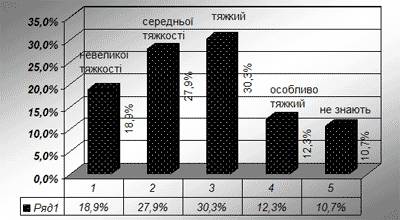
18.9% and 27.8% of those surveyed classified the degree of gravity of the crime they committed as of low and medium gravity (Fig. 4). Respondents making up 12.3% and 30.3% believe they committed grave and especially grave crimes. 10.7% cannot specify the degree of gravity of the crime for which they are serving their sentence.
Fig. 4
As the study showed, convicts are not sufficiently oriented in answering the questions: "Which official can initiate a review of a criminal case based on newly discovered circumstances?" and "Which service should citizens contact to resolve issues of employment, professional training, and retraining?".
To the first question, 55.7% gave the correct answer; all others, which amounts to 44.3% in total, believe that the head of the correctional facility, a police officer, or a lawyer initiates the review of a criminal case.
Answers to the second question were distributed as follows: 13.8% indicated the Service for Children's Affairs, 54.8% the State Employment Service, and 31.9% of respondents consider the Centre for Social Services for Family, Children, and Youth responsible for employment.
KNOWLEDGE OF PAROLE AND PARDON NORMS
We enquired whether the convicts of the Kovel Juvenile Correction Colony know about the possibility and procedure for parole. To this, 92.8% replied that they do know, while 7.2% do not possess information of such content. Such a percentage of responses, i.e., 92.8, is evidence of a fairly high level of awareness among those surveyed regarding criminal procedural law. To verify this assertion, we asked respondents to answer after what term of serving a sentence, provided there is conscientious behaviour, parole may be applied in their specific case? Thus, the distribution of answers formed the following picture: for 74.2% (Table 2), parole is applied after serving at least half of the sentence term; for 15.8%, at least two-thirds of the term; 1.7% will have the opportunity to be released on parole after three-quarters of the sentence has been served, and 8.3% were definitively unable to answer the question posed.
Table 2
| Application of parole | Number of responses, persons | Percentage of responses, % |
| Not less than half of the sentence term | 89 | 74.2 |
| Not less than two-thirds of the sentence term | 19 | 15.8 |
| Not less than three-quarters of the sentence term | 2 | 1.7 |
| I don't know exactly | 10 | 8.3 |
| Total: | 120 | 100.0 |
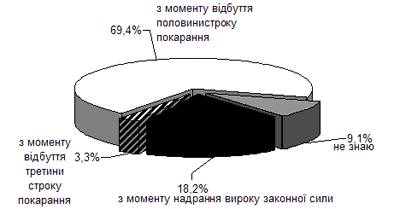
"From what moment does a person have the right to submit a petition for a pardon?" – is one of the questions posed to the convicts. 9.1% of those surveyed do not possess information about the application of such a norm (Fig. 5). 69.4% believe that a pardon petition can be submitted only from the moment half of the sentence term has been served. 18.2% consider it possible to submit a pardon petition from the moment the sentence enters into legal force, and 3.3% believe it can be done after one-third of the sentence term has been served.
Fig. 5
Also important for us is information on whether convicts know after what period, in the event of a petition being rejected, the possibility to submit it again arises. To this question, 61.7% answered as follows: after six months for especially grave crimes, after three months for other crimes; 20.8% answered after a year for especially grave, after six months for other crimes; and 10.3% believe that a repeated pardon petition can be submitted after two years for especially grave crimes, and after one year for other crimes.
RIGHT OF APPEAL AND CASSATION
Among the rights of a convicted person is the right to file an appeal against a court sentence. Thus, slightly less than half, 45.3% of convicts, filed an appeal against a court ruling, while 54.7% answered "no," they did not file an appeal.
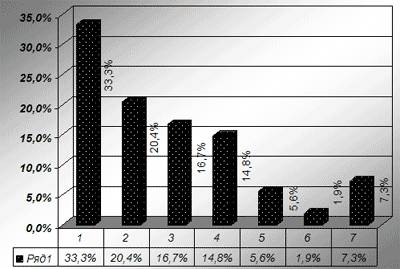
Among the reasons that motivated the convict not to file such an appeal were (Fig. 6):
- unwillingness to file an appeal – 33.3%;
- did not know how to do it – 20.4%;
- feared that it could lead to an increase in the sentence measure – 16.7%;
- the deadlines for filing an appeal had expired – 14.8%;
- were advised not to file – 5.6%;
- my appeal was not accepted by the pre-trial detention centre administration – 1.9%;
- your own variant – 7.3% (no funds, I was sentenced correctly, I am satisfied with the sentence term).
Fig. 6
Despite the fairly high percentage of refusals to file an appeal against a court decision, a significant part of those surveyed (95.9%) are well oriented regarding the deadline for an appeal, which is 15 days. And only 4.1% indicated that an appeal could be filed within six months from the moment the copies of the decision were handed over.
If the previous percentage of awareness was quite high, this, unfortunately, cannot be stated regarding the answers to the question: "What are the deadlines for a cassation appeal of an appellate court decision?". To this question, 54.3% answered that the cassation appeal period is six months; 30.5% indicated 1 month, and 7.6% each indicated two months and, respectively, one year.
RIGHTS OF CONVICTS
The internal regime for holding convicts provides for a number of their rights that must be realised directly by the convicts themselves while serving their sentences, but with the help and mediation of the correctional facility's management. Among such rights, it is worth noting the right to short- and long-term visits, the right to correspondence, and the right to phone calls. These are the rights that help an inmate of the colony not to lose contact with society. One of the questions in this block was: "How many short-term visits is a convict entitled to in a juvenile correction colony?". The main part, amounting to 88.8% of those surveyed, answered – one visit per month; and 5.6% each answered – two per month and one every three months.
A roughly similar picture is observed in the answers about the number of long-term visits. Where 81% of those surveyed indicated that such visits can take place with an interval of once every three months; 16.5% – once a month; 1.7% gave the answer – once a year, and 0.8% – two visits per year.
The possession of information by the respondents about the number of letters they have the right to receive and send forms the picture that 91.2% know that the number of letters is unlimited, 4.8% believe that their number is one letter per week. For 2.4% this figure is three letters per week, and 1.6% marked the answer ten letters per month.
As for phone calls, their maximum number per year is four. Such an answer to the question: "How many phone calls is a person in a juvenile correction colony entitled to?" was given by 76.3%; 14% indicated that a person has the right to one phone call per week, and 9.6% answered – two phone calls per month.
CONCLUSIONS:
1. The main part of the convicts of the Kovel Juvenile Correction Colony are individuals seventeen years of age. Their share amounts to 41.9%.
2. 52% of the inmates have an incomplete secondary education.
3. The vast majority of those surveyed, namely 67.5%, were registered with the criminal executive inspection prior to the moment of conviction.
4. 91.8% of respondents admit their guilt in committing the crime.
5. 73.9% of convicts consider the amount of legal information they receive in the colony to be sufficient.
6. The main carrier of legal information for the inmates is the colony staff.
7. 18.9% and 27.8% of those surveyed classified the degree of gravity of the crime they committed as of low and medium gravity. Respondents making up 12.3% and 30.3% believe they committed grave and especially grave crimes.
8. 54.7% did not file an appeal. Among the reasons that motivated the convict not to file such an appeal were: unwillingness to file an appeal; lack of knowledge on how to do it; fear that it could lead to an increase in the sentence measure; the expiration of deadlines for filing an appeal, etc.