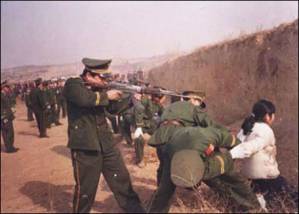
Amnesty International calls for lifting the veil of secrecy surrounding the death penalty
According to the published Amnesty International report, more than 1,200 people were executed in 2007. The organisation expressed deep concern that this number could be much higher, taking into account secret executions carried out in countries such as China, Mongolia, and Vietnam.
According to the report “Death Sentences and Executions in 2007”, at least 1,252 people were executed in 24 countries around the world; at least 3,347 people were sentenced to the death penalty in 51 states. It is estimated that at the moment, approximately 27,500 convicts are awaiting the execution of the death sentence worldwide.
The statistics indicate an increase in the number of executions in a number of countries. For example, at least 317 people were executed in Iran, 143 in Saudi Arabia, and 135 in Pakistan, whereas in 2006 these figures were 177, 39, and 82, respectively.
88% of all recorded executions were carried out in five countries: Iran, China, Pakistan, Saudi Arabia, and the USA. Saudi Arabia recorded the highest number of executions per capita, followed by Iran and Libya.
Amnesty International’s sources confirm at least 470 executions in China; and this is the highest figure compared to other countries. The actual number of executions in China is undoubtedly much higher.
China, leading the list of executioners in the world, classifies any information about the death penalty as state secrets. While the rest of the world and Olympic guests are left to guess, only the Chinese authorities know exactly how many people were killed at the behest of the state.
“Secret execution of death sentences must end: the veil of secrecy that surrounds the death penalty must be lifted. The governments of many countries claim that executions are carried out with public approval. This means that people have the right to know what is being done in their name,” Amnesty International stated.
In 2007, many countries continued to execute people for acts that are not generally recognised as criminal offences. Furthermore, convicts were executed following unfair trials. Such cases include, for example, the case of Jafar Kayani, a father of two children, who was stoned to death in Iran in July for adultery.
Another example: the case of a 75-year-old North Korean factory manager, who was executed by firing squad in October for concealing information about his family background, investing his own funds in the enterprise he managed, appointing his children to executive positions, and making phone calls abroad.
In November, an Egyptian citizen, Mustafa Ibrahim, was beheaded in Saudi Arabia on charges of sorcery.
In Texas (USA), Michael Richard was executed on 25 September. The state court refused to extend its working hours by an additional 15 minutes, which would have provided an opportunity to appeal the verdict on the basis of the question of the constitutionality of lethal injections. Richard’s lawyers failed to file the appeal in time due to computer problems they had already reported to the court, but the US Supreme Court refused to stay the execution. At the same time, earlier that day, the Court had agreed to review the issue of lethal injections in a case from Kentucky. This decision, in effect, imposed a moratorium in the country on carrying out death sentences by lethal injection. The Supreme Court is expected to announce its decision later this year.
In three countries – Iran, Yemen, and Saudi Arabia – convicts who had not yet reached the age of 18 at the time of the crime (i.e., they were minors) were executed, contrary to international law.
However, 2007 is also marked by the fact that the UN General Assembly voted for the cessation of the use of the death penalty. 104 countries voted in favour of the resolution, 53 against, and 29 abstained.
“The UN General Assembly made a historically significant decision to call on all countries of the world to stop executions. The fact that the resolution was adopted in December by such a clear majority of votes confirms the possibility of universal abolition of the death penalty,” Amnesty International is convinced.
“Taking a life by the state is one of the harshest measures in a government’s arsenal. We call on the authorities of all countries to comply with their obligations to the UN and abolish the death penalty once and for all.”