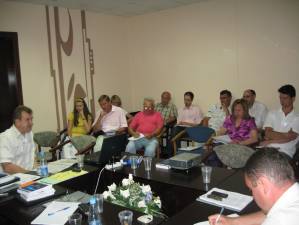
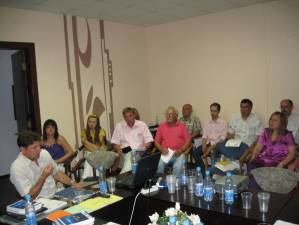
Prison monitoring training in Feodosia
On 07–09 July 2009 in Feodosia, ARC, the International Society for Human Rights – Ukrainian Section (ISHR-US) and the Euroclub ‘Law and Protection’ (Euroclub) conducted the first training within the framework of the OSCE Project Co-ordinator in Ukraine project ‘Prevention of Torture and Ill-Treatment in Places of Deprivation of Liberty’ (hereinafter – the Project).
The Project is aimed at researching the problems of organising a permanently operating system of public monitoring in the institutions of the State Criminal-Executive Service of Ukraine as a component of national preventive mechanisms for the prevention of torture and other cruel, inhuman, or degrading treatment and punishment.
Project activities cover: Donetsk, Zaporizhzhia, Kyiv, Lviv, and Kharkiv regions. The project implementation period is June–November 2009.
The project consists of four parts:
• Methodological part: preparation of a monitoring programme and instructions (regulations) for monitors—persons who will implement monitoring measures—as well as for the administration of the State Department for the Execution of Sentences (SDES) institutions.
• Training part: conducting a series of training sessions to prepare persons who will carry out monitoring visits and for representatives of the administration of SDES institutions.
• Monitoring part: conducting monitoring visits in accordance with the Regulations for the work of monitoring groups.
• Final part: analysis of monitoring information, preparation of recommendations, in particular regarding amendments to legislation; concluding conference.
The first training was dedicated to the presentation of the Project and the discussion of the methodology for conducting monitoring.
Participating as organisers, attendees of the first training, and experts on issues covered by the project were: the management staff of the State Department of Ukraine for the Execution of Sentences (SDES); leading specialists in the field of human rights compliance in the bodies of the Ministry of Internal Affairs of Ukraine; leading specialists of the Ministry of Justice of Ukraine; sociological scientists; employees of relevant regional departments of the SDES; and representatives of human rights non-governmental organisations that will carry out the project monitoring.
The Project was presented by the Chairman of the Board of the ISHR-US, Andriy Sukhorukov, and the Chairman of the Board of Euroclub, Volodymyr Bruschenko.
Andriy Sukhorukov emphasised the ideology of the Project: ‘The project should be implemented at a practical-scientific level, that is, be aimed at researching systemic problems of the criminal-executive service, rather than at identifying individual violations in individual institutions for the purpose of bringing specific officials to justice. Public organisations must help the bodies and institutions of the SDES find ways to solve systemic problems, in particular those that concern torture and ill-treatment of convicts.’
Volodymyr Bruschenko spoke about basic project activities and the technology of cooperation between regional project implementers.
Ihor Ivankov, head of the cycle of criminal-legal disciplines of the Chernihiv Juridical College of the SDES, acting as a trainer, in the introductory part spoke about the goals and tasks of monitoring groups (hereinafter – MG), the necessary regulatory and legal support for their work, and the system of visits to places of deprivation of liberty practiced in the countries of Europe and the USA.
Further, Ihor Ivankov organised a managed dialogue between SDES employees and NGO representatives on the following issues:
a) mechanisms for ensuring by the administration a specific right of a prisoner in a specific institution (for example, the right to protection from torture and inhuman treatment, the right to personal safety, etc.)
b) specifics of observing the rights of a prisoner who is a representative of a minority (for example, national, religious, ethnic minorities, migrants, sexual minorities, persons with physical disabilities, HIV-infected persons, persons with alcohol or drug addiction, etc.)
c) observance of the rights of persons located in special conditions of isolation (for example, persons in a disciplinary isolation cell, high-control section, cell-type room, etc.)
d) ensuring the rights of convicts during their contacts with the institution’s administration (conducting prisoner receptions, consideration of applications and complaints, etc.; the possibility to visit the medical unit and receive necessary assistance, etc.)
e) the possibility to visit the medical unit and receive necessary assistance
f) possibilities for observing basic human rights during measures implemented on legal grounds by special units on the territory of the institution (planned searches for the purpose of seizing prohibited items, suppression of mass unrest, etc.)
From Ihor Ivankov’s point of view, the work of the MG must take place exclusively within the limits of existing regulatory acts, in particular: international acts concerning the rights of prisoners, other international documents of a human rights nature, the Criminal Executive Code, normative acts of the SDES, internal rules of institutions, departmental orders, directives, instructions, etc. I. Ivankov outlined the following legal problem: ‘Today, the tasks of the criminal-executive legislation of Ukraine include, in particular: the protection of the rights, freedoms, and legitimate interests of convicts, providing assistance to convicts in social adaptation. The basic rights of convicts are legally enshrined, the participation of public associations in the work of institutions and bodies executing sentences is ensured, and the forms of their participation in the process of correction and resocialisation of convicts are defined. Social work and social assistance as components of social security for convicts in our country, in accordance with international requirements, are legally enshrined as an independent section of social policy. However, due to economic and organisational problems, social policy regarding convicts remains not fully implemented. At the same time, when resolving issues of bringing criminal-executive legislation into compliance with international legal acts, it should be taken into account that international acts are not normative acts of direct action; they must be appropriately transformed into national criminal-executive legislation.’
Maryna Herasymchuk, a representative of the Department of International Legal Cooperation of the Ministry of Justice of Ukraine, spoke about the status of consideration of the Draft Law on national preventive mechanisms for the prevention of torture and other cruel, inhuman, or degrading treatment and punishment (hereinafter – the Draft Law), which is currently at the stage of coordination with relevant central executive authorities for the purpose of sending it for consideration by the Verkhovna Rada of Ukraine.
The training facilitator, A.O. Sukhorukov, organised a meaningful discussion of the Draft Law. The training participants made the following main observations:
1) The Draft Law does not fully comply with the key requirements and principles of the Optional Protocol to the UN Convention against Torture and Other Cruel, Inhuman or Degrading Treatment or Punishment (shortened name of the Convention); 2) in accordance with the Draft Law, a new state body is being created—the National Committee of Ukraine for the Prevention of Torture, the main task of which is to prevent torture and other cruel, inhuman, or degrading treatment and punishment; however, it is proposed to grant the Committee the status of a state body, which, in the opinion of human rights defenders, contradicts the principles of functional, personal, and financial independence of the preventive mechanism from the executive branch; 3) the Draft Law requires improvement of the terminological apparatus; 4) it is necessary to make additions to the Draft Law regarding the activities of ‘mobile inspection groups’ (in particular, regarding their formation and practical activities), which, in accordance with the Draft Law, are entrusted with the operative verification on the ground of data on violations of the rights of persons located in state institutions of various levels of restriction or deprivation of liberty.
Oleh Martynenko (Doctor of Juridical Sciences, Head of the Human Rights Monitoring Department in the activities of the ATS of the Minister’s Apparatus of the Ministry of Internal Affairs) organised a discussion (questions and answers between ‘experts’—human rights defenders and SDES employees) using the example of mobile groups for monitoring the observance of human and civil rights and freedoms in the activities of internal affairs bodies on the procedure for compiling monitoring reports, the procedure for storing and disseminating information obtained through project monitoring, correct forms of cooperation with the media, etc.
In Oleh Martynenko’s opinion, the expediency of initiating the work of permanently operating monitoring groups in the institutions of the criminal-executive system of Ukraine is determined by the fact that mobile monitoring groups should soon become an element of the national preventive mechanism for preventing torture and ill-treatment, and the SDES would do better to develop its own experience in this matter. Systematic, managed, and well-organised visits to institutions with the participation of the public will also help solve a number of practical problems of convicts (detainees), ensuring their rights and proper conditions of detention, and resolving urgent problems of MIA employees, etc. For example, as a result of the mobile groups’ visits, the situation regarding detainees’ access to a doctor has improved in many MIA institutions; the assurance of providing information to close ones and relatives about the location of a detained person has increased; and first steps have been taken towards effective protection of detention centre workers from tuberculosis infection. The MIA is taking practical steps to improve the material base of detention centres, reception centres, and premises for detainees of the internal affairs bodies. The work of mobile groups in the system of internal affairs bodies was highly appreciated by the Commissioner for Human Rights of the Council of Europe T. Hammarberg, the UN Committee against Torture, and OSCE experts.
Olena Zlobina (Doctor of Sociological Sciences, Head of the Department of Social Psychology of the Institute of Sociology of the NAS of Ukraine) began by blitz-interviewing those present on the topic ‘What do you expect from conducting questionnaires and interviews in the environment of convicts and SDES personnel?’ The main problem of this process, Olena Zlobina considers to be the creation of a correct, high-quality questionnaire, which will make it possible not only to clarify the factual state of human rights compliance in relevant institutions but also to reveal the causes of their possible violations. Also, a difficult task is conducting a truly representative study: ‘The "pilot" nature of the Project does not exempt the implementers from thoroughness and correctness in sociological research,’ Olena Zlobina noted.
Yevhen Kupriyenko, Senior Inspector of the Department for Organisation of Social and Educational Work of the Office of Social-Educational and Psychological Work of the SDES (by request), spoke in the final part of the Training. He noted that the support for the Project on the part of the State Department of Ukraine for the Execution of Sentences, in his opinion, is not formal. The SDES, in particular the Office of Social-Educational and Psychological Work, intends, in accordance with the decisions of the Department’s leadership, to actively facilitate the implementation of project measures in the five selected regions, in particular, they will ensure the access of monitoring groups to the penal institutions, will participate in the work of the MG, will coordinate monitoring materials, and will consider its results.
A feature of the Project and, accordingly, the conducted training is that its implementers hope to lay the foundations for creating a system of public monitoring in institutions for the execution of sentences as a component of national preventive mechanisms for the prevention of torture and other cruel, inhuman, or degrading treatment and punishment.
Report prepared by: V. Bruschenko and A. Sukhorukov.
P.S. The organisers of the Training are sincerely grateful to the monitor from Kharkiv, H. Maryanovsky, and guests O. Bukalov (Donetsk ‘Memorial’) and L. Koval (KHPG) for their extraordinary and useful activity during the discussion of problems at the Training.