Crimes of Ukrainian Internal Affairs Officers: Analysis of Stable Trends
The principle of the rule of law with respect to the activities of law enforcement bodies of the state means the performance by law enforcement officers of all without exception requirements of the law and the actions of any official only on the basis of the law. However, even in the practice of European countries, this principle is not fully observed due to a large number of factors, which leads to numerous "deviations" in the compliance with the requirements of the law by law enforcement officers, violations of human rights during the performance of their official duties. This tendency, unfortunately, fully applies to the bodies of internal affairs of Ukraine.
As was established by a number of domestic studies, the dynamics of the general level of crimes committed by internal affairs personnel generally correspond to the patterns according to which the crime rate changes on the territory of Ukraine [1, 2]. This correlation generally maintains its trend, except for 2006–2008, when the number of convicted internal affairs officers increased as a result of active measures by the Ministry of Internal Affairs of Ukraine to counter these negative phenomena (Fig. 1):
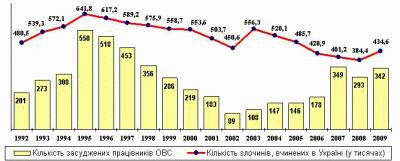
Fig. 1. Comparative analysis of the dynamics of the number of crimes committed in Ukraine in general and convicted internal affairs officers in the period 1992–2009.
As can be seen from the data presented, during 2007–2009 there was a sharp increase in the number of convicted officers on average by 84 per cent compared with 2006, first and foremost due to officers working in Kyiv (75 persons), Dnipropetrovsk (72 persons), Kharkiv (53 persons), Kherson (48 persons), Sumy (41 persons), Odesa (36 persons), Lviv (34 persons), Chernihiv (35 persons) regions and the Autonomous Republic of Crimea (38 persons).
The largest number of internal affairs officers brought to criminal responsibility during 2007–2009 accounts for the criminal investigation service, district police inspectors, investigative departments, public order protection, combating the illegal circulation of drugs, and traffic police. At the same time, among convicted internal affairs officers, representatives of the age category under 30 years predominate (61.2 per cent of the total number of convicted officers) and with a length of service in the internal affairs bodies of up to 10 years (58.9 per cent).
In total, during the period from 1992 to 2010 in Ukraine, more than 9,626 criminal cases were initiated based on facts of unlawful actions of internal affairs officers, as a result of investigation of which courts handed down convictions against 4,999 persons. To other types of responsibility for committing non-criminal offences during the same period, 33,612 officers of various services and departments of the internal affairs bodies were brought to responsibility. As of 1 January 2010, 1,333 criminal cases concerning 1,492 officers were under investigation by prosecutorial bodies.
The share of crimes among internal affairs personnel during the period from 1992 to 2010 remains relatively low and amounts to 11 crimes per 10,000 persons compared to the similar indicator for Ukraine as a whole: 97.7 crimes per 10,000 persons.
A comparison of the overall dynamics of the number of official and general criminal crimes committed by internal affairs officers confirms an increase in the share of precisely crimes in the sphere of official activities, the number of which in 2009 was 3.8 times greater than the number of crimes of a general criminal nature (Fig. 2):
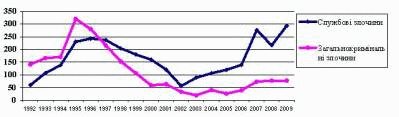
Fig. 2. Dynamics of the number of official and general criminal crimes in the internal affairs bodies
An analysis of the structure of crimes committed by internal affairs personnel in the sphere of official activities during 2002–2009 makes it possible to establish the prevalence of facts of bribery, exceeding official authority and abuse of official position (Fig. 3).
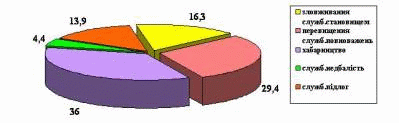
Fig. 3. Share (in per cent) of individual types of crimes committed by internal affairs personnel during 2002–2008 in the sphere of official activities
According to materials from judicial practice, official crimes are most often committed directly during the performance of duty and in 68 per cent of cases in official premises. The overwhelming majority of those convicted of official crimes are persons under 30 years of age – age categories from 20 to 25 years and from 25 to 30 years (25.3 per cent and 32.6 per cent respectively).
In the structure of general criminal crimes, the most numerous are traffic accidents (22.2 per cent), whose share significantly exceeds the indicators of registered cases of causing bodily injury and committing thefts – 8.6 per cent and 6.7 per cent respectively (Fig. 4).
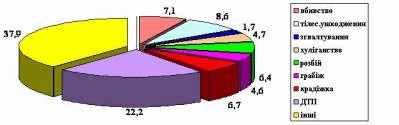
Fig. 4. Share of individual types of crimes in the structure of general criminal crime by internal affairs personnel during 2002–2009.
It is noteworthy that quite a "non-transparent" category of crimes, marked in departmental statistics as "other", whose share amounts to more than one-third (37.9 per cent) of all crimes of a general criminal nature. This category includes the number of persons convicted of committing crimes against life and health (including torture), against freedom, honour and dignity of a person, against the rights and freedoms of a person and citizen, against property, against public safety, against the safety of movement, etc.
Among all types of crimes committed by officials of the internal affairs bodies, the category of torture today attracts the most attention from international experts and domestic specialists, as it is a kind of indicator of law enforcement bodies' adherence to the principle of the rule of law. Attempting to give a criminological assessment of the prevalence of cases of torture in the law enforcement activities of the internal affairs bodies of Ukraine, we must state that their small number is recorded in the forms of statistical reporting. So, by the prosecutor's bodies during 2002–2009, only 16 criminal cases were opened against internal affairs officers under Article 127 of the Criminal Code of Ukraine (Torture):
Table 1
Number of criminal cases under Article 127 of the Criminal Code of Ukraine (2002–2009)
|
| 2002 | 2003 | 2004 | 2005 | 2006 | 2007 | 2008 | 2009 |
| Cases pending investigation | 1 | 1 | 1 | 6 | 11 | 12 | 15 | 16 |
| – of which opened in the current year | 0 | 0 | 0 | 5 | 5 | 2 | 4 | 1 |
| – closed on exonerating grounds | 0 | 0 | 0 | 0 | 0 | 2 | 4 | 2 |
| Persons convicted | 0 | 0 | 0 | 0 | 0 | 2 | 3 | 3 |
These figures are not cause for complacency for several reasons. First, the study of analytical reference materials shows that quite a significant number of unlawful actions of internal affairs officers related to the application of torture and cruel treatment become artificially latent through their inadequate classification by prosecutorial bodies. Second, there is a consistent judicial practice according to which actions of internal affairs officers related to the unlawful application of physical force measures, beatings and other forms of cruel treatment are predominantly classified under only two articles of the Criminal Code – Article 364 (Abuse of power or official position) and Article 365 (Exceeding authority or official powers). In fact, selective examination of criminal cases concerning unlawful actions of law enforcement officers involving the application of physical force showed that the courts in at least 22.2 per cent of cases "overlook" when delivering verdicts the elements of the crime provided for under Article 127 of the Criminal Code of Ukraine.
For example, there was a resonant case when on 1 October 2008, in the first half of the day in the city of Prylucky, Chernihiv region, officers of the Department for Combating Organised Crime detained Citizen M., who was subsequently taken to Nizhyn, Chernihiv region. In the premises of Nizhyn city district police department, Senior Lieutenant of Police N. and Senior Lieutenant of Police S., intentionally acting beyond the authority granted to them, applied violence to M. for the purpose of obtaining a confession to committing crimes (emphasis added by author). On 27.01.2009 the prosecutor's office of Chernihiv region opened a criminal case against operatives N. and S. only under Article 365, Part 2 of the Criminal Code of Ukraine.
The elimination of such negative practice was at one time specifically addressed by the Plenum Resolution of the Supreme Court of Ukraine "On Judicial Practice in Cases of Exceeding Authority or Official Powers" No. 15 of 26 December 2003, however, stereotypes of judicial logic prove stronger than the requirements of official documents.
Taking into account the above, even with a small volume of criminal cases opened under Article 127 of the Criminal Code of Ukraine, it is deemed appropriate to take into account all elements of crimes which may have potential relation to the application of torture. In this regard, we must take into account at least four such categories: intentional murder, causing bodily injury of varying degrees of severity, abuse of power and exceeding authority. The share of these crime elements according to statistical data for 2002–2009 amounts to 43.5 per cent of the total number of convicted internal affairs officers (Fig. 5):
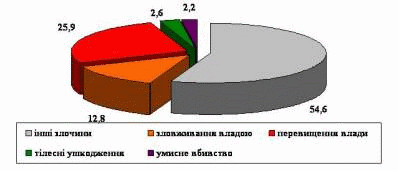
Fig. 5. Share of internal affairs officers brought to criminal responsibility for actions that may be related to torture and cruel treatment
To this aggregate, it is advisable to add the number of internal affairs officers brought to disciplinary responsibility for committing offences, which may also indicate signs of applying cruel forms of treatment towards detained and arrested persons. This, above all, includes such violations of discipline and legality as unlawful methods of conducting investigation, unlawful application of special means, unlawful actions with respect to detainees, as well as unlawful administrative detention and unlawful bringing to administrative responsibility, unlawful arrest and unlawful bringing to criminal responsibility. The share of personnel who committed these offences, unlike the category of crimes, amounts to only 6.1 per cent (986 persons) of the total number brought to disciplinary responsibility (16,196 persons) during 2002–2009. Under stricter selection criteria, if we take into account only facts of unlawful methods of conducting investigation, unlawful application of special means and unlawful actions with respect to detainees, the share of such persons is only 0.4 per cent (64 persons).
Taking these points into account, it is possible to compile an approximate picture of the so-called "risk zone", that is, the potential volume of identified unlawful and illegal actions of internal affairs officers which have direct relation to the practice of applying torture and cruel forms of treatment (Table 2):
Table 2
Number of internal affairs officers brought to criminal and disciplinary responsibility for actions that may be related to torture and cruel treatment
|
| 2002 | 2003 | 2004 | 2005 | 2006 | 2007 | 2008 | 2009 |
| Total convicted for crimes committed | 89 | 108 | 147 | 146 | 178 | 349 | 293 | 342 |
| – including for: |
|
|
|
|
|
|
|
|
| intentional murder | 3 | 1 | 7 | 4 | 1 | 8 | 5 | 4 |
| bodily injury | 5 | 4 | 9 | 2 | 0 | 7 | 7 | 5 |
| abuse of power | 7 | 16 | 21 | 19 | 17 | 47 | 41 | 41 |
| exceeding authority | 34 | 39 | 51 | 34 | 43 | 79 | 59 | 65 |
| Total disciplined for violations of legality | 1649 | 2061* | 2814 | 1451 | 1366 | 1474 | 2090 | 3291 |
| – including for: |
|
|
|
|
|
|
|
|
| unlawful methods of conducting investigation | 6 | 1 | 1 | 0 | 0 | 3 | 0 | 2 |
| unlawful application of special means | 7 | 3 | 1 | 5 | 1 | 0 | 6 | 1 |
| unlawful actions with respect to detainees | 1 | 0 | 0 | 13 | 0 | 5 | 0 | 9 |
| unlawful administrative detention | 21 | 25 | 31 | 27 | 3 | 25 | 15 | 61 |
| unlawful bringing to administrative responsibility | 20 | 34 | 74 | 56 | 34 | 75 | 56 | 210 |
| unlawful arrest | 0 | 0 | 1 | 2 | 1 | 3 | 1 | 3 |
| unlawful bringing to criminal responsibility | 6 | 5 | 27 | 16 | 44 | 21 | 8 | 16 |
* – data for 10 months of 2003
When assessing the prevalence of torture in the activities of practical divisions of the internal affairs bodies, one cannot overlook an analysis of complaints, reports and grievances by citizens regarding unlawful actions of internal affairs officers. It should be noted at once that departmental forms of statistics of the Ministry of Internal Affairs of Ukraine continue to remain rather imperfect from the point of view of accountability to society. Complaints by citizens, after being recorded in the departments of the Department of Documentation and Regime, are reviewed by workers of other departments and services with the adoption of appropriate decisions, which are recorded both in these services and in the general ministry reporting. However, it is now impossible to track such obvious things as the correspondence of the number of complaints about individual actions of internal affairs officers to the number of decisions taken on these categories of complaints. The reason is different categories of records used by departments and services, as well as the elementary absence in the record-keeping registers of the Ministry of Internal Affairs of Ukraine of such categories of citizen complaints as "torture", "beating and rough treatment", "unlawful methods of conducting investigation", and so on.
For precisely these reasons, the analysis of complaints and appeals by citizens is rather fragmentary, but it makes it possible to determine the following. Of the total number of complaints received by the internal affairs bodies regarding unlawful actions of internal affairs officers, on average 7.8 per cent are accounted for by facts of beating and causing bodily injury. Reports of facts of torture constitute a significantly smaller part – 1.3 per cent of the total number of citizen complaints. On average, with the exception of individual years, only 9.2 per cent of all citizen complaints find confirmation.
The total number of citizen complaints is also influenced by the fact that in a number of cases improper conduct by an internal affairs officer finds support from citizens and even from relatives of victims.
Thus, a senior district police inspector of the Irshan municipal police department of the Volodymyr-Volynskyi District Office of the Ministry of Internal Affairs of Ukraine in Zhytomyr region B. on 27 July 2005 at around 02:00 hours in the municipal police department premises interrogated the victim K. in connection with the commission of a burglary in Irshan. The court established that B. "… in order to obtain a confession to committing a burglary … applied prohibited and inappropriate in this situation methods of physical force and special means, dealt the detainee … numerous blows with his hand to the head and with a rubber baton to the buttocks, in order to obtain a self-incriminating confession by the victim, thereby causing K. substantial damage to her rights and interests protected by law".
According to the defendant's account, he indeed, when the victim did not admit her involvement in the commission of the burglary and attempted to leave the official premises, dealt the victim 2 blows with a rubber baton to the buttocks and pushed her onto a chair, as a result of which K. struck her head against the wall. On the same day in the morning, when K.'s non-involvement in the commission of the burglary was established, B. invited her mother to the department and informed her of the reasons for her daughter's presence in the department. At the same time, B. also informed her that K. was in close relations with her acquaintance. Offended by her daughter, the mother arbitrarily seized a rubber baton from the table and dealt her daughter several blows [3].
In addition, the cited case clearly demonstrates the discrepancy between the purpose and methods of committing the crime established in the judicial process, which indicate the elements of the crime provided for under Article 127 of the Criminal Code (Torture), and the court's classification of these actions as exceeding authority, that is, under Article 365 of the Criminal Code of Ukraine.
The above considerations regarding the criminological assessment of unlawful actions of internal affairs officers are clearly to be the subject of further discussion and initiate research in the field of human rights compliance. In this regard, the author places great hopes on young scholars whose dissertation research is devoted precisely to these problems.
List of Sources
1. Monitoring of Unlawful Violence in Bodies of Internal Affairs of Ukraine / KHSD. – Kharkiv: Human Rights, 2010. – 192 pp.
2. Ignatov Oleksandr Mykolaiovych. Prevention of Violent Crimes Committed by Officers of Bodies of Internal Affairs of Ukraine: Thesis for Candidate of Juridical Sciences: 12.00.08 / Kharkiv National University of Internal Affairs. – Kh., 2007. – 239 pp.
3. Verdict of the Chernyakhiv District Court of Zhytomyr region in Case No. 1-16/147 of 16 June 2007.