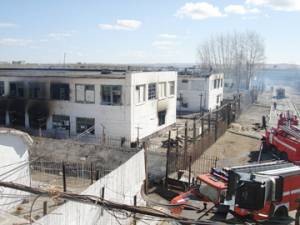
Circumstances of the riot
The burnt-out colony was inspected personally by the Director of the FSIN of Russia, Alexander Reymer. By his decision, five officers, including the head of IK-10, Alexander Ryabko, were dismissed from the penitentiary system. The remaining officers were demoted or received reprimands. The head of the Zabaykalsky FSIN, Vladimir Niketeyev, also received a warning about incomplete official compliance.
A team from the central apparatus of the penitentiary service spent three days conducting an internal investigation into the fire, which destroyed almost the entire ‘ten’ (colony No. 10). ‘A number of violations of job descriptions and miscalculations in work were identified, which, in particular, provoked the situation at IK-10,’ stated the head of the press bureau of the FSIN of Russia, Alexander Kromin.
Kromin did not clarify what these miscalculations were, or which specific instructions were violated, or what led each officer to be punished.
At the same time, the Prosecutor’s Office of the Zabaykalsky Krai has reconstructed the picture of the riot. The prisoners had been preparing for the pogrom for two days. They assigned roles and split into groups. Immediately before the arson, they covered the windows with blankets so that the administration staff would discover the fire as late as possible. There were about ten organisers among the prisoners. The investigation is not yet finished. However, according to investigators, the primary cause of the incident was the ‘desire of the convicts to disorganise the activities of the colony administration.’ Other reasons have not yet been named.
The Zabaykalsky Krai FSIN reports that the situation in the colony is now calm, there are no deaths or injuries, and a commission has been created whose main concern is the food and housing of the prisoners.
However, there is other information. The mother of one of the prisoners was there for a visit during the riot. She recounts that after the fire, all the prisoners were driven onto the parade ground, stripped, forced to lie flat on the asphalt, and then the FSIN staff began beating them, jumping on their bodies, and setting service German shepherds on them. This is confirmed by prisoners from the ‘ten’ who have been transferred to other colonies in the region. Many of them are severely beaten and are being held in isolation units. This is despite the fact that, according to FSIN staff, the instigators of the riot remained on the territory of the burnt-out colony.
For Zabaykalsky human rights defenders, the riot at the ‘ten’ did not come as a surprise. ‘The situation in the regional colonies began to deteriorate sharply at the beginning of this year,’ says the head of the Zabaykalsky Human Rights Centre, Vitaly Cherkasov, who himself is a former FSIN employee. In January, reports began to arrive from prisoners at IK-5 and IK-3 about ‘preventive raids’ by special forces, during which prisoners were beaten. Moreover, the prosecutor’s office, which is legally required to accompany such raids, knew nothing about them. Then there was a hunger riot at IK-10, which was suppressed by the same special forces.
‘I met with the head of the Zabaykalsky FSIN, Niketeyev, twice,’ says Cherkasov. ‘I asked him to let us into the colony grounds. I assured him that we were not planning to smear the system. We simply wanted to verify the information we were receiving. However, I was refused. Therefore, it is very important now that an independent commission from the Civic Chamber of the Russian Federation participates in the investigation. After all, the “official” human rights defenders in the regions, for example those attached to the FSIN, usually only voice official versions.’
However, FSIN representative Alexander Kromin believes that Cherkasov’s demand has no basis. ‘The head of the Buryat Public Council under the FSIN has already visited the colony, as well as a representative of the Human Rights Ombudsman in the Zabaykalsky Krai. We see no need for other human rights defenders.’