Women's Correctional Colonies of Ukraine
In all penitentiary systems, women constitute a minor portion of the incarcerated population. As men make up the vast majority of prisoners, the prison system is designed specifically for them. Prisons are built for men and are often practically unsuitable for meeting the needs of women. Despite the small number of incarcerated women, their detention is associated with a series of problems that the prison administration is obliged to address.
Are Ukraine's women's correctional colonies well-adapted for women specifically? What are the conditions of detention within them, and what problems require resolution?
It is quite difficult to provide objective answers to these questions for two reasons.
The first reason is that research into various aspects of the operation of penal institutions in Ukraine is almost non-existent; there is no structure or institution that systematically investigates the situation, develops recommendations and proposals, or produces generalizations and conclusions. The last known serious study on the conditions of detention and other aspects of women's incarceration was conducted over ten years ago (in 2001).
Subsequent research conducted by the department and its results have not been made public, making it impossible to assess their quality and reliability. It is also impossible to evaluate their impact on the situation in places of deprivation of liberty and their effectiveness.
The second reason is that the administration of women's correctional colonies (as, indeed, with any institution) is usually focused on describing the achievements and positive aspects of their colonies, for it is quite natural to speak primarily of what one can be proud of. Difficulties and problems often remain in the shadows, out of focus.
Some rather interesting information regarding women in detention, provided by the penitentiary service, is contained in the article "Some Aspects of the Organization of Correctional Colonies for Incarcerated Women," which is included in this publication.
"Donetsk Memorial," within the framework of the project "Improving the Level of Observance of Incarcerated Women's Rights," conducted a survey of all women's correctional colonies in Ukraine and obtained a series of data that provides a fairly general idea of the detention conditions in the colonies. It is interesting to compare them with those contained in the aforementioned article by the State Penitentiary Service of Ukraine.
Certain difficulties in the research arose as early as the information collection stage. A request was sent to all women's correctional colonies in February 2012. No more than a third of the institutions provided responses immediately. It was necessary to appeal three times, and in some cases even more, to persuade them to provide the requested data, as well as to involve the leadership of the department to obtain the information in full.
The process of collecting information highlighted significant problems in the attitude of the administration of many institutions towards complying with the requirements of the Law of Ukraine "On Access to Public Information."
It is worth noting that the favorable position of the leadership of the State Penitentiary Service of Ukraine facilitated the receipt of data. Some institutions attempted to create the impression that they had provided responses, but it seemed that the provision of answers was merely simulated. It is likely that the responses were either not prepared at all or had been prepared and even registered, yet were not actually sent. Two institutions initially responded that they could not provide the information because it was confidential.
Only in September—after an interval of 7 months—was it possible to collect the data which are presented in the table.
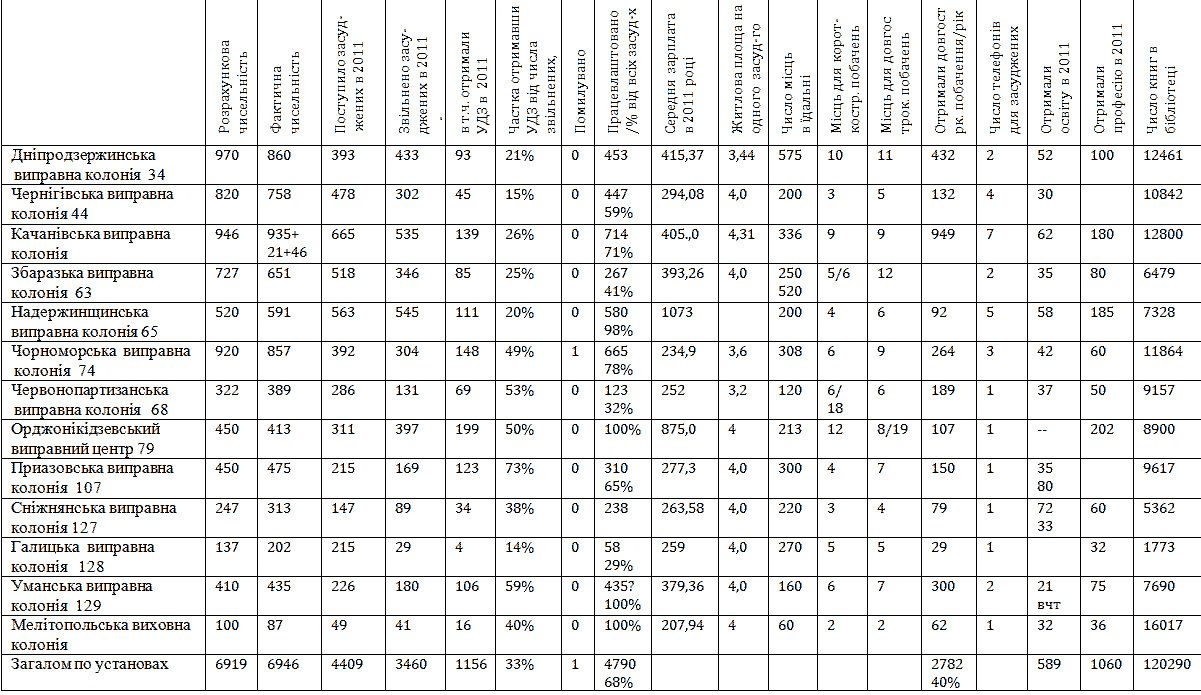
(click on the table to enlarge)
Women sentenced to deprivation of liberty in Ukraine are held in 12 penal institutions for adult women and one educational colony for minors. Their locations are shown in Figure 1.
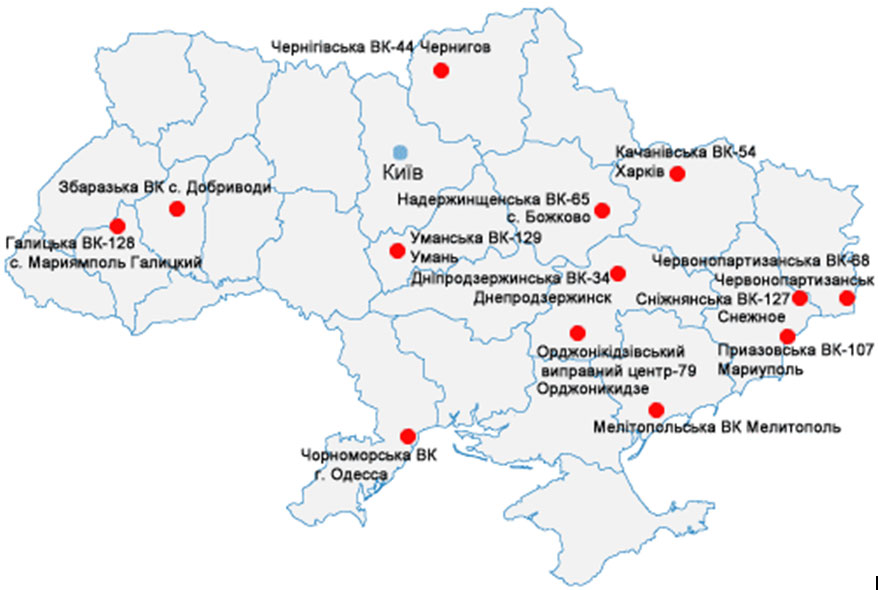
Two colonies for adult female convicts have Infant Homes—in Odesa and Chernihiv. As of mid-2012, 108 children under the age of three were being held there.
In the Melitopol Educational Colony for girls, there are 94 convicts, 44 of whom are minors (under 18 years of age). The country's legislation allows, if deemed appropriate, for persons up to 22 years of age to be kept in educational colonies.
The estimated capacity of the 12 institutions for adult women, as follows from the obtained data, is 6,919 persons; as of March 2012, 6,946 women were actually being held there. As of 1 July 2012, their number reached 7,161. Another 665 convicted women, according to the State Penitentiary Service, were in pre-trial detention centers.
The occupancy rate of most colonies is close to 100%—ranging from 92% to 106%. However, the minimum occupancy is 89% (Dniprodzerzhynsk CC-34), and the maximum is 147% (Halytska CC-128).
In 2011, 4,409 women were admitted to penal institutions, and 3,460 were released. Thus, the number of women serving sentences in places of deprivation of liberty grew during 2011 by almost a thousand people, or by 14%.
1,156 women were released on parole—33% of the total number of those released during the year. At the same time, in different colonies, the share of women released on parole ranges from 14% to 73%. One woman was granted a pardon in 2011.
According to the Penal Code, living space of 4 sq. m. must be provided for each person. According to data obtained from the colonies, this standard is met in eight institutions. The lowest figure is 3.2 sq. m. per person—in Chervonopartyzanska CC-68.
An important indicator is the extent to which convicts are engaged in work. This level ranges from 29% in Halytska CC-128 and 32% in Chervonopartyzanska CC-68 to almost 100% in Umanska CC-129, Naderzhynshchynska CC-65, and Ordzhonikidzevskyi Correctional Centre-79.
Overall, across all institutions of the penitentiary service, out of 118,909 convicts, the number of able-bodied individuals is 74,327. 31,254 people are engaged in work—26.3% of the total number of convicts (this accounts for 42% of the able-bodied), whereas in all women's colonies, this percentage is 69%.
The average earnings of convicted women in 2011 in 10 colonies ranged from 234 UAH to 415 UAH. In the educational colony, the average earnings in 2011 were 208 UAH. Across all institutions of the penitentiary service, the average salary was 327.39 UAH in 2010, and 383.6 UAH in 2011.
Exceptions to this picture are the Naderzhynshchynska CC-65, where 98% of convicts are employed, and the average earnings in 2011 were 1,073 UAH, and the Ordzhonikidzevskyi Correctional Centre No. 79, where the average earnings were 875 UAH.
The cost of maintenance for convicts, which an institution is entitled to deduct from their earnings, is within the range of 200–250 UAH. This means that to a large extent, the funds earned by convicts are barely enough to cover their own maintenance in the colony, and in the best case, only a few dozen hryvnias can be transferred to the personal accounts of working women, or up to a hundred hryvnias at most.
Conditions of detention for convicted women
To characterize the conditions of detention for women, only a few indicators (characteristics) were chosen. These are the number of seats in the canteen, the number of places for short-term and long-term visits, the number of long-term visits received during the year, the number of telephones in the institution, and the number of books in the library.
The number of seats in the colony canteens ranges from 120 to 570 and is 1.5 to 3 times less than the number of convicts in the colonies. This means that the convicts eat in 2–3 shifts.
The number of premises for visits in the institutions allows for providing short-term visits for 3 to 12 people simultaneously, and long-term visits for 4 to 12 people. During 2011, long-term visits in different colonies were received by between 29 people, or 15% of the number of incarcerated women in the institution (Halytska CC-128), and 949 women, or 95% (Kachanivska CC-54).
Five colonies have only one telephone for convicts to make calls. Up to 413 women serve sentences in these colonies (Ordzhonikidzevskyi Correctional Centre No. 79), and even up to 475 convicted women (Pryazovska CC-107). However, despite the possibility to call without restrictions, reports from women about problems in gaining access to telephones are unknown.
In 2011, between 20 and more than 100 women in each colony received education, and between 30 and 200 women in each acquired a profession.
The library stock of the institutions ranges from 5,326 books to 12,800 copies (from 10 to 25 books per convicted person).
The listed characteristics are not definitive or the most important, but they provide an idea of what conditions have been created in the colonies for women in the sphere of contact with the outside world and what their opportunities are for maintaining socially beneficial ties.
A more complete picture of each of the institutions for women can be formed from their descriptions, provided to "Donetsk Memorial" according to a proposed scheme. The scope of information provided was determined by the institutions themselves.
Description of penal institutions for women
Dniprodzerzhynsk Correctional Colony No. 34
Dnipropetrovsk Region, 51912
Dniprodzerzhynsk, 214 Dimitrova St.
Phone: 05692-2-03-28; Fax: 05692-2-02-75 E-mail: dvk.org.ua
Head of the institution: Iryna Yuriivna Bobrova
Date of establishment: 10 October 1992
Capacity of the colony: 970
Actual number of prisoners in the colony as of 01.03.2012: 860
The canteen of the institution can accommodate 575 people at one time.
10 people can receive short-term visits at one time, and 11 people can receive long-term visits.
During 2011, 432 women had long-term visits.
The living space per incarcerated person is 3.44 sq. m.
The institution provides the necessary living and domestic conditions for convicts, which comply with sanitary and hygienic rules. Each woman is provided with a sleeping place and bedding according to the norms of entitlement.
Convicts are housed in barracks-type living premises, equipped with centralized heating from a gas boiler room, provided with water supply, sewage facilities, toilets, and utility rooms (a drying room for clothes and footwear, a storage room for personal belongings, a dining room, and a relaxation room).
The living premises are located in two four-storey dormitories, divided into 10 sections. To improve the communal and domestic conditions of the convicts, in addition to routine repairs, the premises of two sections were refurbished, where barracks-style living was replaced by a room-based system. The old heating system was replaced with modern materials in both dormitories. Major repairs were carried out on the roof of the dormitories, the production building, and the canteen-club. The shop for convicts, the canteen, the visitation room premises, the bath and laundry complex, and the reception area for newly arrived convicts were renovated and refurbished in a modern style. Work was carried out to install windows manufactured using modern technologies in the long-term visitation rooms, in the library for convicts, and in some premises of the socio-psychological service sections.
In 2006, a new building was commissioned, housing the duty unit and other premises of the supervision and security department. On the territory of the residential zone, there is a medical facility for convicted women suffering from dermatovenereological diseases: a polyclinic and inpatient premises, designed for 15 patients. In case of need, sick convicts are taken to city hospitals and special medical institutions of the State Department.
To provide telephone calls for convicts, there is one landline and one mobile phone.
All convicts preparing for release from the institution for various reasons attend classes at the school for preparing convicts for release, which was created by order of the head of the institution. Employees of various departments of the institution, representatives of the Dniprodzerzhynsk Employment Center, the Center for Social Services for Youth, the passport office, the supervisory commission, etc., are involved in conducting the classes. In close cooperation with state and public organizations, issues of assistance to those being released regarding domestic settlement, as well as the provision of advisory and other targeted assistance, are resolved.
The institution operates classes with an evening form of study. Lessons are conducted by teachers from secondary school No. 31 of Dniprodzerzhynsk. During the 2011–2012 academic year, 38 convicts received certificates of secondary education, 14 received certificates of general basic secondary education, and 28 received certificates of complete general secondary education.
A vocational school has been opened in the institution, where 100 convicts annually acquire the professions of seamstress, cook-confectioner, cutter, and florist.
All convicts in the colony, without exception, are involved in differentiated education. The institution has created conditions for the observance of religious needs by convicts and the conduct of spiritual and educational work with them. On the territory of the institution, a place has been set aside for the construction of an Orthodox church.
Interest clubs have been created at the institution's club: "Health Group," "Vocal," "Drama," "Choreography," "Applied Arts," and "Aerobics."
A psycho-emotional relaxation room has been set up for convicts in the institution, equipped with a color television, a video recorder with a selection of videos, an acoustic system providing a quadraphonic effect, a slide projector, stereo headphones, and an air conditioner. In the psycho-emotional relaxation room, the institution's psychologists conduct psychotherapy and relaxation sessions, teach psychosomatic self-regulation skills, and the convicts, in turn, have the opportunity to be in silence alone, listen to music, and communicate with a psychologist.
As of 01.03.2012, 453 women are employed in the colony; their average monthly salary is 415.37 UAH.
In 2011, 52 convicts received certificates of complete secondary education and 100 received certificates of professional qualification.
The colony library has a collection of 12,461 items, consisting of legal, educational, and fiction literature.
During 2011, 393 convicted women arrived at the institution, and 433 women were released, including 93 people who received parole; none were pardoned.
Work with state and public organizations has been established in the institution:
- the supervisory commission of the Zavodskyi District Executive Committee of Dniprodzerzhynsk, which participates in the meetings of the commission on the application of benefits to convicts and exercises public supervision over those released;
- the Museum of City History;
- the "Women's Information and Coordination Center," which participates in work on the resocialization of women serving sentences;
- the Dniprodzerzhynsk City Employment Center, representatives of which participate in the work of the school for preparing convicts for release;
- the City Center for Social Services for Youth, which conducts group consultations and conversations, invites doctors from the city family planning center, psychologists, and lawyers to give lectures, organizes cultural and mass events, and carries out social accompaniment of those released;
- the Center for Social and Legal Assistance to the Population, which conducts lectures and provides consultations to convicts;
- the "Resurrection" Charitable Foundation, which organizes and conducts campaigns and participates in preparing convicts for release;
- Representatives of the Ukrainian Orthodox Church.
CHERNIHIV CORRECTIONAL COLONY No. 44
14014 Chernihiv, 38 Promyslova St.
Tel: 662-100 Fax: 662-100
Head of the institution: Andrii Ivanovych Kyriienko
The institution is designed for 820 convicts. The number of convicts as of 25.02.2012 is 758.
During 2011, 478 convicts arrived at the institution, and 302 convicts were released, including 45 who received parole; there were no pardons. The institution's canteen can accommodate 200 convicts at one time. Three convicts can receive short-term visits at one time, and five convicts can receive long-term visits. During 2011, 132 convicts had long-term visits. The space per convict is 4 sq. m. The colony has four telephones for providing telephone calls to convicts.
All convicts are employed, except for the disabled, pensioners, mothers with children, and pregnant women.
Convicts who do not have complete secondary education study at Chernihiv Evening School No. 1 at the institution.
The institution operates a club, a library, and clubs. As of 25.02.2012, 447 convicts are employed in the institution's production, and their average monthly salary is 294.08 UAH.
In 2011, 30 convicts received certificates of complete secondary education. The library of the institution has 10,842 books, including those of a legal nature.
The institution is visited by public organizations: the Chernihiv Women's Human Rights Center and the City Center for Social Services for Family, Children, and Youth. Public organizations provide legal assistance to convicts and conduct legal consultations.
Kachanivska Correctional Colony No. 54
61124, Kharkiv, 16 Vyshnevyi Lane.
Phone: (0572) 52-41-21, Fax: (0572) 52-41-21.
E-mail: kvk [email protected]
Date of establishment: October 1943.
Capacity of the colony: 946 people.
Actual number of prisoners in the colony as of 01.03.2012 is 935 convicts,
medium-security sector for women sentenced to life imprisonment: 21 convicts,
social rehabilitation section: 46 convicts.
336 convicts can be accommodated in the institution's canteen at one time.
9 convicts can receive short-term visits at one time, and 9 convicts can receive long-term visits.
During the year, 949 convicts received long-term visits.
The colony has seven landline telephones to provide telephone calls to convicts.
On the territory of the residential zone of the institution is the Kachanivskyi Training Center, where convicts acquire the specialties of painter, mason, tiler, and seamstress. The institution operates an evening school of I–III degrees (from 9th to 12th grade).
Located on the territory of the residential zone are a gym, a sports ground, a psycho-emotional relaxation center, and a library. Artistic and applied arts clubs are organized on the club premises, and a large screen is placed for watching films. A church has been built for the spiritual development of convicts, where religious services are regularly held. In the resocialization sections, there are rooms for cultural and mass activities, equipped with televisions, sets of chess, checkers, backgammon, dominoes, and books of a legal and educational nature.
As of 01.03.2012, 714 convicts are employed in the institution, working in two sewing workshops. The average monthly salary of convicts is 405.00 UAH.
The living space per incarcerated person is 4.31 square meters.
The institution's convicts are provided with 3 meals a day, proper clothing, footwear, linen, detergents, and medical care. They can purchase food and personal hygiene items in the shop for convicts, use the services of the bath and laundry complex, exercise their right to long-term (once every three months) and short-term (once a month) visits, and receive parcels and transfers without restrictions.
In the institution's library, there are 12,800 books in total, including legal publications: "Uriadovyi Kurier" ("Government Courier") and "Zakon i Oboviazok" ("Law and Duty").
During 2011, 665 convicts arrived at the institution, and 535 were released, including 139 released on parole; 0 convicts were pardoned.
The colony cooperates with the Turgenev City Library, the City Employment Center, the Center for Social Services for Family, Children, and Youth of the Kominternivskyi District of Kharkiv, the "Caleb-Dienste" Charitable Foundation, and the All-Ukrainian Charitable Organization "All-Ukrainian Network of People Living with HIV/AIDS."
Public organizations help newly arrived convicts adapt to their new conditions and help those being released to prepare for life in freedom. They provide useful information, and with their help, convicts maintain a spiritual connection with life in freedom, and they helpfully occupy the convicts' free time and engage their interest.
ZBARAZKA Correctional Colony No. 63
47341 Dobrovody village, Zbarazkyi district, Ternopil region
Tel. (03550) 49482, Fax (03550) 49492
E-mail: Zbarag [email protected]
Head of the institution: Oleksandr Oleksandrovych Retiuk
Date of establishment: 25.01.1962
Capacity of the institution: 727
Actual number of convicts in the colony as of 01.03.2012: 651
250 people can be accommodated in the institution's canteen at one time.
5 convicts and 6 citizens can receive short-term visits at one time, and 12 people can receive long-term visits.
The living space per convict is 4 sq. m.
Zbarazka Correctional Colony is a minimum-security colony with general conditions of detention, where repeat-offender women serve their sentences.
On the territory of the institution, there are seven residential dormitories, two of which are set aside for a medical facility. The institution includes:
- a quarantine, diagnostic, and distribution section;
- cell-type premises and a disciplinary isolation ward;
- a canteen, which allows for the feeding of 550 people in one shift;
- a bath and laundry complex with a washing hall, which allows 20 convicts to wash simultaneously;
- an outpatient-prophylactic department, consisting of four wards with 16 beds.
The priority activity of the colony's enterprise is sewing production, and additionally, the manufacturing of paving slabs. There are 260 sewing machines available, two stationary cutting-band machines, a fabric measuring machine, two fabric spreading tables, a table for making stencils, and two mobile machines for unraveling. Vocational training for the profession of "Seamstress" is conducted at the colony's enterprise.
Short-term and long-term visits take place in five rooms. A shop is located in the residential zone.
Beyond the prohibited zone is the social rehabilitation section.
A canteen with 520 seats operates on the territory of the institution.
The institution organizes training for convicts who do not have complete general secondary education.
The medical staff at the institution provides medical care to convicts suffering from tuberculosis and dermatovenereological diseases. There is an outpatient-prophylactic department.
The colony has two landline telephones to provide telephone calls to convicts.
On 05.12.2011, a chapel of the Blessed Virgin Mary was opened on the territory of the inter-regional tuberculosis hospital at the institution.
The colony implements a program of differentiated educational influence: "Spiritual Revival." The goal of the program is to increase the importance of the clergy, traditions, and Christian culture in moral education, to develop useful initiatives and creative abilities, and to prevent moral and psychological deformation associated with deprivation of liberty.
450 convicts participate in it, attending divine services and other religious events (confessions, conversations of a spiritual-educational nature, watching films and videos, listening to radio programs on religious themes). Eleven churches and religious organizations contribute to the realization of the programs, also providing humanitarian aid (clothing, essential items, food products).
As of 01.03.2012, 267 convicted women are employed; their average monthly salary is 393.26 UAH.
35 women received education in 2011, and 80 people acquired a profession.
The library has 6,479 books, of which 450 are legal publications.
During 2011, 518 convicts arrived at the institution, and 346 women were released during the same period, including 85 people released on parole; 0 were pardoned.
The colony cooperates with public organizations: the "Brody" Rehabilitation Center in Brody, Lviv region, and the "Vybir" ("Choice") Rehabilitation Center in Bucha.
The colony has also been cooperating with the Ternopil Regional Association of Women (TRAW) for eleven years already. Representatives of TRAW provide individual consultations to the colony's convicts one or two times a month, involving doctors (gynecologist, therapist, narcologist), a psychologist, a lawyer, and a systems analyst.
Naderzhynshchynska Correctional Colony No. 65
38734, Poltava region, Poltava district, Bozhkivske village
Phone: (053)2 55 47 14, Fax: (053)2 55 46 16
E-mail: kanz [email protected]
Head of the institution: Mykola Ivanovych Alieksieienko
The institution was established on 31 March 2000 by reorganizing the Bozhkivskyi Medical-Labor Dispensary into a general-regime correctional labor colony, which was later renamed Naderzhynshchynska Correctional Colony No. 65.
Capacity of the colony: 520 people
Actual number of convicts in the institution as of 01.03.2012: 591 people
During 2011, 563 convicted women arrived at the institution, and 545 women were released from the institution, including 111 women on parole. No women were pardoned during 2011.
200 people can be accommodated in the institution's canteen at one time.
Four people can receive short-term visits at one time, and 6 people can receive long-term visits. During 2011, 92 convicted women had long-term visits.
There are five payphones available to provide telephone calls to convicts.
The colony's enterprise specializes in the production of sewn goods; it has two sewing sections, and the institution's convicts are 100% provided with work. The institution has organized four interest clubs: amateur arts, literature, physical culture and health, and folk applied arts. The institution cooperates closely with religious and public organizations. Convicts who do not have complete general secondary education have the opportunity to study at the general education institution at the Bozhkivskyi Educational-Educational Complex at the institution. At the vocational training center, the institution's convicts acquire the professions of seamstress, plasterer, cook, and mason.
As of 01.03.2012, 580 convicted women are employed; their average monthly salary is 1,073 UAH.
Complete general secondary education was received by 12 people in 2011, basic general secondary education by 46 people, the profession of plasterer by 40 people, mason by 40 people, cook by 20 people, and seamstress by 85 people.
The library fund of the institution has 7,328 copies of fiction literature and textbooks. The institution's library contains legal publications and collections of Laws of Ukraine.
The institution cooperates with public organizations: the Poltava Regional Media Club, the "Public Health" Charitable Foundation, the "Light of Hope" Charitable Association, the "School for Parents 'Happy House'" NGO, and the organization of Great Patriotic War veterans.
The programs of public organizations are aimed at helping convicts adapt quickly to the conditions of serving their sentences, at rehabilitation and preparation for release, and at providing individual, legal, socio-pedagogical, and information services, as well as providing assistance to HIV-infected convicts.
Chervonopartyzanska Correctional Colony No. 68
94830, Luhansk region, Chervonopartyzansk
Tel. (06434) 7-22-33
Fax. (06434) 7-19-95
E-mail: [email protected]
Head of the institution: E.V. Melnichenko
Date of establishment: 29.11.1999
The colony is designed to hold 322 convicts; the actual number of prisoners in the colony as of 01.03.2012 is 389 convicts.
120 people can be accommodated in the institution's canteen.
6 convicts/18 relatives can receive short-term visits at one time, and 6 convicts can receive long-term visits. During 2011, 189 convicted women received long-term visits.
The space per person is 3.2 sq. m.
The colony has one landline telephone to provide telephone calls to convicts.
Convicts work at the institution's production site in the sewing section. A program of differentiated educational influence is in effect for convicts, and there are six convict interest clubs: literature, embroidery and knitting, fine arts, cultural and mass event preparation, macrame, and beekeeping.
As of 01.03.2012, 123 women are employed; their average monthly salary is 252 UAH.
In 2011, 37 women received education at school, and 50 women acquired a profession.
There are 9,157 books in the library; the library is supplied with scientific, legal, publicistic, and literary books. There are legal publications.
During 2011, 286 convicted women arrived at the institution, and 131 women were released, including 69 women on parole; 0 were pardoned.
The colony cooperates with the Sverdlovsk administration of the Center for Social Services for Family, Children, and Youth of Sverdlovsk and the city employment center. They conduct lectures, conversations, explanatory work, and consultations, and facilitate employment.
Chornomorska Correctional Colony No. 74
65059, Odesa, 15 Liustdorfska Rd.
(048) 760-26-45, (048) 765-90-72
e-mail: [email protected]
Head of the institution: Olha Mykolaivna Karakai
Date of establishment: 20.05.1961
The colony is designed for 920 convicts; the actual number of convicts in the institution as of 01.03.2012 is 857 women.
248 women can be accommodated in the institution's canteen at one time, plus 60 in the dietary hall, for a total of 308 people.
6 people can receive short-term visits at one time, and 9 people can receive long-term visits.
During 2011, 264 convicted women had long-term visits. The space per incarcerated person is 3.6 sq. m.
The colony has three landline telephones to provide telephone calls to convicts.
The institution has created proper communal and domestic conditions for convicts; in 11 sections, rooms for educational work function, and each section has a television and a refrigerator. Annual routine repairs are carried out in the premises of the socio-psychological service sections, and a review-competition is held for the best socio-educational and psychological service section.
The institution operates a psycho-emotional relaxation room, equipped with the necessary equipment: a color television, a video recorder, an audio recorder, a set of soft furniture, and a computer with the necessary peripherals.
The institution has a general education school, as well as a vocational training center.
The institution operates a library, a club, and clubs for decorative and applied arts, as well as a literature club. To develop physical and sports work in the institution, there is a gym where all interested convicts have the opportunity to engage in sports.
As of 01.03.2012, 665 convicted women are employed; their average monthly salary is 234.9 UAH.
42 women received education in 2011, and 60 women acquired a profession.
The library has 11,864 books, including 60 legal publications.
During 2011, 392 convicted women arrived at the institution, and 308 women were released, including 152 women on parole; one was pardoned.
A number of public organizations work with the institution.
Ordzhonikidzevskyi Correctional Centre No. 79
CC-79, Ordzhonikidze,
15 Zonova St., Dnipropetrovsk region, 53300
Phone: (05667)-4-38-61 Fax: (05667)-4-14-04
E-mail: [email protected]
Head of the institution: Olena Mykhailivna Chepurko
In 1986, in Ordzhonikidze, Dnipropetrovsk region, a medical-labor dispensary No. 53 (MLD-53) was organized on the territory of the Chkalovskyi Mining and Processing Plant, where women served sentences and underwent a course of treatment for drug and alcohol addiction.
From 01.02.1992, this dispensary was reorganized into a settlement colony UAI-79, where women sentenced to deprivation of liberty who had firmly taken the path of correction served their sentences.
In November 1999, UAI-79 was renamed Ordzhonikidzevskyi Correctional Colony No. 79. In 2001, a correctional center section for holding persons sentenced to restriction of liberty was created within it. The planned occupancy of the special contingent was 750 people, including 100 people sentenced to restriction of liberty.
Ordzhonikidzevskyi CC-79 is classified as a minimum-security colony with light conditions of detention, featuring a correctional center section, which holds persons sentenced for the first time to deprivation of liberty for crimes committed through negligence, crimes of minor and medium gravity, as well as persons transferred from minimum-security colonies with general detention conditions and medium-security colonies, as well as those sentenced to restriction of liberty.
From 01.01.2005, the correctional colony was repurposed as Ordzhonikidzevskyi Correctional Centre No. 79 for holding women sentenced to restriction of liberty, with a minimum-security sector with light detention conditions for holding women sentenced to deprivation of liberty for a specific term.
The planned capacity of the institution is 450 people, including 15 people sentenced to deprivation of liberty. Actual number of convicts: 402 sentenced to restriction of liberty and 11 sentenced to deprivation of liberty. Serving sentences for the first time: 150 people (37.0%); repeatedly: 252 people (63.0%).
During 2011, 311 convicted women arrived at the institution.
In total, since the beginning of 2012, 214 convicts have been eligible for parole, whose cases were considered by the institution's commissions. 109 convicts were denied the referral of materials to court for parole. Since the beginning of the year, 88 people have been released on parole. 97 convicts were eligible and considered by the institution's commissions for the application of Article 82 of the Criminal Code of Ukraine (replacement of the unserved part of the sentence with a more lenient one). 1 convict was released to correctional labor; for 1, the unserved part of the sentence in the form of deprivation of liberty was replaced with restriction of liberty.
Over the 12 months of 2011, 517 convicts were eligible for parole, whose cases were considered by the institution's commissions. 312 convicts were denied the referral of materials to court for parole. Since the beginning of the year, 199 people were released on parole. 259 convicts were eligible and considered by the institution's commissions for the application of Article 82 of the Criminal Code of Ukraine—replacement of the unserved part of the sentence with a more lenient one. According to the requirements of Article 82 of the Criminal Code of Ukraine, 6 convicts were released to correctional labor, and for 3, the unserved part of the sentence in the form of deprivation of liberty was replaced with restriction of liberty.
Since the beginning of 2012, 4 sets of materials regarding petitions for pardon of convicts were sent to the Administration of the President of Ukraine. All materials were returned with a refusal (in 2011, 2 sets of materials were sent, which also received a refusal).
Over the first 6 months of 2012, 169 convicts were released from the institution (26 to the territory of the Dnipropetrovsk region). In 2011, 397 convicts were released (63 people to the territory of the Dnipropetrovsk region).
The living space per convicted woman in the institution is 4 sq. m.
The correctional center has a sewing enterprise. Convicted women serving their sentences in the institution live in a dormitory, which is located in a separate four-storey building and consists of four sections and the premises of the minimum-security sector with light detention conditions, which is located separately and has an exit separate from the building where those sentenced to restriction of liberty are held.
The institution operates:
- premises for providing first aid and recording sick convicts;
- a bath and laundry complex;
- a hairdresser, where haircuts, coloring, perms, and styling are performed;
- a mobile shop;
- a library, which contains diverse literature, and where videos are also shown;
- a gym, equipped with a stationary bicycle, a trainer, a wooden Swedish wall, a "Titan" training machine, rubber dumbbells, and other equipment;
- a room for religious ceremonies, where convicts meet with priests of the Orthodox Church.
The canteen for convicts is located in a two-storey building with 21 rooms; the number of seats at one time is 213.
For meetings between convicts and relatives and acquaintances, the institution is equipped with a short-term visitation room and 9 rooms for long-term visits, of which:
- 1 high-comfort room with improved layout;
- 1 high-comfort room;
- 6 standard living rooms;
- 1 children's room;
The total number of places in the long-term visitation rooms is 19.
The room for short-term visits is designed for 12 seats.
In 2011, 107 long-term visits were granted.
In the duty unit, there is a payphone for convicts; calls are provided according to a schedule approved by the head.
The employment of convicts in the institution is 100% and is carried out at contractor facilities and at the institution's own enterprise, where convicted women work on manufacturing workwear for industrial enterprises and medical institutions, and are engaged in the production of knitwear, bed linen, cinder blocks, and paving slabs.
The sewing workshops are fully equipped with upgraded technological equipment with an equipment capacity of 12,000 UAH of finished products per day.
Regular clients of the enterprise are about a dozen industrial enterprises.
The average monthly salary of convicted women is 875.00 UAH.
Due to the fact that convicts are in the institution for a short time and the percentage of persons with incomplete education is very low, there is no need for an educational institution to function in CC-79. However, work is being carried out on the professional training of convicts by the production master staff. Women have the opportunity to master the skills of some working professions and receive a certificate. In order to prevent cases of convicts being released without a profession, training is applied in the form of minimum professional preparation in production or instruction with the corresponding processing of documents on the acquisition of a profession.
Thus, in 2011, 202 people underwent training in the institution, of whom the following acquired a profession: seamstress - 29;
- auxiliary worker - 33;
- scrap and metal waste separator - 139;
kitchen worker - 1
To stimulate law-abiding behavior, convicts are involved in participating in programs of differentiated educational influence. Thus, at present, 387 convicts are participating in such programs in the institution on a voluntary basis.
The colony has a psycho-emotional relaxation room for convicts, and an educational work classroom for convicts being released from the institution, where women have the opportunity to watch television programs, participate in trainings offered by the psychologist, conduct conversations, address their problems to the psychologist one-on-one, and familiarize themselves with compilations of periodicals.
At present, there are 4 clubs operating in the institution: an amateur arts club, a decorative and applied arts club, a library club, and a spiritual-educational club, as well as a sports section. Through the efforts of the club members, concerts, musical programs, exhibitions of creative works, and sports competitions are held.
To develop physical and sports work, the institution has a gym equipped with exercise machines (elliptical, stationary bicycle); a Swedish wall, a tennis table, and various sports equipment are available. The gym operates according to a schedule approved by the head of the institution.
The institution operates a library, which contains over 8.9 thousand copies of fiction, scientific, and educational literature. The institution's library contains a corner for legal education, provided with current regulatory documents. In each section of the SPS (socio-psychological service), there is visual information, including on legal topics (a "Man and Law" stand - rules, rights, and duties of convicts, conditions of serving a sentence). Each section is provided with the Constitution of Ukraine.
Since the beginning of 2012, state, public, and religious organizations have been involved in educational work. (The name and contact information regarding the organizations are provided).
Pryazovska Correctional Colony No. 107
87519, Donetsk region, Mariupol, 61 Uralskyi Lane
Acting Head of the institution: Mykhailo Lukianovych Khadzhynov.
Date of commencement of the institution's operation: May 1984.
The institution is designed for 450 people, while 475 people are actually held in the institution.
Pryazovska Correctional Colony No. 107 is a minimum-security colony with general conditions of detention.
475 women from 18 to 74 years of age serve sentences in the colony. During 2011, 215 people arrived at the colony, and 169 people were released. 6 materials regarding the pardon of convicts were sent to the Administration of the President of Ukraine—all were refused a pardon.
To ensure optimal conditions for serving the sentence, the following sections were created: quarantine, diagnostic and distribution; resocialization; social rehabilitation. There is a functioning office for preparing convicts for release, and a psycho-emotional relaxation room where psychologists work with convicts.
In 2011, 123 women were released on parole, and 20 at the end of their term.
The main profile of industrial and economic activity is sewing, in which an average of 310 convicts are employed; they manufacture workwear and consumer goods.
The colony canteen can accommodate up to 300 people at one time. There is a private mini-bakery and a pasta workshop. A space has been set aside for a vegetable garden, where in the spring-summer period, convicts grow vegetables and greens to enrich dishes with vitamins. A shop is in operation.
In each section, there is a room for cultural and mass work, where one can rest, watch television, and play checkers and chess. The colony has a play and disco ground and a library, whose collection amounts to 9,617 books, among which are publications of a legal nature.
A general education school functions, where 80 convicts who do not have secondary education study. In 2011, 23 convicts received certificates of basic secondary education and 12 received certificates of complete secondary education.
Convicts have the opportunity to receive short-term visits—four people at a time, and long-term visits for up to three days—seven people at a time, and also to make telephone calls—one payphone has been installed. During the year, on average, 150 convicts receive long-term visits.
Religious and public organizations are constantly involved in the process of educational work. Convicts are visited by representatives of six religious denominations and three public organizations, whose activities are aimed at promoting a healthy lifestyle, supporting convicts living with HIV/AIDS, and providing humanitarian aid in the form of clothing, footwear, and food products. In March 2004, a chapel was equipped in the colony.
Specialists of the Illichivskyi District Center for Social Services for Youth of Mariupol work in the colony. A lawyer and a psychologist from the Center for Social Services for Youth conduct consultations for convicts, carry out work on preparation for release, and provide practical assistance after release.
Snizhnyanska Correctional Colony No. 127
Donetsk region, Snizhne, 10 Tsentralna St., 86591.
Tel.: 0625654068, Fax: 0625654068.
E-mail: [email protected]
Head of the institution: Alla Hennadiivna Kraievska.
Date of establishment: 2000.
Capacity of the colony: 247 people
Actual number of convicts in the colony as of 01.03.2012: 313 convicts.
220 people can be accommodated in the institution's canteen at one time.
Three convicts can receive short-term visits at one time, and four convicts can receive long-term visits. During 2011, 79 convicts had long-term visits.
The space per convict is 4 sq. m.
The colony has one landline telephone to provide telephone calls to convicts.
All convicts who can work according to their health status work in the colony's sewing production. The institution operates convict applied arts clubs "Creativity" (drawing, embroidery) and the checkers-chess club "Rook"; in each section, there is a sports corner, as there is no space for a sports ground in the institution. All convicts who do not have complete secondary education have the opportunity to study at the general education institution at the institution. A training center has been opened at the institution, where they teach working professions (seamstress, tailor).
As of 01.03.2012, 238 convicted women are employed; their average monthly salary is 263.58 UAH.
In 2011, 72 convicts received education, studying at the general education institution at the colony; eight received certificates of complete secondary education, 25 convicts received certificates of completion of 9th grade, and 60 convicts acquired a profession.
There are 5,362 books in the library; there are legal publications.
During 2011, 147 convicted women arrived at the institution, and 89 people were released, including 34 convicts on parole; 0 were pardoned.
The colony cooperates with the public organization "Club 'Svitanok' ('Dawn')". The activity is aimed at improving the living conditions of women living with HIV/AIDS who are in places of deprivation of liberty. They conduct trainings on various topics related to problems of HIV/AIDS, human rights, drug addiction, carry out anonymous testing, and also provide humanitarian aid to convicts.
Halytska Correctional Colony No. 128
Ivano-Frankivsk region, Halytskyi district, Mariyampil village, 77181.
Phone: (03431) 32-260.
Head of the institution: Volodymyr Bohdanovych Atamaniuk
.
The history of the establishment of Halytska Correctional Colony No. 128 began in 1979.
According to order No. 64 dated 18.03.2011, a minimum-security sector with general detention conditions for women sentenced for the first time to deprivation of liberty for a specific term, who previously worked in the court, prosecutor's office, justice agencies, and law enforcement agencies, was created in Halytska Correctional Colony No. 128. The total capacity is 122, and the minimum-security sector capacity is 15 convicted persons.
As of 1 March 2012, the actual number of convicts in the colony is 202.
The institution’s canteen can accommodate 270 people at one time.
Five convicts can receive short-term and long-term visits simultaneously. Throughout the year, 29 convicts receive long-term visits.
Each convict is allocated 4 sq. m. of living space.
A single landline telephone is available on the colony premises for convicts to make calls.
Convicts have access to a library and television network. To satisfy religious needs, a prayer room operates within the institution, meetings are held with representatives of religious and public organisations, and concert programmes are organised featuring convicts as well as local, regional, and district artistic groups.
As of 1 March 2012, 58 people are employed.
The average monthly salary of working women is 259 hryvnias. In 2011, 32 female convicts qualified as seamstresses.
The library fund consists of 1,773 books, including legal publications.
During 2011, 215 female convicts were admitted to serve their sentences.
In 2011, 29 female convicts were released, including four who were granted parole; no convicts were pardoned.
Public and religious organisations that cooperate with the institution provide convicts with religious literature, offer charitable assistance for convicts’ needs during state and religious holidays, conduct concert programmes for convicts, hold thematic discussions and lectures, lead religious services, and provide practical assistance in organising group activities for convicts.
Uman Correctional Colony No. 129
6 Enerhetychna St., Uman, Cherkasy Oblast, 20300
Tel.: 0-4744-4-99-15, fax: 0-4744-4-99-15
Head of the institution and head of the arrest house of Uman Correctional Colony No. 129: Anatoliy Oleksandrovych Laputskyi.
By order of the Ministry of Internal Affairs of Ukraine No. 261 dated 16 April 1998, the medical and labour prophylactic centre (institution ECh 325/p-25) of the Ministry of Internal Affairs of Ukraine in Cherkasy Oblast was reorganised into a general-regime correctional labour colony for the detention of women convicted of imprisonment for the first time, designated No. 129, given the conventional name “Institution ECh-325/129”, and set with a planned capacity of 610 people.
On 29 November 1999, the institution was renamed Uman Correctional Colony No. 129.
At present, the institution’s planned capacity is 400 people: 350 in the resocialisation ward and 50 in the social rehabilitation ward. In 2011, an arrest house was established in the institution with a planned capacity of 10 people, where, as of 1 February 2012, two people are serving their sentences.
As of 1 February 2012, the actual number of convicts in the colony is 435. During 2011, 226 female convicts were admitted to the institution. 180 people were released in 2011, including 106 on parole; 0 were pardoned.
The institution provides necessary living conditions that comply with sanitation and hygiene rules. Catering for convicts is organised, they are provided with clothing, bed linen, and inventory, sanitary measures for convicts are arranged, and the operation of a shop is ensured. The institution’s shop is open 16 days a month and stocks an average of 350 items.
The institution’s canteen can accommodate 160 people at one time.
The operation of the short-term and long-term visit rooms complies with the requirements of current legislation. Seven convicts can receive long-term visits simultaneously, and six can receive short-term visits. During 2011, 300 female convicts had long-term visits. Two payphones have been installed in the colony.
The institution operates an enterprise that carries out non-commercial economic activity without the aim of making a profit, in order to engage convicts in socially useful labour, taking into account production capacities.
Primarily, the institution’s industrial production is focused on sewing (mainly workwear), providing packaging services for medical items, and providing grain processing services. All convicts staying in the institution are employed, and their average monthly earnings are 379.36 UAH.
The general education institution is provided with separate premises, including a staff room, a library, and classrooms for Ukrainian language and literature, history, and a computer room equipped with 16 new computers. Currently, in the 2011/2012 academic year, 21 convicts are studying at the general education institution attached to the facility.
Uman Training Centre No. 129 is a state vocational-technical educational institution of the second certification level. In 2011 alone, 75 convicts mastered a profession—30 seamstresses, 30 cutters, and 15 computer operators—and received state-standard certificates.
The institution’s library contains 7,690 books, 1,653 of which are textbooks. There are bound copies of the newspapers “Osvita Ukrainy”, “Uriadovyi Kurier”, “Holos Ukrainy”, “Zakon i Oboviazok”, and other publications. Dictionaries, atlases, and educational maps are available. Convicts may subscribe to newspapers, magazines, and books at their own discretion.
Convicts are 100% provided with educational literature, and the library stock is constantly increasing; in 2011 alone, the school library was replenished with 543 new textbooks.
The colony hosts amateur art groups, applied arts clubs, literary creativity groups, and a sports section.
To achieve better results in educational and social work with convicts, the institution cooperates with various public, religious, and charitable organisations, the municipal employment centre, representatives of the supervisory commission, and the Uman Centre for Labour and Social Protection. With the assistance of the supervisory commission, work has been organised to place released persons without a permanent place of residence into a centre for homeless citizens.
Melitopol Educational Colony
72312 Zaporizhzhia Oblast, Melitopol, 81 O. Nevskoho St.
(06192) 69725
E-mail: [email protected]
Head of the institution: Svitlana Mykolaivna Rulievska
Date of establishment: 27 May 1967. By 30 June 1967, the newly created Melitopol colony was reorganised into an educational-labour colony for minor girls.
The institution is designed for 100 people; the actual number of convicts as of 1 March 2012 is 87. The institution’s canteen can accommodate 60 people at one time; two people can receive short-term visits and two people can receive long-term visits simultaneously.
The living space per person is 4 sq. m.
The residents live in a three-storey dormitory, with bedrooms and utility rooms located on each floor. Washrooms are equipped with ventilation, sinks, and water taps.
Heating, lighting, water supply, access to fresh air, ventilation, and sewage systems are in accordance with established standards. Laundry equipment is provided in full, ensuring the washing and disinfection of clothing, linen, and personal belongings. Retail services meet established requirements. The rooms for long-term and short-term visits are provided with necessary furniture, inventory, and household items. There is a full supply of detergents and disinfectants. The bathhouse capacity ensures weekly bathing for convicts. There is a sufficient supply of clothing, footwear, and bedding according to established standards, along with the necessary equipment for their repair. The canteen is fully equipped. There are industrial, auxiliary, and utility premises, forced-air and exhaust ventilation, and access to hot and cold water, equipment, inventory, and backup means for cooking and baking bread. There is a sufficient quantity of tableware. A food warehouse and vegetable store have been set up according to established standards. Food supply is provided according to established norms and diets, with consideration for substitutions.
The institution organises general education based on the Melitopol General Secondary School (grades II-III) with day-time attendance. Pupils are sufficiently provided with school supplies. The school operates on a five-day working week and has six classrooms that meet modern requirements and are equipped with teaching aids and technical devices.
The general education school is located on a separate floor and has six properly equipped classrooms. The computer lab is equipped with 12 PCs. The school is provided with textbooks and teaching literature, and a teacher’s office is equipped.
The institution has one landline telephone for convicts to make calls.
The psycho-emotional relaxation room consists of two areas and is equipped with soft furniture, curtains, a colour television, video and audio recorders, an acoustic system providing a quadraphonic effect, and lighting equipment.
The library includes a book depository and a reading room equipped with the necessary furniture and inventory. The library fund corresponds to the institution’s maximum capacity, and the books are in satisfactory physical condition.
The sports ground is equipped with a horizontal bar, parallel bars, a barbell, and a tennis table.
The sports hall is equipped with sports equipment and a changing room. The pre-release preparation classroom is equipped with tables, chairs, visual aids, a small legal library, and a television.
The club is equipped with a foyer-vestibule, an auditorium, the manager’s office, rooms for interest-based groups, a props storage room, an artist’s room, a projection room, a photo laboratory, and a set of musical instruments (piano, “YAMAHA”).
The premises for religious services and rites are equipped as a separate room with a television, video and audio recorders, and a religious library.
Cable television is available via a telecentre (TV/video equipment, video camera, cable network).
The radio network is supported by a radio centre (radio receiver, audio recorder, microphones, set of audio cassettes) and the radio network itself.
As of 1 March 2012, 100% of convicts are employed.
At the end of 2011, 68 people were studying at the school, and three were studying by correspondence at a higher educational institution. At the end of the 2011-2012 academic year, 19 certificates of full general secondary education and 13 certificates of basic secondary education were issued. 36 people hold a vocational qualification.
The library contains 16,017 books, including legal publications.
During 2011, 49 people arrived at the institution, and 41 were released.
16 people were eligible for parole. In 2011, four pardon applications were submitted. 0 people were pardoned.
The following organisations cooperate with the colony:
- Zaporizhzhia Branch of the All-Ukrainian Network of People Living with HIV;
- “Kvitka Zhyttia” (Flower of Life) Charitable Foundation;
- “Siaivo Nadii” (Radiance of Hope) Charitable Organisation.