The Yukhymenko Case: When the State Explains Helplessness as ‘Malingering’
He does not walk, has not got out of bed for many years, does not speak, and communicates only in writing. For over two decades, he has been serving a life sentence. Yukhymenko claims that he was made this way at Temnivka Correctional Colony No. 100. The official position of the system is different: his condition is described as ‘deliberate malingering’.
Between these two versions lies more than just a difference in assessment. Between them is the question of the state’s responsibility for a person completely under its control, who has no means of defending himself other than through a few written lines.
Yukhymenko’s story is not merely a personal tragedy. It is a test of whether the state is capable of acting professionally, impartially, and transparently where it holds absolute power over a human body and life.
A State of Complete Dependence
Today, Yukhymenko is in Stryzhavka Multi-profile Hospital No. 81 in the Vinnytsia region. As other life-sentenced prisoners testify and as we observed during our visits, he cannot move independently, cannot get out of bed, cannot care for himself, wears incontinence pads, and requires constant assistance. He does not speak and communicates only in writing. For years, he has not been taken outside for walks. His daily care – assistance with hygiene, eating, and physiological needs – is largely provided by other convicts rather than medical staff. Formally, he has relatives; in reality, he is completely isolated and entirely dependent on the conditions created by the penitentiary system.
This is fundamental.
In places of detention, the state has complete control over a person: it determines their regime, living conditions, access to medical care, freedom of movement, and contact with the outside world. A person in this position cannot independently consult an independent doctor or initiate a full medical examination.
This is why the state's responsibility in such cases is heightened. It is accountable not only for security but also for life, health, and human dignity.
Testimony Naming Officials
In his notes, Yukhymenko directly names specific officials of Temnivka Correctional Colony No. 100:
‘I was tortured at Colony 100 – this was by Sector Chief S. A. Shulha and Operational Department Chief Lymar. Visible injuries from the torture remain on me: broken ribs, a split head, smashed knees, and beaten soles of my feet.’
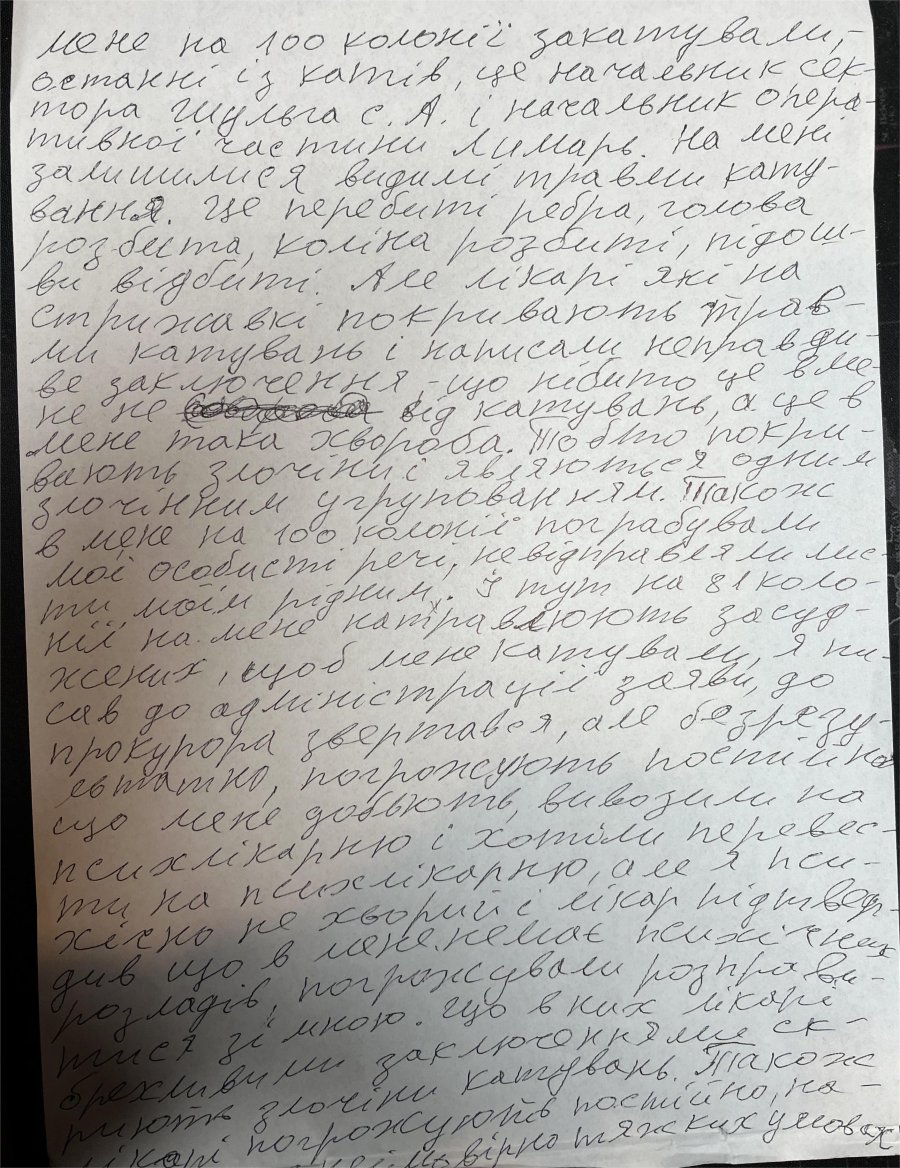
On another sheet, he notes:
‘Here they recorded the remnants of the torture (broken ribs, split head, smashed knees, beaten soles), but the doctors are covering up the torture and have written a conclusion stating that this is not torture, but that I have such a disease.’
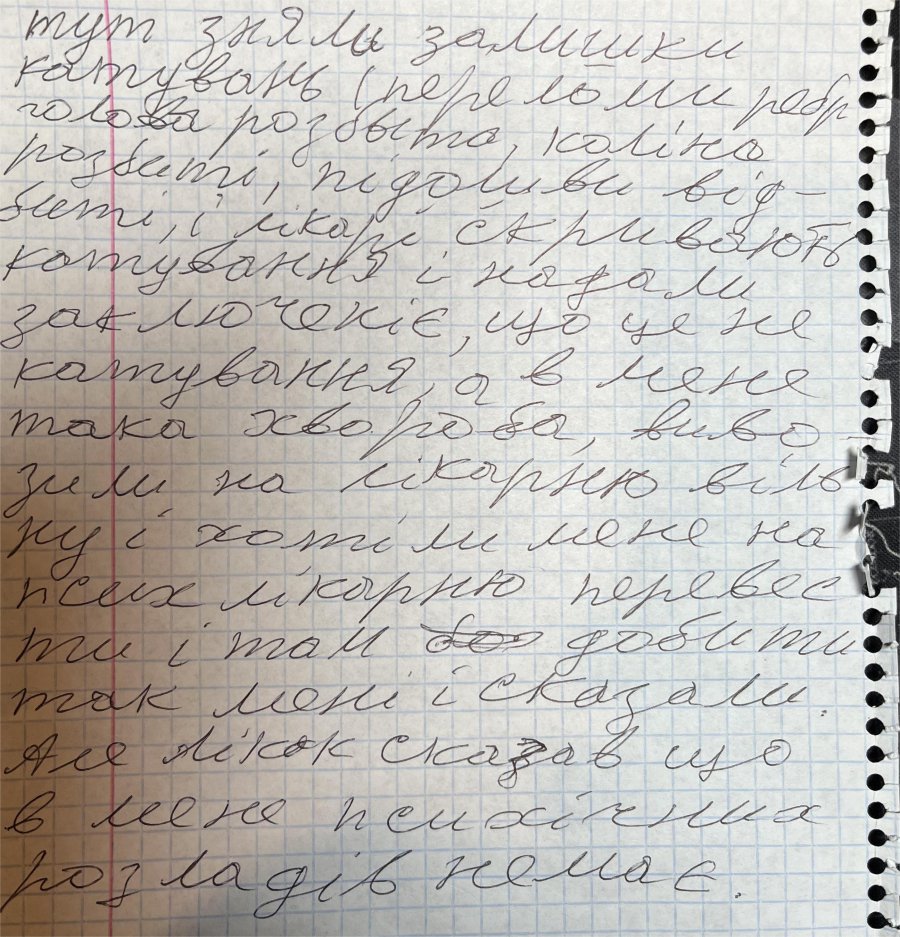
He also writes:
‘I applied to the administration, sent statements to the prosecutor, but to no avail...’
These are not merely emotional assertions. This is a report of a potential crime, naming specific individuals.
Under the standards of Article 3 of the European Convention on Human Rights, any arguable claim of potential torture or ill-treatment automatically triggers a positive obligation on the state to conduct an effective, independent, and impartial investigation. This obligation is also enshrined in national law – Article 28 of the Constitution of Ukraine, Article 127 of the Criminal Code, and Article 214 of the Criminal Procedure Code, which obliges law enforcement agencies to register reports of a crime without delay.
The key question is whether such an investigation was conducted, and whether it complied with both international and national standards?
Medical History: Consistent Diagnoses and a Sudden About-Turn
Kostiantyn Zaporozhtsev is a forensic medical expert of the highest professional category, with over 20 years of experience as a forensic medical examiner, including twelve years of documenting torture and ill-treatment. He analysed 195 of Yukhymenko’s medical documents. Here are extracts from the prisoner’s medical history.
In 2003, a neurologist recorded: ‘The patient remains confined to bed. He does not stand up, does not sit up, and occasionally wets the bed. During the examination, he does not unclench his jaws.’
Diagnosis: ‘malingering of a neuropsychiatric illness’.
However, between 2021 and 2024, the situation looked different. Yukhymenko was repeatedly hospitalised. The following diagnoses were recorded:
– depressive disorder with catatonic stupor;
– chronic delusional disorder;
– psychoorganic syndrome;
– schizotypal disorder (F21);
– paresis of the lower limbs, speech aphasia, dysfunction of the pelvic organs.
Psychiatric outpatient monitoring, regular treatment, and contraindication to heavy labour were recommended.
And after that – a sudden about-turn.
On 1–3 October 2025, Yukhymenko spent only two to three days in a psychiatric hospital. Following this, the following diagnosis was established:
‘Conscious malingering of illness (selective mutism of speech, movement, and physiological excretions)’.
The Medical Consultative Commission (MCC) confirmed this conclusion, noting that he did not require further inpatient treatment.
In his expert opinion, Zaporozhtsev points out:
– 2–3 days is an insufficient period to definitively establish a mental state;
– the volume of objective clinical data in the documentation is insufficient for a categorical conclusion;
– during 2021–2024, mental disorders were recorded that could fall under the grounds for applying Article 84 of the Criminal Code of Ukraine.
In other words, the question is not whether doctors are entitled to make a diagnosis. The question is whether the diagnostic process was sufficiently comprehensive and professional to reach a definitive conclusion.
Statistics That Offer No Grounds for Optimism
According to the official response from the Healthcare Centre of the State Penitentiary Service of Ukraine (No. 643/30-D of 3 February 2026):
– between 2021 and 2025, only two people were released from serving their sentences due to mental disorders;
– not a single person sentenced to life imprisonment was released on these grounds;
– in 14 cases, medical reports were provided that could have served as grounds for applying Article 84 of the Criminal Code of Ukraine.
The mechanism exists on paper, but in practice, it is virtually non-existent.
The Limits of State Responsibility
The prohibition of torture is absolute. The state is obliged to:
– investigate reports of ill-treatment;
– provide adequate medical care;
– conduct a full and independent diagnosis of severe mental disorders;
– genuinely apply the mechanism for changing detention regimes if the state of health requires it.
When a person has been in a state of physical dependence for years, and the final conclusion of ‘malingering’ is based on a brief examination, the line between medicine and human rights disappears.
And this is precisely where the real responsibility of the state is measured.
An Issue That Cannot Be Ignored
We visited Yukhymenko once again. We spoke with the head of Stryzhavka Multi-profile Hospital No. 81, Oleksandr Anatoliyovych Torbas. He informed us that Yukhymenko is being prepared for discharge and they plan to transfer him to Berdychiv Correctional Colony No. 70 to continue serving his life sentence.
In other words, a man who cannot walk or speak is scheduled to be returned to the colony.
Can the state make such a decision without an independent, comprehensive examination?
Can a brief conclusion of ‘malingering’ serve as sufficient grounds for transfer?
We appeal to the Healthcare Centre of the State Penitentiary Service of Ukraine, the Office of the Prosecutor General, and the Verkhovna Rada Commissioner for Human Rights, demanding that an independent, comprehensive, and interdisciplinary assessment of Yukhymenko’s condition be ensured before any decisions regarding his transfer are made.
For if a person remains in a state of complete dependence for years, and the system’s response is a formal medical decision and a transfer back to the colony, this is no longer a mere internal administrative procedure.
It is a question of state responsibility.
And the answer to it must be professional, responsible, and convincing.