Report on the results of a monitoring visit to Berdychiv Correctional Centre No. 108
On 15 July 2026, in accordance with the Optional Protocol to the Convention against Torture and Other Cruel, Inhuman or Degrading Treatment or Punishment, taking into account the provisions of the United Nations Standard Minimum Rules for the Treatment of Prisoners (the Nelson Mandela Rules) and the judgments of the European Court of Human Rights, and on the basis of Article 24 of the Criminal Executive Code of Ukraine (“Visits to penal institutions”), a group of monitors from the Kharkiv Human Rights Protection Group and the NGO “Protection for Prisoners of Ukraine” carried out a visit to the state institution “Berdychiv Correctional Centre (No. 108)” (hereinafter — BCC-108, the institution, the establishment, the correctional centre). The visit was conducted as a scheduled visit without prior notice. All facilities of the institution were examined.
The previous visit took place on 2 May 2024.
In preparing for the visit, the monitors made use of the materials of complaints submitted by convicted persons and their relatives, the materials of previous reports, and also the reports of the monitors of the National Preventive Mechanism under the Ukrainian Parliament Commissioner for Human Rights (NPM).
The visit was carried out within the framework of the project “Seeking Justice for Survivors”, funded by the Ministry of Foreign Affairs of Denmark with the support of the Danish Institute Against Torture, DIGNITY.
The visit was conducted by the following monitors:
- Andrii Didenko — assistant to Yaroslav Yurchyshyn, Member of Parliament of Ukraine, programme coordinator of the Kharkiv Human Rights Protection Group, with experience of monitoring visits since 2014, NPM monitor (National Preventive Mechanism), member of the NPM advisory board;
- Serhii Zuikov — assistant to Kostiantyn Kasai, Member of Parliament of Ukraine, member of the public council under the Ministry of Justice of Ukraine, member of the civic organisation “Protection for Prisoners of Ukraine”, NPM monitor, with many years’ experience of monitoring visits;
- Artemii Shumnyi — journalist of the news agency “Zakhyst Viazniv Ukrainy / PROTECTION FOR PRISONERS OF UKRAINE”, lawyer of the Kharkiv Human Rights Protection Group, NPM monitor.
During the monitoring visit to BCC-108, a number of violations of the requirements of national legislation and of international standards for the treatment of convicted persons were identified. The monitoring group recorded inadequate facilitation of public oversight: certain convicted persons obstructed the monitors’ work, including the conduct of confidential interviews, while the staff of the institution failed to ensure proper conditions for the safe and unimpeded conduct of the visit.
Violations of the procedure for admitting newly arrived convicted persons were established, in particular the exceeding of the statutory fourteen-day period of their stay in a separate unit, inadequate provision of information about their rights and about the conditions for serving their sentence, as well as substantial shortcomings in material, domestic and sanitary-hygienic provision. In the disciplinary isolation unit, inadequate conditions of detention were recorded: insufficient natural light, the absence of proper ventilation, the absence of an adequate level of privacy when using the sanitary facilities, of staff call buttons and of radio broadcasting, as well as shortcomings in the organisation of social and preventive work with convicted persons serving disciplinary penalties. Violations were identified in the organisation of bathhouse and laundry services, in particular a non-functioning disinfection chamber, inadequate operation of the ventilation, the absence of barbering services and of the necessary ancillary premises. Shortcomings were also established in the provision of food, in access to the Internet and in the provision of legal information to convicted persons.
Substantial shortcomings were identified in the organisation of social, educational and psychological work. A single head of a Social and Psychological Service unit in practice covers the work of all three units, and a random inspection of the documentation revealed that, for a number of convicted persons, there were no timely risk assessments, no individual programmes of social and educational work, no periodic assessment of behaviour and no proper supervision of the keeping of individual work diaries.
During confidential interviews, convicted persons reported overtime work, low pay and shortcomings in the medical provision for those engaged in labour. At the same time, the administration did not provide the monitoring group with the primary documentation concerning the organisation of labour, the recording of working time, remuneration and the payment of the unified social contribution, which made it impossible to verify the complaints received in full and to assess compliance with the labour and social rights of convicted persons.
Taken together, the shortcomings identified indicate the need for systemic measures to bring the conditions of detention, the organisation of social and educational work, labour, and the material and domestic provision for convicted persons into line with the requirements of national legislation and international standards.
General information
The state institution “Berdychiv Correctional Centre (No. 108)” is located at 2-A Nyzhiretska Street, Berdychiv, Zhytomyr region. The correctional centre is intended for holding men sentenced to restriction of liberty. The institution consists of three units of the Social and Psychological Service (SPS), a catering block, a quarantine, diagnosis and distribution unit (QDD), a bathhouse and laundry complex, a disciplinary isolation unit (DIZO) and administrative premises. At the time of the previous monitoring visit on 2 May 2024, one of the three SPS units had been mothballed.
At the time of the visit, the head of the institution was Vitalii Volodymyrovych Boiko.
The planned capacity of the institution is 335 persons. On the day of the monitoring visit, 314 convicted persons were held in the institution, which is approximately 94% of the planned capacity. Three SPS units are in operation in the institution.
The authorised staffing level of the institution is 96 posts, while the actual level is 75; accordingly, the staffing shortfall amounts to 19.25 posts. During 2026, 148 convicted persons arrived at the institution. During 2025, no deaths among convicted persons were recorded; in 2026 two persons died. No cases of suicide were recorded in 2025 or 2026. As at the day of the visit, the following were on the preventive register: one person prone to suicide, five persons prone to self-harm and five persons prone to escape.
According to information provided by the administration, emergency medical assistance was called out 55 times in 2026. During that year, 14 cases of bodily injury among convicted persons were recorded: one on arrival at the institution and 13 during their stay in the institution. No complaints from convicted persons regarding inadequate conditions of detention or the inadequate provision of medical assistance were registered in 2025–2026.
Thirteen convicted persons with category III disability are held in the institution. In 2025–2026, no cases of release of convicted persons on grounds of serious illness were recorded.
According to information from the administration, the total number of convicted persons in employment is 177, of whom eight are engaged in maintenance work.
Over the past six months, six prosecutorial response documents have been submitted to the institution.
The group of monitors interviewed approximately 90 convicted persons during visits to the SPS units, the QDD unit and the disciplinary and maintenance premises. The interviews took the form both of general conversations, with advice given and questions answered, and of individual conversations, including on terms of confidentiality and anonymity. In the course of the interviews, questions were clarified concerning observance of the rights of convicted persons, the conditions of detention, the organisation of labour, access to medical assistance and possible instances of ill-treatment.
Violations of national and international law identified
During the monitoring visit, violations of the requirements of national legislation and a failure to comply with international recommendations in the field of the treatment of prisoners were identified, resulting in violations of the rights of convicted persons:
1. The monitoring group recorded instances of inadequate facilitation by the administration of the institution of the conduct of the monitoring visit in accordance with Article 24 of the Criminal Executive Code of Ukraine. During the visit, certain convicted persons repeatedly obstructed the monitors’ work, in particular during the inspection of official documentation and the conduct of confidential interviews with convicted persons, using obscene language, displaying aggressive behaviour and provoking conflict situations. In the presence of staff of the institution, no effective measures were taken to put a stop to such conduct, to ensure the confidentiality of the interviews and to ensure the safe conduct of the monitoring visit, which created obstacles to the exercise of public oversight of observance of the rights of convicted persons.
2. The procedure for, and the conditions of, the admission of convicted persons to the institution do not fully comply with the requirements of the legislation of Ukraine and with international standards for the treatment of prisoners.
Pursuant to the first paragraph of Article 59 of the Criminal Executive Code of Ukraine (hereinafter — the CEC of Ukraine), all convicted persons newly arrived at a correctional centre are held in separate premises, where, over a period of fourteen days, they undergo a medical examination for the purpose of detecting infectious and other diseases, as well as an initial psychological, educational and other assessment.
At the same time, during the visit to the separate unit for newly arrived convicted persons (hereinafter — the unit) as at 15 July 2026, the monitoring group established that ten convicted persons who had arrived at the institution on 27 June 2026 were being held there, that is to say, they were being held in the unit beyond the statutory fourteen-day period. Moreover, in accordance with the minutes of the meeting of the commission for the distribution of newly arrived convicted persons No. 66 of 10 July 2026, they were already due to be allocated to the units of the Social and Psychological Service (hereinafter — the SPS).
3. The monitoring group established that the administration and staff of the institution had failed to ensure the proper organisation of work with newly arrived convicted persons.
During the visit to the unit and confidential interviews with newly arrived convicted persons, it was established that they are not informed of the procedure for, and the conditions of, serving their sentence, or of their rights as defined by the legislation of Ukraine, nor are they given fire-safety instruction.
The foregoing is contrary to the requirements of paragraph 1 of Section V of the Internal Regulations of Penal Institutions, approved by Order of the Ministry of Justice of Ukraine No. 2823/5 of 28 August 2018 (hereinafter — the IRPI).
4. The monitoring group established that the material and domestic provision of the unit does not fully comply with the established regulatory requirements.
Thus, in breach of the requirements of the Standards for the Provision of Furniture, Equipment and Household Items for a Correctional Centre, approved by Order of the Ministry of Justice of Ukraine No. 1118/5 of 27 July 2012 (hereinafter — the Provision Standards), the following premises are absent from the unit for newly arrived convicted persons: an educational work room; a room for storing the exchange stock of bedding, clothing and workwear; a storeroom for the temporary storage of soiled bedding, clothing and workwear; a cloakroom; a domestic facilities room; and a drying room.
In addition, the absence of a washroom and of a shower cubicle fitted with a mixer tap and a shower head on a flexible hose was established, as a result of which proper conditions for maintaining the personal hygiene of newly arrived convicted persons are not ensured.
The absence of the aforementioned premises and of the necessary equipment fails to provide proper material, domestic and sanitary-hygienic conditions of detention, makes it more difficult to maintain proper sanitary conditions and order, and also has an adverse effect on the process of adaptation of newly arrived convicted persons to the conditions of serving their sentence.
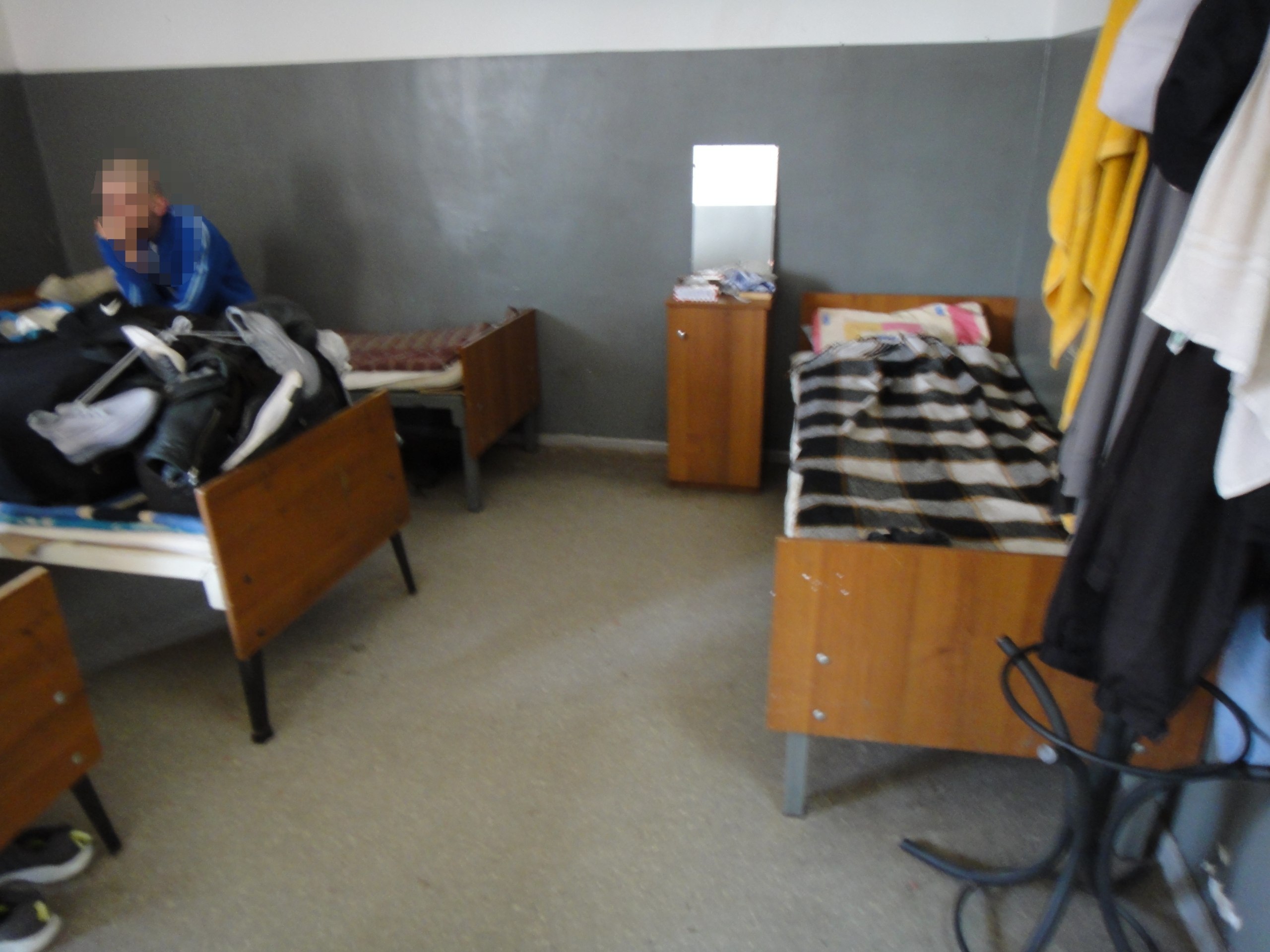
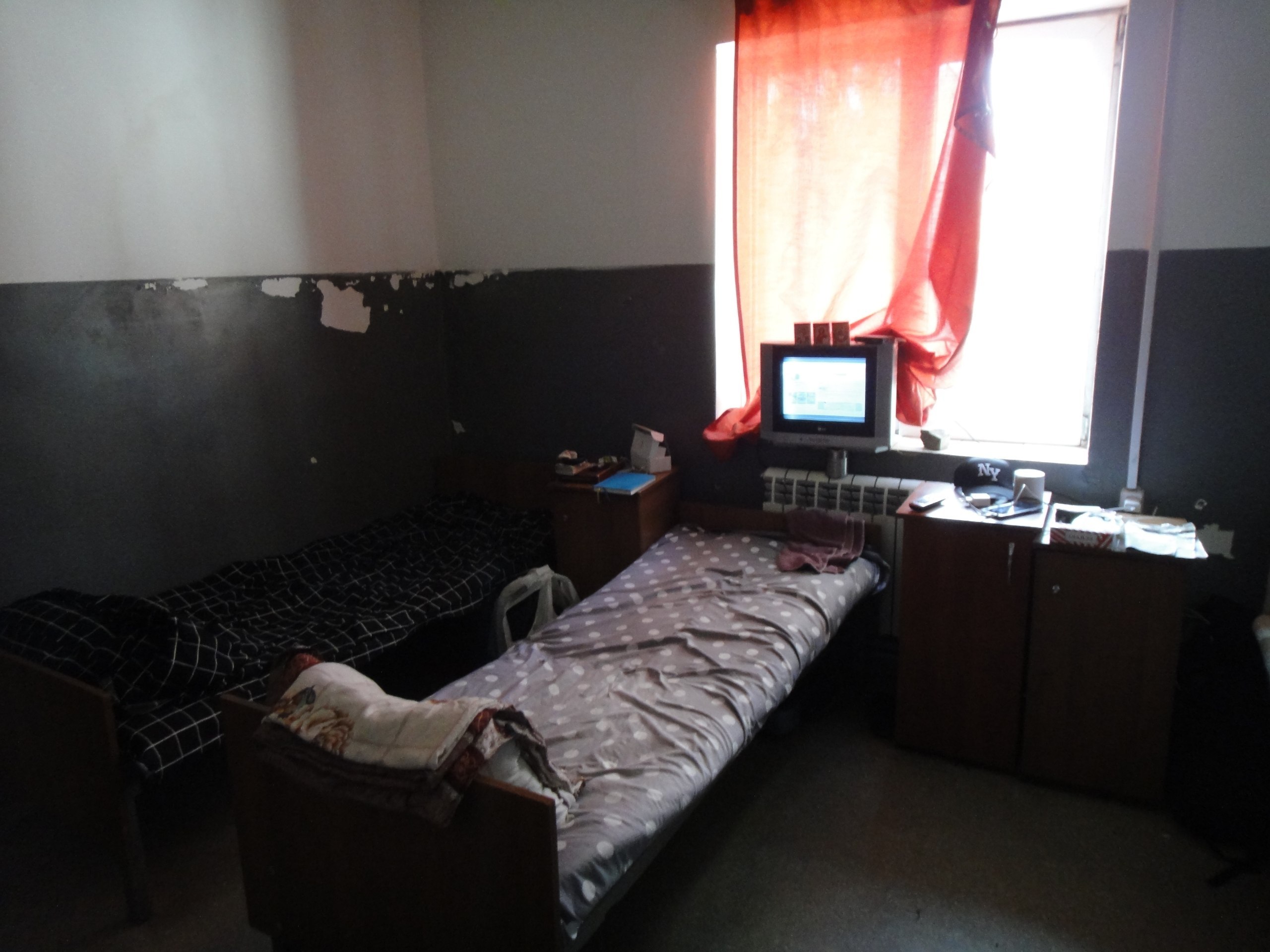
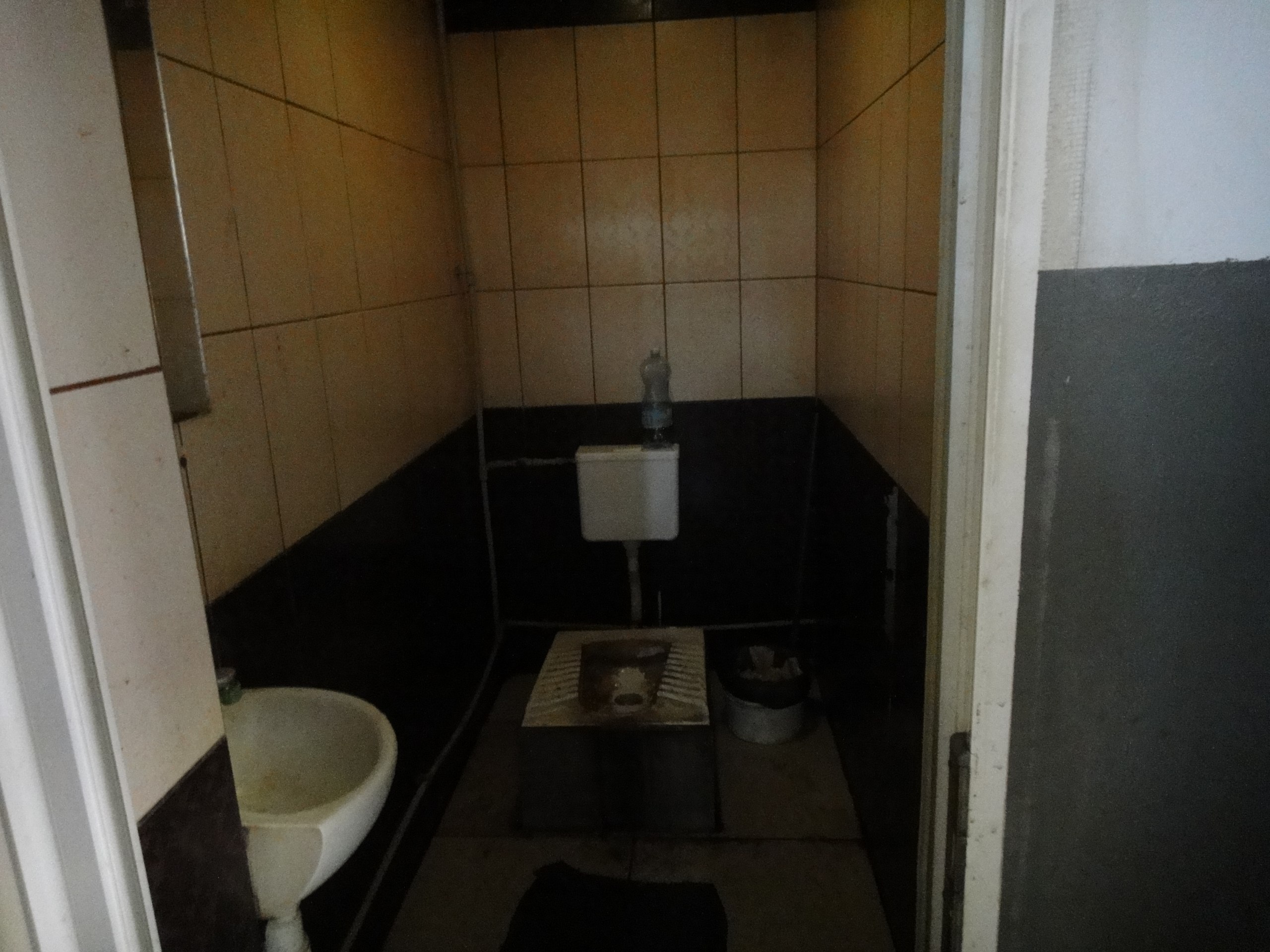
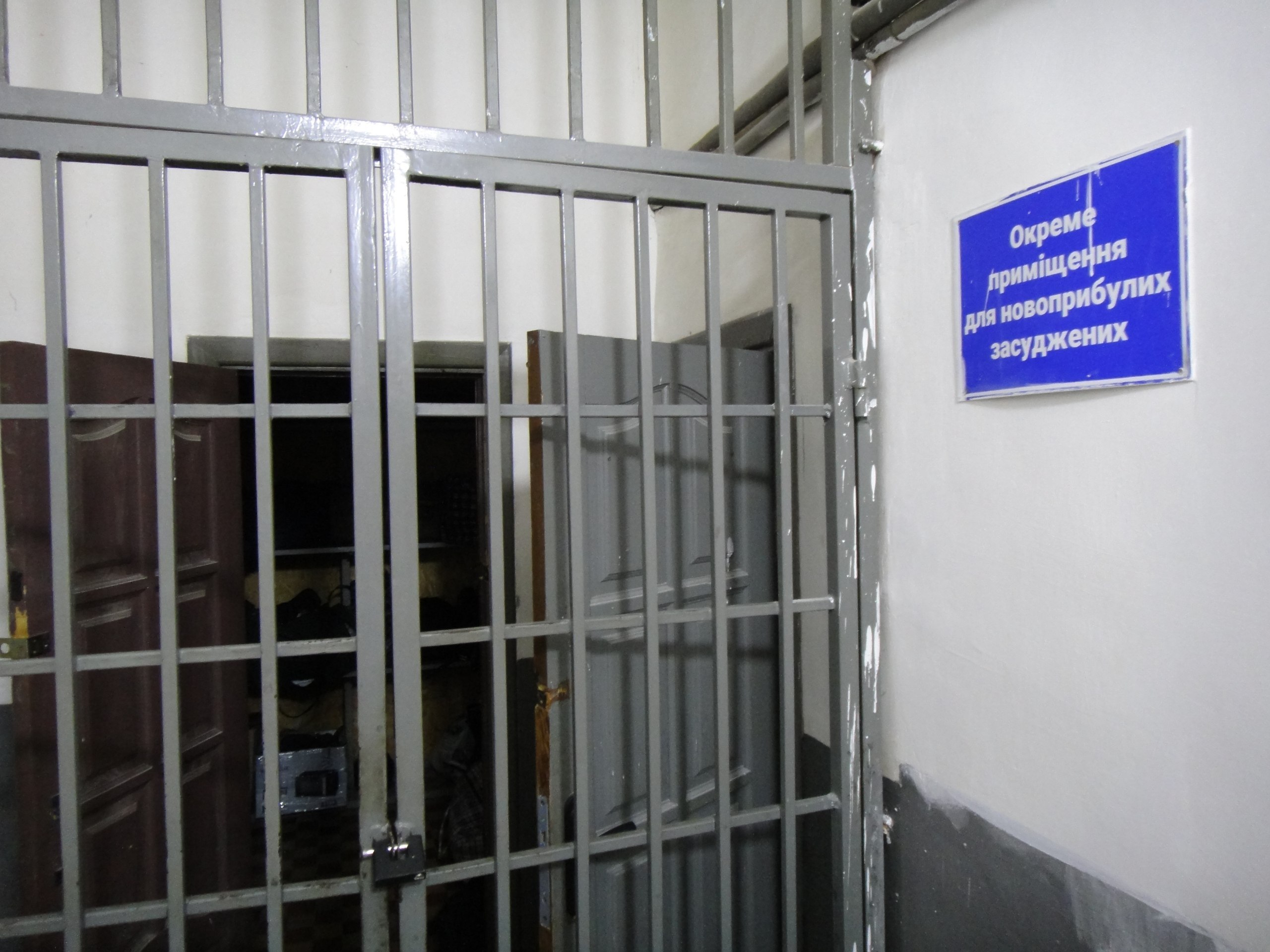
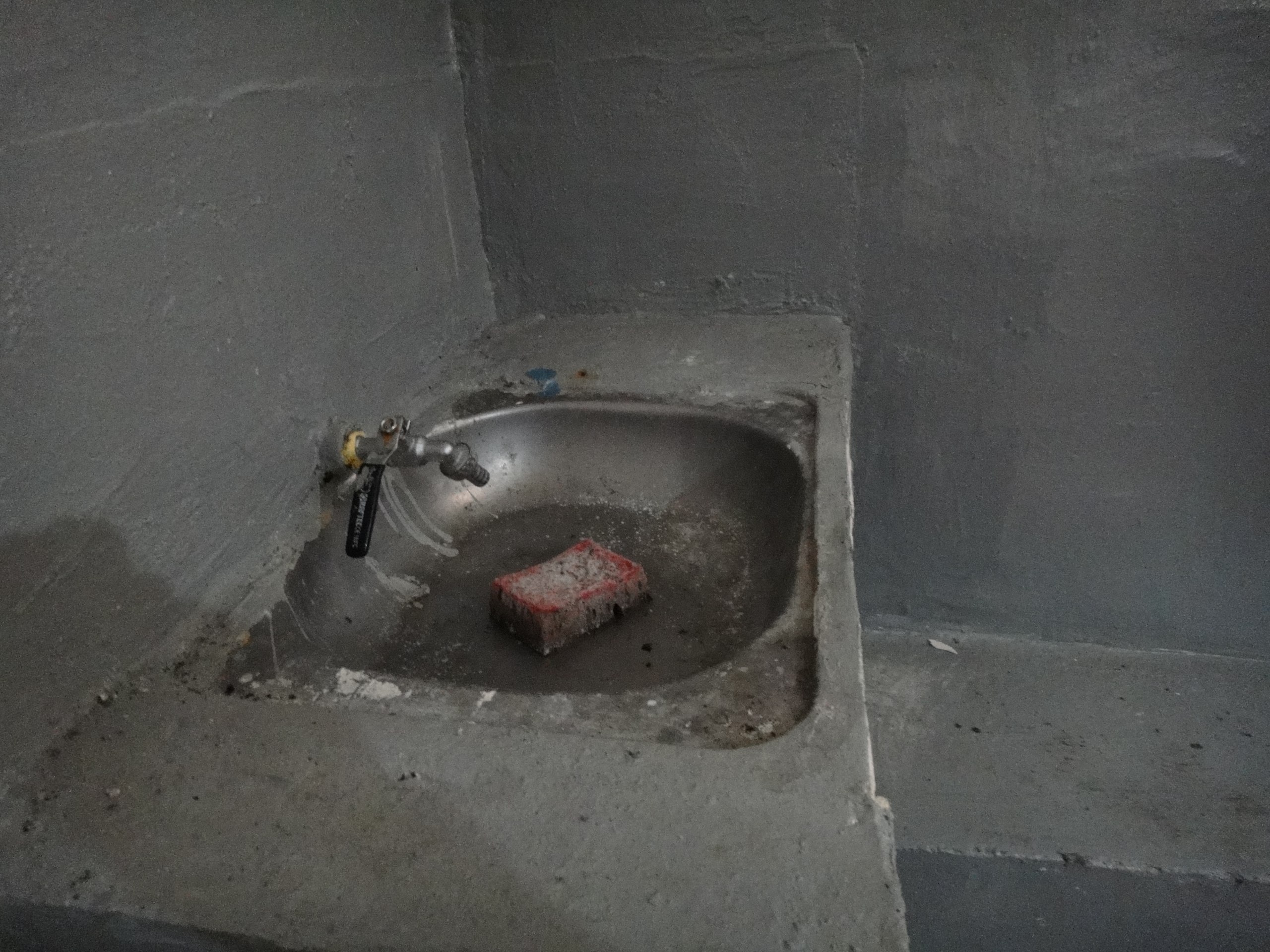
5. In breach of the requirements of Rule 22.5 of the European Prison Rules, Rule 22.2 of the United Nations Standard Minimum Rules for the Treatment of Prisoners (the Nelson Mandela Rules) and the Provision Standards, the living quarters are not equipped with a 15-litre drinking-water tank with a tap, a lid, a mug and a basin.
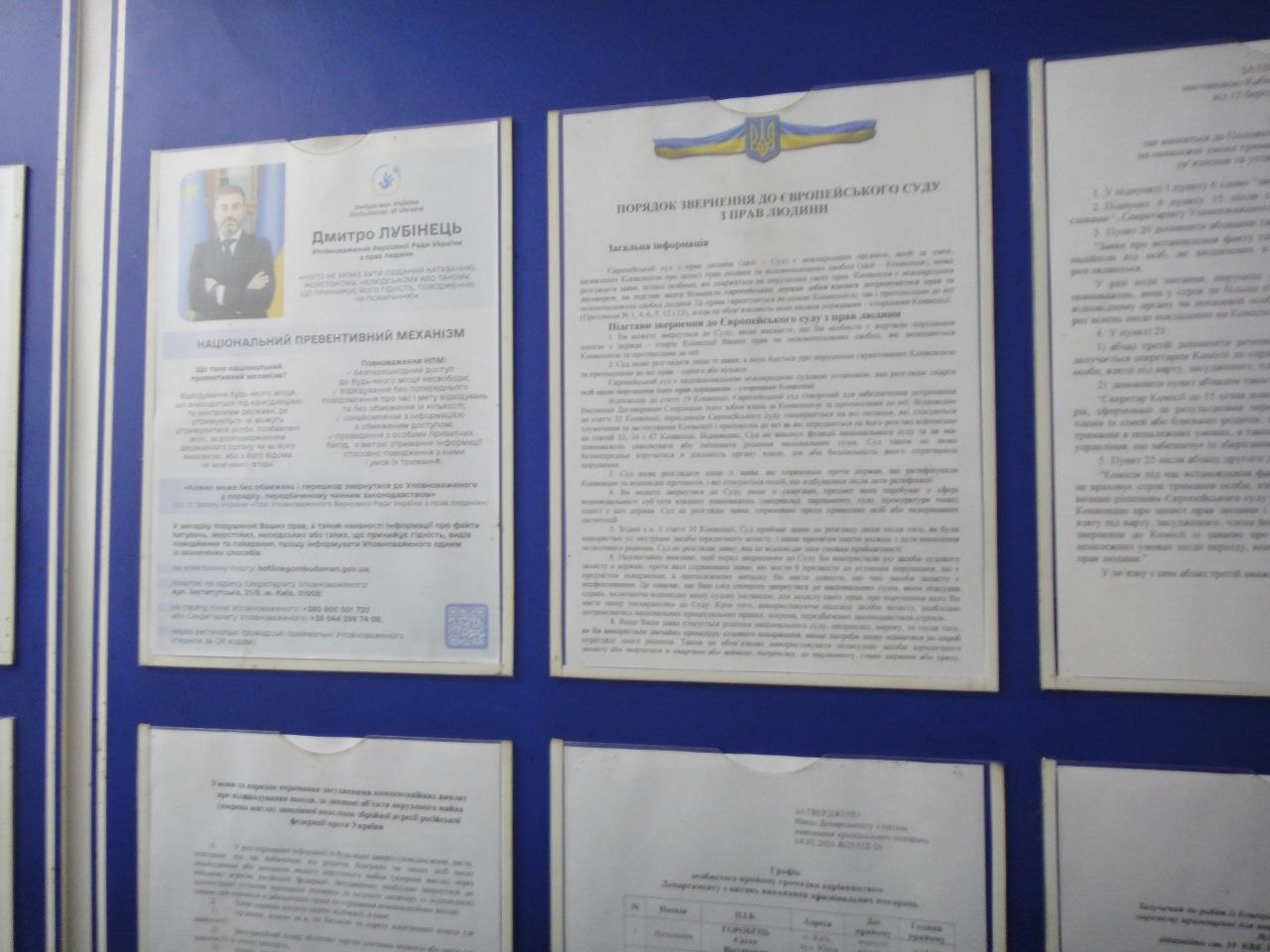
6. During the visit to the unit for newly arrived convicted persons, it was established that there was no visible information setting out the telephone numbers of the “hotlines”, or the postal and email addresses of the Ministry of Justice of Ukraine, the European Court of Human Rights, the State Bureau of Investigation, the Office of the Prosecutor General, the regional and district prosecutor’s offices, the Department, the interregional directorate, or the regional centre for the provision of free legal aid. The foregoing is contrary to the requirements of paragraph 6 of Section II of the IRPI.
7. The administration of the institution has not ensured in full the right of convicted persons to access the Internet, and the procedure for granting such access complies only in part with the established requirements. In particular, on the premises of the separate unit for newly arrived convicted persons there are no facilities enabling convicted persons to exercise the right of access to the Internet provided for by the seventh paragraph of Article 110 of the CEC of Ukraine through the use of tablets. No Wi-Fi access point has been installed on the premises of the unit.
8. The arrangement of the premises of the institution’s disciplinary isolation unit (hereinafter — the DIZO) does not fully comply with the established standards for the treatment of prisoners and does not ensure proper material, domestic and sanitary-hygienic conditions, which results in a violation of the rights of convicted persons.
Thus, in breach of the requirements of the Provision Standards, a number of the requisite premises are absent from the DIZO, in particular rooms for the reception of convicted persons by the administration and by medical staff; a room for storing convicted persons’ personal belongings; a room for storing the exchange stock of bedding, clothing and workwear; a storeroom for the temporary storage of soiled bedding, clothing and workwear; and a barber’s room.
The absence of such premises results in a breach of sanitary and hygiene standards.
9. The sanitary facilities in the cells of the DIZO are not fitted with doors, which makes it impossible to ensure privacy when using the toilet and breaches Rule 19.3 of the European Prison Rules and Rule 15 of the United Nations Standard Minimum Rules for the Treatment of Prisoners (the Nelson Mandela Rules). At the same time, the sanitary facility is situated on a raised platform with steps, which creates considerable difficulties in its use by persons with disabilities and other persons with reduced mobility, fails to meet accessibility requirements and demeans human dignity.
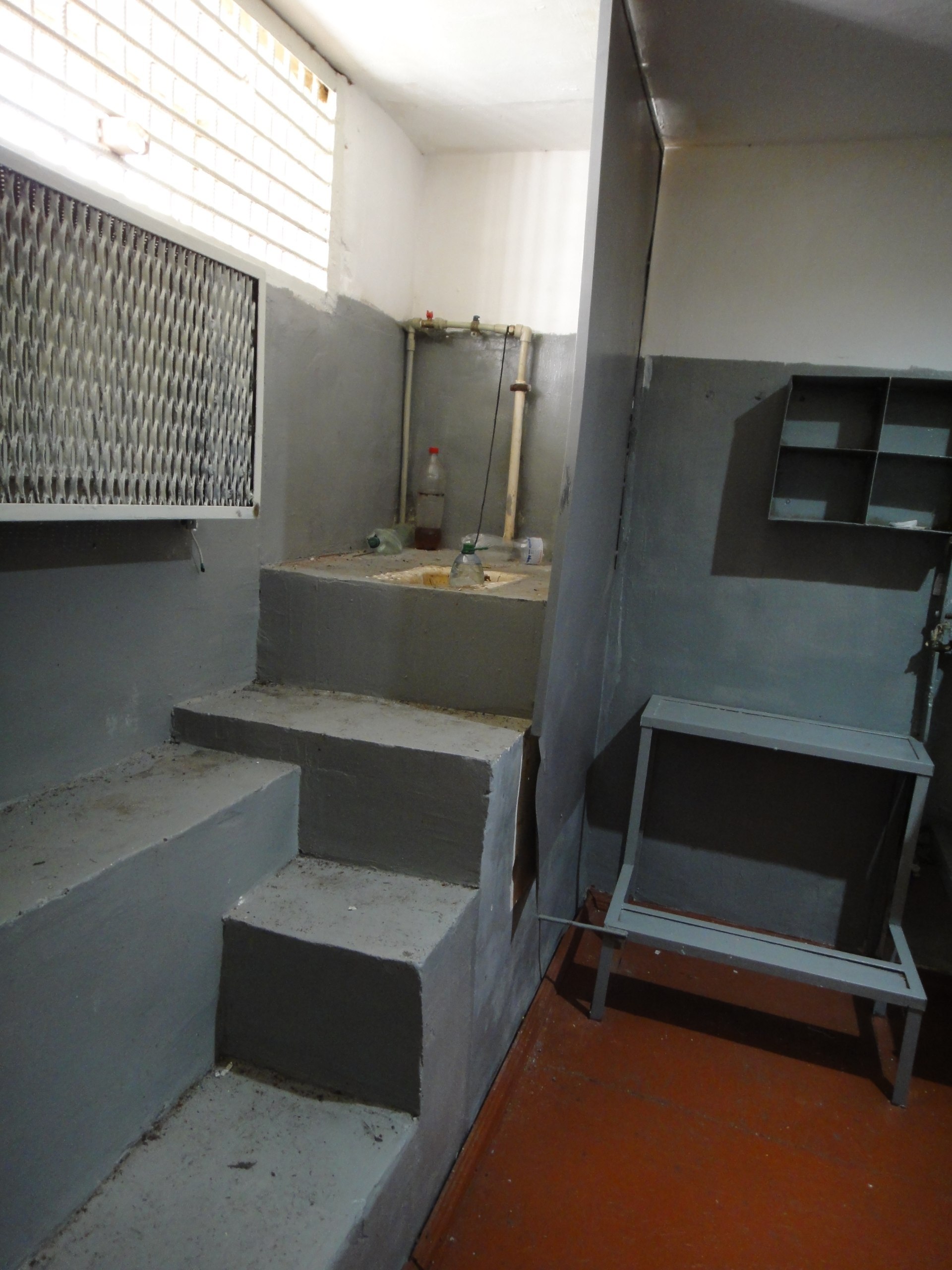
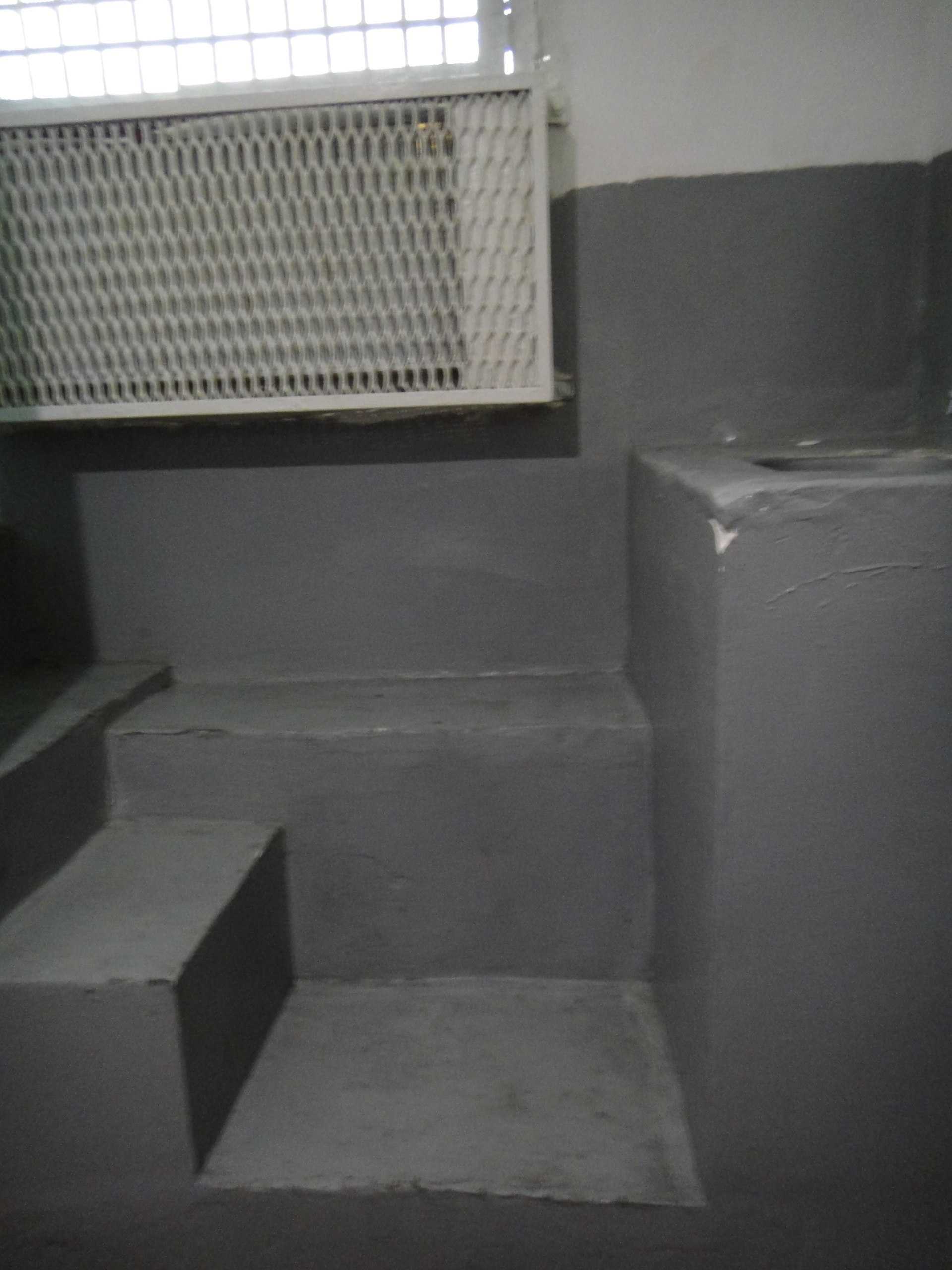
10. In the cells of the DIZO, the operation of mechanical ventilation is not ensured, which does not comply with the requirements of Rule 13 of the United Nations Standard Minimum Rules for the Treatment of Prisoners (the Nelson Mandela Rules).
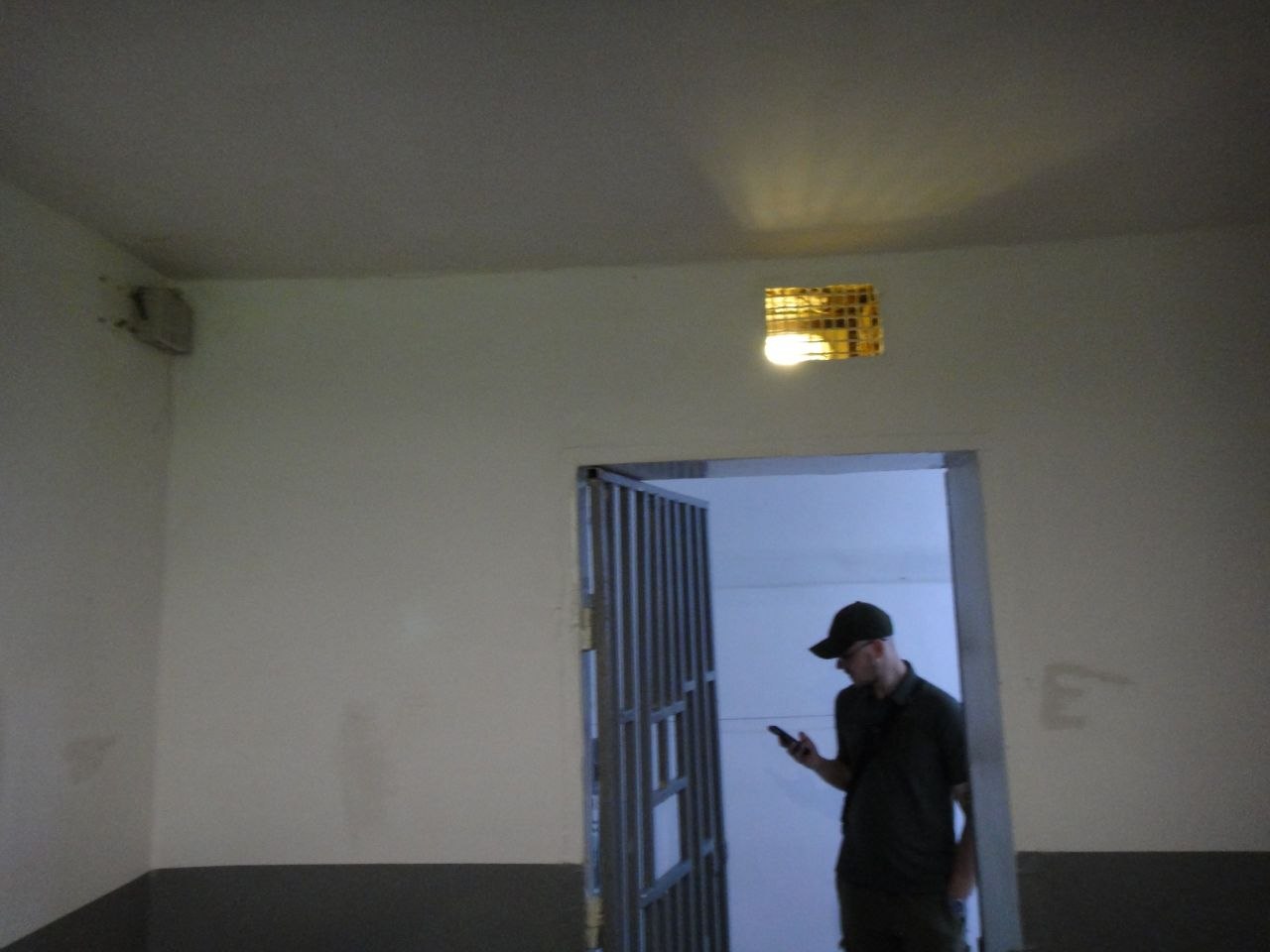
11. In the cells of the DIZO, an adequate level of natural light is not ensured, since the cell windows are small in size, are situated at a considerable height and are excessively barred, as a result of which access to natural light is restricted and insufficient to ensure normal conditions of stay. These conditions create additional psychological discomfort for convicted and remand prisoners on account of their limited visual contact with the outside environment.
The foregoing does not comply with the requirements of Rule 18.2 (a) of the European Prison Rules or Rule 14 of the United Nations Standard Minimum Rules for the Treatment of Prisoners (the Nelson Mandela Rules).
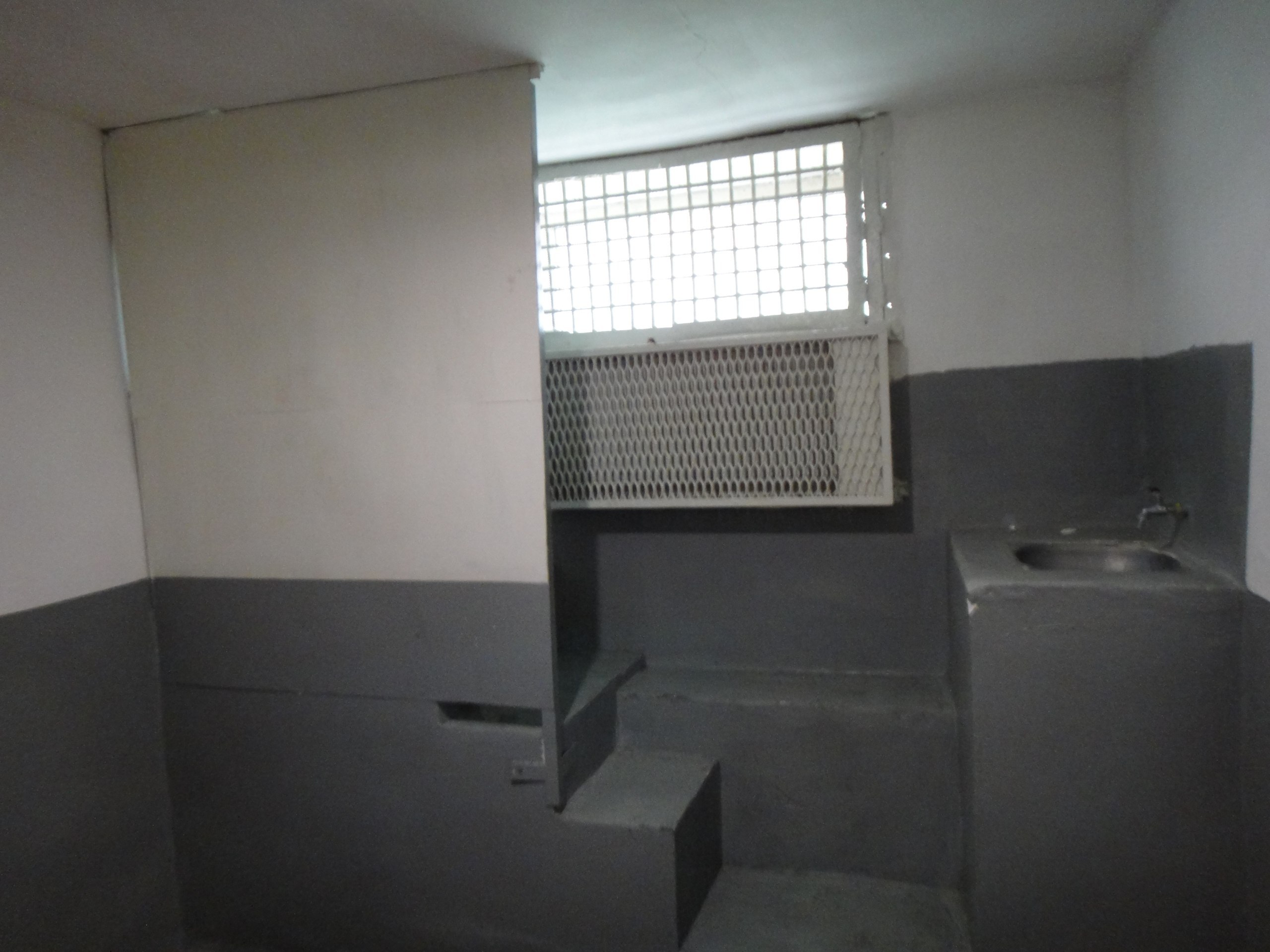
12. In breach of paragraph 4 of Section IV of the Procedure for the Use of Technical Means of Supervision and Control in Correctional and Educational Colonies of the State Criminal Executive Service of Ukraine, approved by Order of the Ministry of Justice of Ukraine No. 2025/5 of 26 June 2018 (hereinafter — the Procedure for the Use of Technical Means), cells Nos. 3 and 4 of the DIZO are not equipped with staff call buttons, which makes it more difficult for convicted persons to make prompt contact with the staff of the institution.
13. There is no radio broadcasting in the cells of the DIZO, which is contrary to the requirements of paragraph 3 of Section XX of the IRPI and paragraph 63 of the United Nations Standard Minimum Rules for the Treatment of Prisoners (the Nelson Mandela Rules).
14. Pursuant to the twenty-third sub-paragraph of paragraph 6 of Section XXI of the IRPI, for the purpose of individual preventive work, the head of the Social and Psychological Service unit is to visit the DIZO, the punishment cells and the cell-type premises (single cells) upon a convicted person’s placement in or transfer to them, and not less than once a week. Following such visits to the DIZO, the punishment cells and the cell-type premises (single cells), he or she is obliged to make the appropriate entries in the register of visits by the administration of the penal institution to the disciplinary isolation unit, cell-type premises, single cells and punishment cells.
At the same time, during the inspection of the register of visits to the disciplinary isolation unit (DIZO), it was established that the entries which, in accordance with the applicable regulatory requirements, ought to have been made by the head of Social and Psychological Service unit No. 2 while convicted person Z. was serving a disciplinary penalty in the period from 4 July 2026 to 14 July 2026 were absent.
This violation may indicate that the head of Social and Psychological Service unit No. 2 is in fact failing to perform his duties and that social, educational and psychological work is inadequately organised.
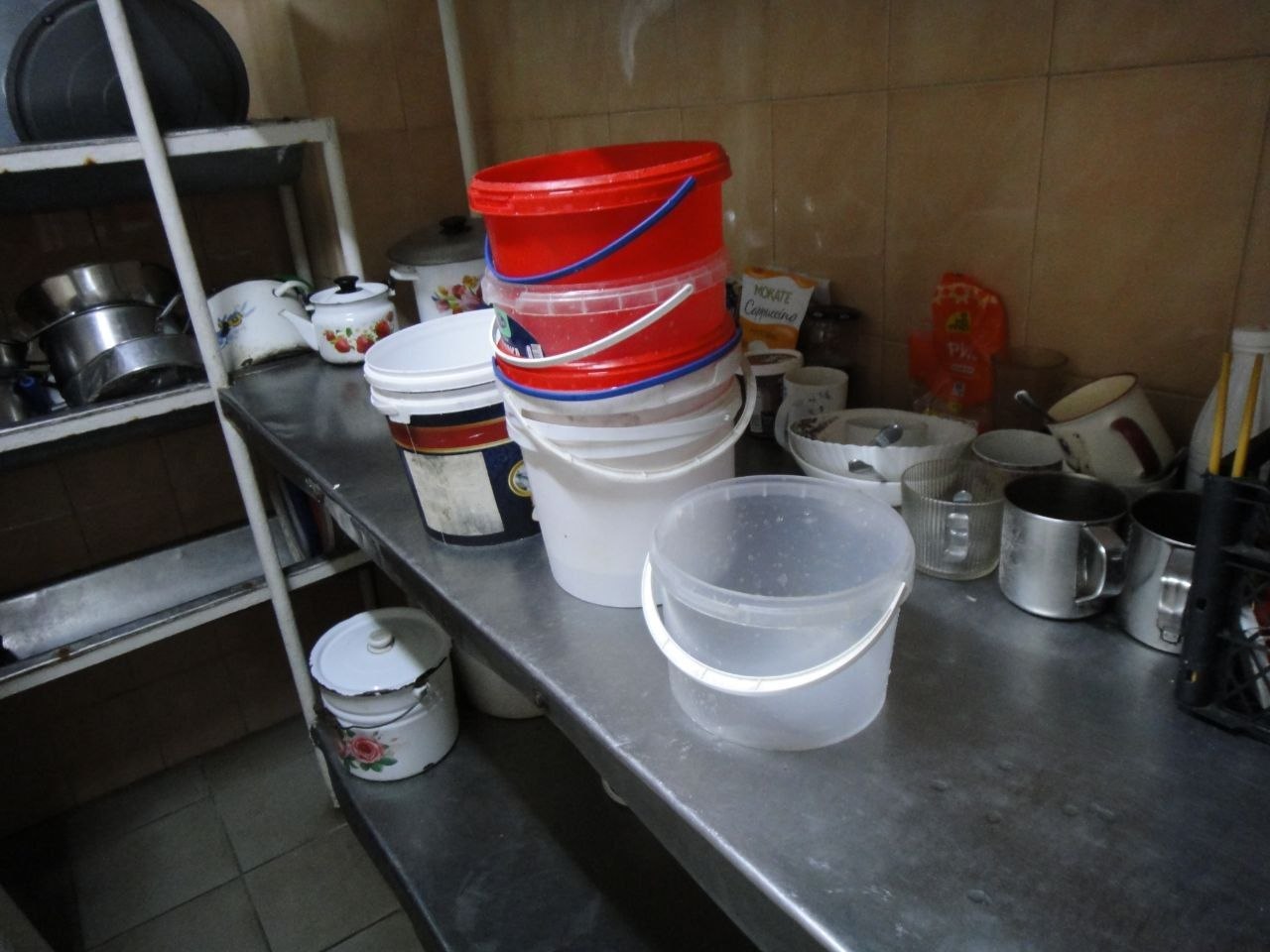
15. In breach of the requirements of paragraph 14 of Section V of the Regulations on the Organisation of Food Provision in the State Criminal Executive Service of Ukraine in Peacetime, approved by Order of the Ministry of Justice of Ukraine No. 2160/5 of 15 June 2021 (hereinafter — the Regulations on the Organisation of Food Provision), food is delivered to convicted persons from the institution’s canteen in plastic buckets rather than in labelled thermal containers.
16. During the visit to the institution’s library, the monitoring group established that, contrary to the requirements of the third sub-paragraph of paragraph 4 of Section XX of the IRPI, the library’s book stock does not contain the texts of the European Prison Rules, the United Nations Standard Minimum Rules for the Treatment of Prisoners (the Nelson Mandela Rules), the Internal Regulations of Penal Institutions or the Criminal Executive Code of Ukraine. 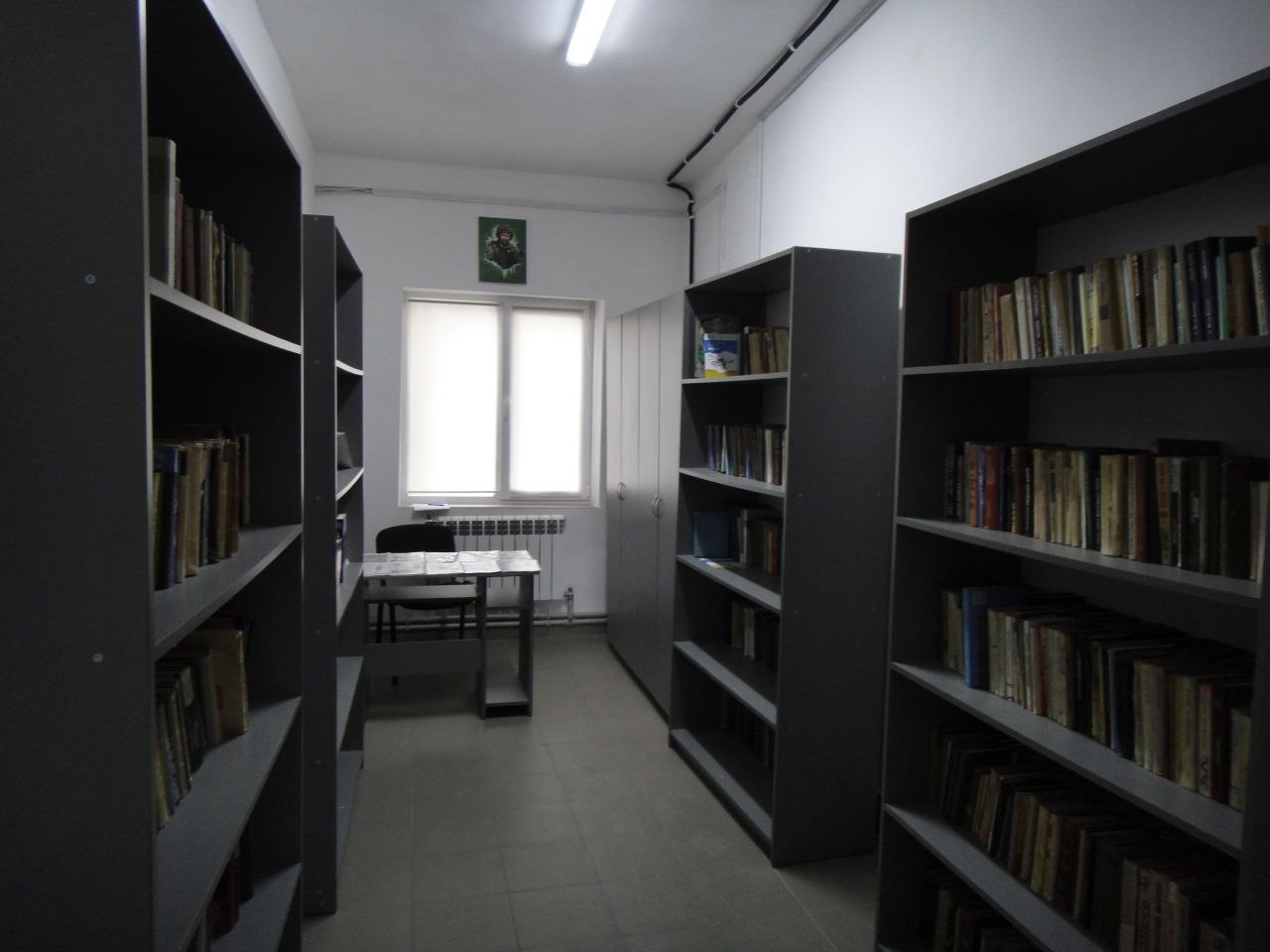
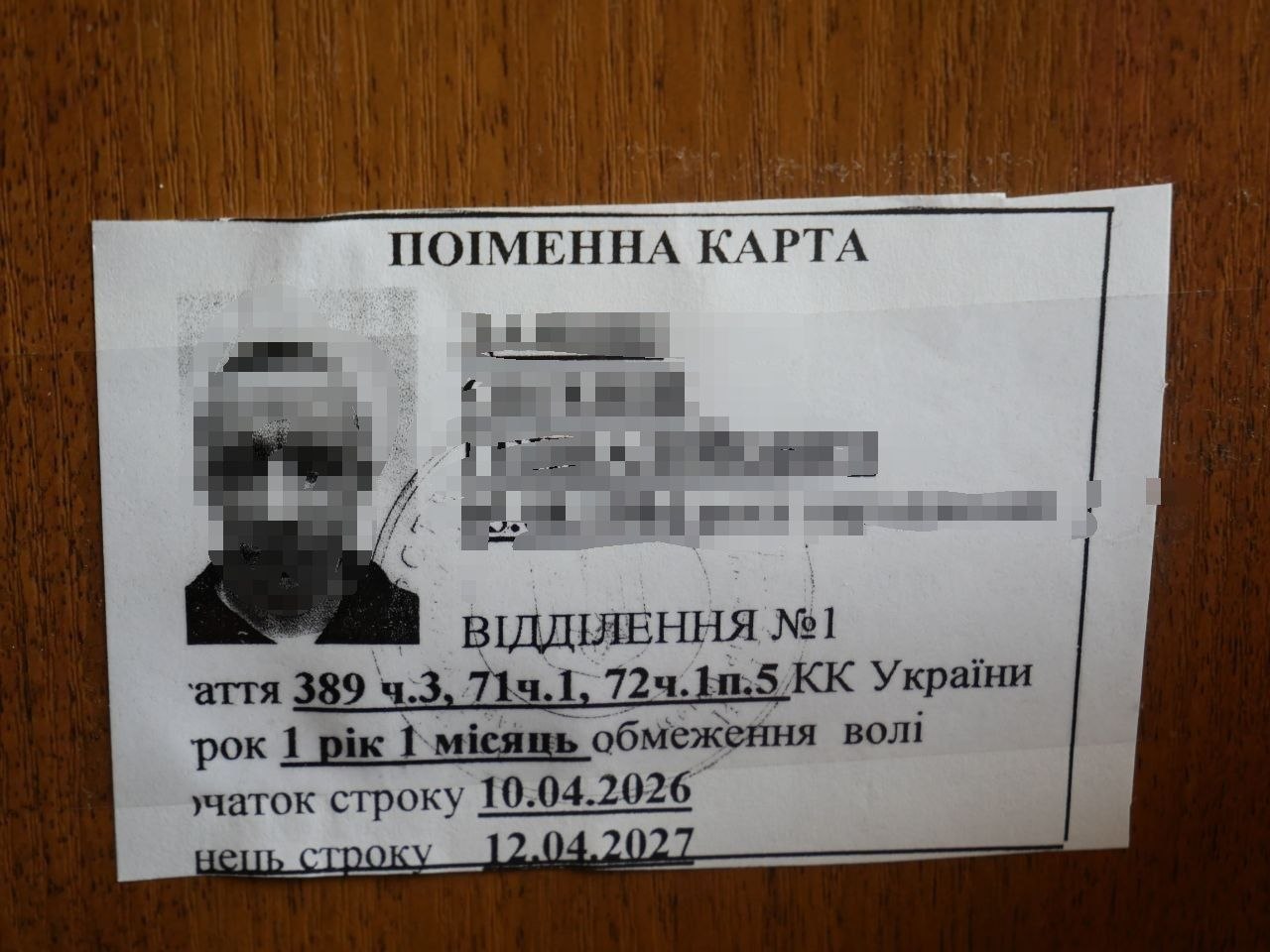
17. During the visit to an SPS unit, it was established that name cards had been placed on convicted persons’ beds in the living quarters, setting out a brief description of the criminal offences committed by the persons occupying those beds. In its report on the results of its visit to Ukraine in 2020, the Committee noted, in analogous circumstances, that this practice should be discontinued, since it serves no reasonable purpose and, in addition to being stigmatising, has an adverse effect on relations between prisoners and prison staff (CPT/Inf (2020) 40, paragraph 52).
18. The monitoring group established a number of violations in the organisation of bathhouse and laundry services for convicted and remand prisoners.
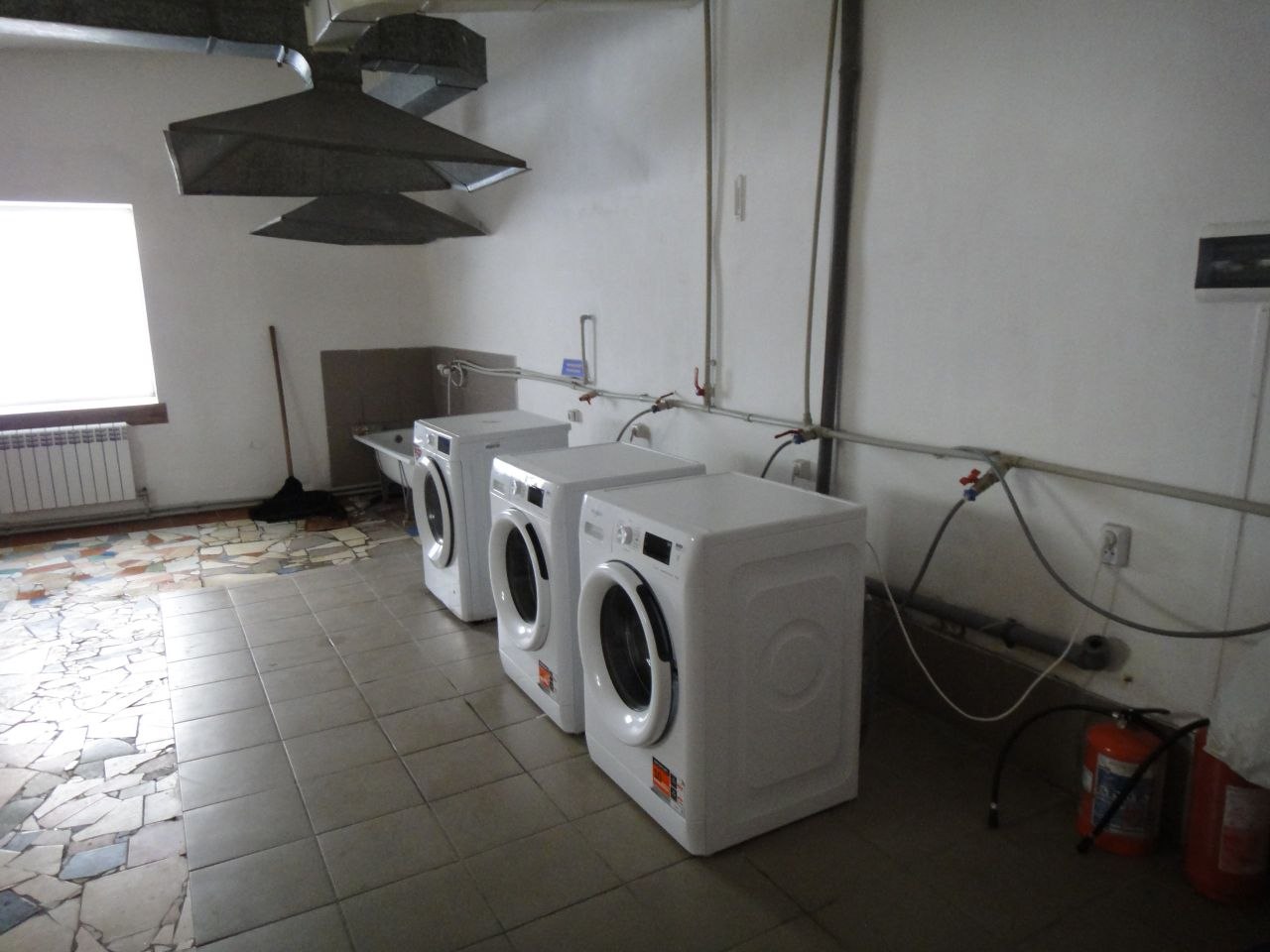
In accordance with paragraph 3.19.1 of Section III of the Regulations on the Organisation of Bathhouse and Laundry Services for Persons Held in Penal Institutions and Remand Centres, approved by Order of the Ministry of Justice of Ukraine No. 849/5 of 8 June 2021 (hereinafter — the Regulations), sanitary processing involves the washing of convicted persons (persons taken into custody) in the bathhouse using soap and a flannel, the compulsory changing of bedding and underclothing, and also the disinfection (destruction of pathogenic micro-organisms) and disinsection (destruction of insects and mites that are vectors of infectious diseases) of personal clothing and bedding (pillows, mattresses, blankets) in a disinfection chamber. However, as the monitoring group established, the disinfection chamber in the institution is not in working order, which makes it impossible to carry out proper sanitary processing of bedding and clothing, increases the risk of the spread of infectious diseases among convicted persons and staff, and is contrary to the established sanitary and hygiene standards.
19. In breach of the requirements of paragraph 2.14 of Section II of the Regulations on the Organisation of Bathhouse and Laundry Services, the institution does not ensure the provision of barbering services to convicted persons.
20. In breach of the requirements of paragraph 2.11 of Section II of the Regulations, the forced supply-and-extract ventilation system in the bathhouse premises does not function properly.
21. In breach of the requirements of Annex 3 to the Regulations, the laundry has no toilet, no shower for workers and no staff room for laundry personnel.
22. During the monitoring visit, substantial shortcomings were established in the organisation of social, educational and psychological work with convicted persons, in particular as regards the planning and documenting of such work, the keeping of individual work diaries, the drawing up of individual programmes of social and educational work and the carrying out of risk assessments.
Three SPS units operate in the institution. At the same time, the head of SPS unit No. 2 in practice carries out the relevant work in all three SPS units, which creates an excessive workload and may objectively have an adverse effect on the thoroughness and regularity of individual work with convicted persons.
During the inspection of the documentation, quarterly plans of social, educational and psychological work were found to be in place. At the same time, the head of the SPS unit did not submit reports to the deputy head of the institution for social, educational and psychological work on the implementation of the quarterly plans for either the first or the second quarter of 2026.
A random inspection of the diaries of individual work with convicted persons revealed systemic shortcomings in the keeping of documentation and in the actual implementation of the prescribed measures of individual social and educational work.
Thus, convicted person F. arrived at the institution on 26 March 2026 and is held in SPS unit No. 3. His documentation contains no information about a quarterly assessment of his behaviour or about the conduct by the head of the SPS unit of an individual interview at least once a quarter. There is likewise no risk assessment, which ought to have been carried out no later than 30 days after the convicted person’s arrival at the institution and subsequently reviewed every six months. In the case of convicted person D., who is held in SPS unit No. 2 and arrived at the institution approximately three months ago, the individual work diary contains no marks indicating that it had been checked by the head of the relevant unit. The individual programme of social and educational work, which ought to have been drawn up no later than 30 days after the convicted person’s arrival at the institution, is absent. No risk assessment has been carried out either. Analogous shortcomings were established during the inspection of the documentation of convicted person Yu., who has been in the institution for approximately four months. His individual work diary contains no marks indicating that it had been checked by the head of the unit, and no individual programme of social and educational work has been drawn up. Convicted person Z. arrived at the institution on 27 April 2026. As at the day of the monitoring visit, his individual work diary likewise contained no marks indicating that it had been checked by the head of the unit, and no risk assessment had been carried out.
Accordingly, the shortcomings identified are not isolated in nature, since analogous violations were established during the random inspection of the documentation of convicted persons from different SPS units. The absence of timely risk assessments, of individual programmes of social and educational work, of periodic assessment of behaviour and of proper supervision of the keeping of individual work diaries indicates that individual social and educational work with convicted persons is inadequately organised.
In such circumstances, social and educational work risks becoming largely formal in nature, since without the timely identification of a convicted person’s individual needs and risks, the setting of specific objectives and the systematic assessment of results, it is impossible to ensure the proper individualisation of the process of correction and resocialisation. The situation is further compounded by the fact that the work in all three SPS units is in practice carried out by a single unit head.
23. During the monitoring visit, violations of convicted persons’ right to work and to adequate social protection were established.
During confidential interviews in the SPS units, convicted persons informed the monitoring group of excessive length of the working day, a low level of remuneration, and also inadequate medical provision for those engaged in carrying out work.
In particular, convicted person D. reported that he works in the canteen, where he washes dishes, and also cleans the corridor. Convicted person S. reported that he works as a general labourer.
The organisation of medical supervision of convicted persons engaged in work in the catering block requires particular attention. During its inspection, it was established that there was no register of medical examinations of catering block workers. According to the information obtained, no medical examination of convicted persons is carried out before they are permitted to undertake work involving the preparation, processing and distribution of foodstuffs.
At the same time, the specific nature of a correctional centre does not provide for the operation of a separate medical unit within the institution, and consequently there is no medical worker who could directly exercise the relevant medical supervision. In such circumstances, another appropriate organisational mechanism must be put in place for carrying out the requisite medical examinations of persons engaged in work with foodstuffs. During the monitoring visit, no documents confirming the operation of such a mechanism or the conduct of the relevant medical examinations were provided to the monitoring group.
The monitoring group was unable to verify the information obtained during the confidential interviews concerning the conditions and duration of work, its remuneration, the legal grounds for engaging convicted persons in work and the provision of their social guarantees, owing to the failure of the administration of the institution to provide the necessary documentation.
The administration of the institution did not provide the monitoring group with the requested primary documentation concerning the organisation and use of convicted persons’ labour, the formalisation of employment relations, the recording of working time, remuneration, the payment of the unified social contribution and the accrual of insurance record. Nor was the institution’s staffing schedule provided.
In such circumstances, the monitoring group was unable to verify by documentary means the reports made by convicted persons during confidential interviews concerning the excessive length of the working day and the low level of remuneration, or to establish the legal grounds for their engagement in work, the actual duration of working time and rest time, the correspondence of the wages accrued to the work performed, the payment of the unified social contribution and the accrual of insurance record.
Given the dependent position of convicted persons and their limited ability to monitor for themselves the recording of hours worked and the calculation of wages and social contributions, access to the primary documentation is of fundamental importance for the exercise of independent oversight of observance of their labour and social rights. The failure to provide it not only made it impossible to verify the complaints received properly, but also prevented the monitoring group from confirming by documentary means that the actual organisation of convicted persons’ labour complies with the requirements of the legislation and from ruling out the existence of systemic violations in this field.
Recommendations
1. To ensure the unimpeded exercise of public oversight in accordance with Article 24 of the CEC of Ukraine, including proper and safe conditions for the work of monitoring groups, access to the necessary documentation and confidential interviews with convicted persons without interference by third parties.
2. To ensure strict compliance with the fourteen-day period of stay of newly arrived convicted persons in a separate unit established by the first paragraph of Article 59 of the CEC of Ukraine, and their timely transfer to the appropriate SPS units following allocation.
3. To ensure that all newly arrived convicted persons are properly informed of the procedure for, and the conditions of, serving their sentence and of their rights and obligations, and that the prescribed instruction is given, including on fire safety.
4. To bring the material, domestic and sanitary-hygienic provision of the unit for newly arrived convicted persons into line with the established regulatory requirements, by providing the necessary domestic premises, facilities for washing and showering and an adequate supply of drinking water.
5. To display, in places accessible to convicted persons, the information prescribed by regulations concerning the addresses and means of contacting state bodies, prosecutor’s offices, the free legal aid system, the European Court of Human Rights and other institutions to which convicted persons have the right to apply.
6. To provide convicted persons, including newly arrived ones, with the conditions prescribed by legislation for exercising the right of access to the Internet.
7. To bring the conditions of detention in the DIZO into line with national and international standards, in particular to ensure an adequate level of natural light and ventilation, privacy when using the sanitary facilities and the accessibility of sanitary premises for persons with reduced mobility, to equip the cells with staff call buttons and to provide them with radio broadcasting.
8. To provide the DIZO premises prescribed by regulatory requirements for the reception of convicted persons by the administration and by medical staff, for the storage of personal belongings, clean and soiled linen, clothing and workwear, and for the provision of barbering services.
9. To ensure regular visits to the DIZO by the head of the relevant SPS unit, the conduct of individual preventive work with convicted persons and the proper documenting of such visits.
10. To ensure the delivery of prepared food from the canteen to convicted persons in specially designated and properly labelled thermal containers in accordance with the established requirements.
11. To provide the institution’s library with up-to-date texts of the Criminal Executive Code of Ukraine, the Internal Regulations of Penal Institutions, the European Prison Rules and the United Nations Standard Minimum Rules for the Treatment of Prisoners (the Nelson Mandela Rules).
12. To discontinue the practice of placing name cards containing information about the criminal offences they have committed beside convicted persons’ sleeping places, as being stigmatising in nature.
13. To remedy the violations in the organisation of bathhouse and laundry services: to restore the operation of the disinfection chamber and of the supply-and-extract ventilation, to ensure the provision of barbering services, and to equip the laundry with the necessary sanitary and domestic premises.
14. To take organisational and staffing measures to ensure the proper operation of all three SPS units and to prevent a situation in which the corresponding volume of work is in practice placed on a single unit head.
15. To ensure the proper planning, performance and documenting of social, educational and psychological work, including the drawing up of reporting documents on the implementation of quarterly plans, the timely carrying out of risk assessments, the drawing up of individual programmes of social and educational work, the periodic assessment of convicted persons’ behaviour, the conduct of individual interviews and systematic supervision of the keeping of individual work diaries.
16. To ensure observance of convicted persons’ labour and social rights, in particular the requirements as to the duration of working time and rest time, the proper formalisation of employment relations, the recording of hours actually worked, the calculation and payment of wages, the payment of the unified social contribution and the accrual of insurance record.
17. To put in place an appropriate organisational mechanism for carrying out the requisite medical examinations of convicted persons engaged in work involving the preparation, processing and distribution of foodstuffs, with the results of such examinations documented accordingly.
18. To provide monitoring groups with access to the documentation necessary for an objective verification of observance of convicted persons’ labour and social rights, in particular documents concerning the legal grounds for engagement in work, working time, remuneration, the calculation and payment of the unified social contribution and the accrual of insurance record.